AQA · A-Level · Physics
Course version: 7408 · Version from Sept 2016
Minimum angular resolution of telescope.
Full specification wording
Advantages of large diameter telescopes (A-level only): Minimum angular resolution of telescope.
The minimum angular resolution of a telescope is the smallest angular separation between two point sources that can still be distinguished as separate.
Checked against the AQA 7408 specification (opens in a new tab) on .
- Point 1 of 4
- 4 key terms
Study notes
From the checked teaching notes for this specification point.
The idea
The minimum angular resolution of a telescope is the smallest angular separation between two point sources that can still be distinguished as separate. Diffraction at the circular aperture spreads each point source into an Airy pattern. Two stars are just resolved when the centre of one diffraction pattern falls on the first dark ring of the other. This limiting angle θ is measured in radians and depends on the wavelength λ and the diameter D of the objective aperture. A larger D gives a smaller θ, resolving finer detail.
For example: A 0.20 m telescope observing light of wavelength 5.5 × 10⁻⁷ m has θ ≈ 5.5 × 10⁻⁷ ÷ 0.20, which is 2.75 × 10⁻⁶ rad.
What earns the marks
- Minimum angular resolution is the smallest angular separation at which two point sources can be distinguished.
- Diffraction at the circular aperture produces an Airy pattern, preventing a perfect point image.
- The Rayleigh criterion defines the just-resolved condition: the central maximum of one pattern coincides with the first minimum of the other.
- The limiting angle is calculated from θ ≈ λ ÷ D, with θ in radians.
- A larger objective diameter D reduces θ, improving angular resolution.
Common mistakes and how to put them right
Treating resolution as magnification.
Put it right: Magnification makes an image larger but cannot reveal detail finer than the diffraction limit; link resolution to aperture diameter.
Using degrees directly in θ ≈ λ ÷ D.
Put it right: The equation gives θ in radians; work in radians and convert only at the end if required.
Including the 1.22 factor.
Put it right: AQA specification uses the approximation θ ≈ λ ÷ D; do not use 1.22λ ÷ D.
Exam tips
- State the Rayleigh criterion in words before substituting values to show physical understanding.
- Keep quantities in consistent units to ensure the final angle is correctly calculated in radians.
Try the lesson
The start of the Advantages of large diameter telescopes (A-level only): Minimum angular resolution of telescope. lesson, made from checked teaching notes for this specification point.
Have a go first
A telescope has a circular objective of diameter 0.50 m. Using the Rayleigh criterion approximation \theta \approx \lambda / D, what is its minimum angular resolution when observing light of wavelength 600 nm?
Listen
The minimum angular resolution of a telescope is the smallest angular separation between two point sources that can still be distinguished as separate. Diffraction at the circular aperture spreads each point source into an Airy pattern. Two stars are just resolved when the centre of one diffraction pattern falls on the first dark ring of the other. This limiting angle θ is measured in radians and depends on the wavelength λ and the diameter D of the objective aperture. A larger D gives a smaller θ, resolving finer detail. For example, a 0.20 m telescope observing light of wavelength 5.5 × 10⁻⁷ m has θ ≈ 5.5 × 10⁻⁷ ÷ 0.20, which is 2.75 × 10⁻⁶ rad. A strong answer earns marks for these points. Minimum angular resolution is the smallest angular separation at which two point sources can be distinguished. Diffraction at the circular aperture produces an Airy pattern, preventing a perfect point image. The Rayleigh criterion defines the just-resolved condition: the central maximum of one pattern coincides with the first minimum of the other. The limiting angle is calculated from θ ≈ λ ÷ D, with θ in radians. Exam tip: State the Rayleigh criterion in words before substituting values to show physical understanding.
See it
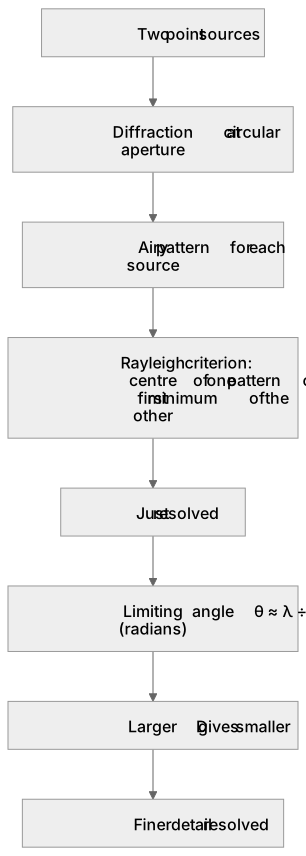
Put it in order
Put these steps in the order they happen.
- 1. Just resolved
- 2. Finer detail resolved
- 3. Limiting angle θ ≈ λ ÷ D (radians)
- 4. Two point sources
- 5. Diffraction at circular aperture
- 6. Larger D gives smaller θ
- 7. Airy pattern for each source
- 8. Rayleigh criterion: centre of one pattern on first minimum of the other
Key words
Say what each word means before you turn the card.
Minimum angular resolution
Try answering aloud or in your head before turning the card.
Rayleigh criterion
Try answering aloud or in your head before turning the card.
Airy pattern
Try answering aloud or in your head before turning the card.
Limiting angle
Try answering aloud or in your head before turning the card.
See every definition
- Minimum angular resolution
- The smallest angular separation between two point sources that can still be distinguished as separate.
- Rayleigh criterion
- Two stars are just resolved when the centre of one diffraction pattern falls on the first dark ring of the other.
- Airy pattern
- The pattern produced when diffraction at the circular aperture spreads each point source.
- Limiting angle
- An angle measured in radians that depends on the wavelength λ and the diameter D of the objective aperture.
Label the diagram
Some boxes have lost their names. Pick the right name for each number.
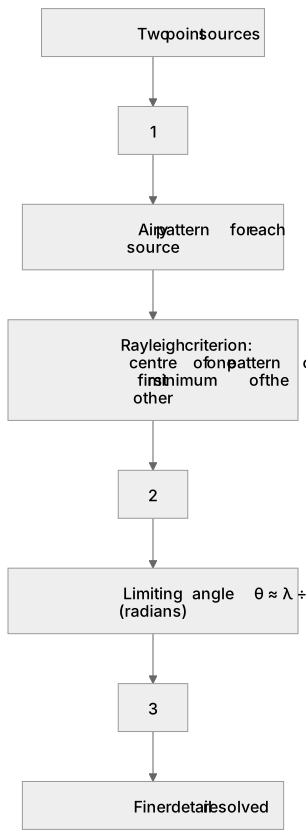
1Box 1
2Box 2
3Box 3
There is more to this lesson
The full lesson goes on to check your understanding and help you earn the marks. Create a free account to carry on, with your progress saved.
A week of Premium from your first lesson · Then the free plan continues · No card, no charge
Test your understanding of Advantages of large diameter telescopes (A-level only): Minimum angular resolution of telescope.
Active recall beats re-reading. Take an instant quiz now to test what you’ve learned and lock it into long-term memory.
A week of Premium from your first lesson · Then the free plan continues · No card, no charge