AQA · A-Level · Physics
Course version: 7408 · Version from Sept 2016
Λ Rayleigh criterion, θ ≈ D Collecting power is proportional to diameter .
Full specification wording
Advantages of large diameter telescopes (A-level only): λ Rayleigh criterion, θ ≈ D Collecting power is proportional to diameter .
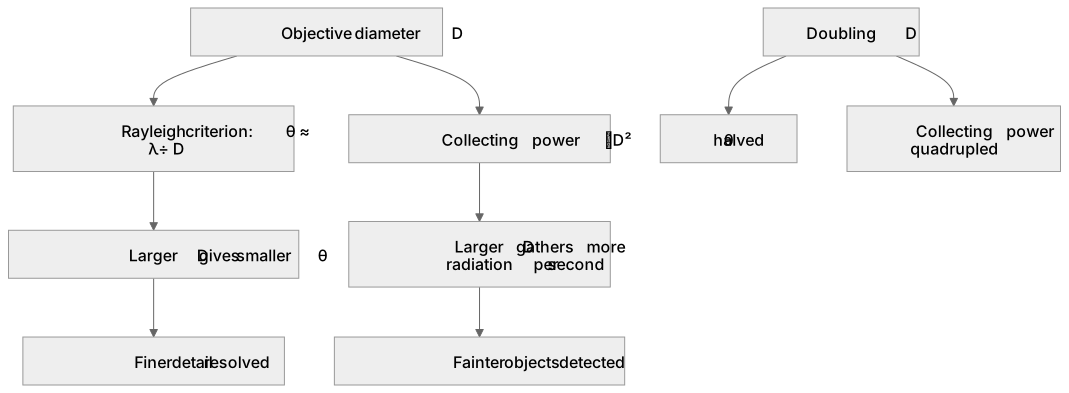
The Rayleigh criterion gives the minimum angular resolution θ of a telescope as θ ≈ λ ÷ D, where λ is the wavelength of the radiation and D is the diameter of the objective aperture.
Checked against the AQA 7408 specification (opens in a new tab) on .
- Point 2 of 4
- 3 key terms
Study notes
From the checked teaching notes for this specification point.
The idea
The Rayleigh criterion gives the minimum angular resolution θ of a telescope as θ ≈ λ ÷ D, where λ is the wavelength of the radiation and D is the diameter of the objective aperture. The angle θ is in radians. Because the ratio is dimensionless, λ and D must simply be in the same units, not necessarily metres. A larger D produces a smaller θ, meaning finer detail can be resolved. Separately, the collecting power of a telescope is proportional to the area of its objective, so it is proportional to D². A larger diameter gathers more radiation per second, allowing fainter objects to be detected.
For example: Doubling D halves θ and quadruples the collecting power.
What earns the marks
- The Rayleigh criterion is θ ≈ λ ÷ D, with θ in radians, λ the wavelength and D the objective diameter.
- A smaller θ corresponds to better angular resolution, separating closer sources.
- Collecting power is proportional to the area of the objective, which is proportional to D².
- Doubling the diameter halves the minimum resolvable angle and increases collecting power by a factor of four.
Common mistakes and how to put them right
Writing collecting power as proportional to D rather than D².
Put it right: The objective is a circular area, so collecting power ∝ D².
Mixing units by substituting λ in nanometres while D is in metres.
Put it right: Convert both to the same unit so the ratio is dimensionless.
Confusing resolution with collecting power.
Put it right: Treat θ ≈ λ ÷ D as the resolution relationship and collecting power ∝ D² as the light-gathering relationship.
Exam tips
- Quote θ ≈ λ ÷ D and collecting power ∝ D² explicitly before using them.
- For comparison questions, calculate the ratio of diameters and use it to find both the change in θ and the change in collecting power.
Try the lesson
The start of the Advantages of large diameter telescopes (A-level only): λ Rayleigh criterion, θ ≈ D Collecting power is proportional to diameter . lesson, made from checked teaching notes for this specification point.
Have a go first
Which statement correctly describes how the collecting power of a telescope depends on its objective diameter D?
Listen
The Rayleigh criterion gives the minimum angular resolution θ of a telescope as θ ≈ λ ÷ D, where λ is the wavelength of the radiation and D is the diameter of the objective aperture. The angle θ is in radians. Because the ratio is dimensionless, λ and D must simply be in the same units, not necessarily metres. A larger D produces a smaller θ, meaning finer detail can be resolved. Separately, the collecting power of a telescope is proportional to the area of its objective, so it is proportional to D². A larger diameter gathers more radiation per second, allowing fainter objects to be detected. For example, doubling D halves θ and quadruples the collecting power. A strong answer earns marks for these points. The Rayleigh criterion is θ ≈ λ ÷ D, with θ in radians, λ the wavelength and D the objective diameter. A smaller θ corresponds to better angular resolution, separating closer sources. Collecting power is proportional to the area of the objective, which is proportional to D². Doubling the diameter halves the minimum resolvable angle and increases collecting power by a factor of four. Exam tip: Quote θ ≈ λ ÷ D and collecting power ∝ D² explicitly before using them.
See it
Key words
Say what each word means before you turn the card.
Rayleigh criterion
Try answering aloud or in your head before turning the card.
Collecting power
Try answering aloud or in your head before turning the card.
Angular resolution
Try answering aloud or in your head before turning the card.
See every definition
- Rayleigh criterion
- Gives the minimum angular resolution θ of a telescope as θ ≈ λ ÷ D, where λ is the wavelength and D is the diameter of the objective aperture.
- Collecting power
- Proportional to the area of the objective, so it is proportional to D², and a larger diameter gathers more radiation per second.
- Angular resolution
- Given by θ ≈ λ ÷ D in radians, and a larger D produces a smaller θ, meaning finer detail can be resolved.
Label the diagram
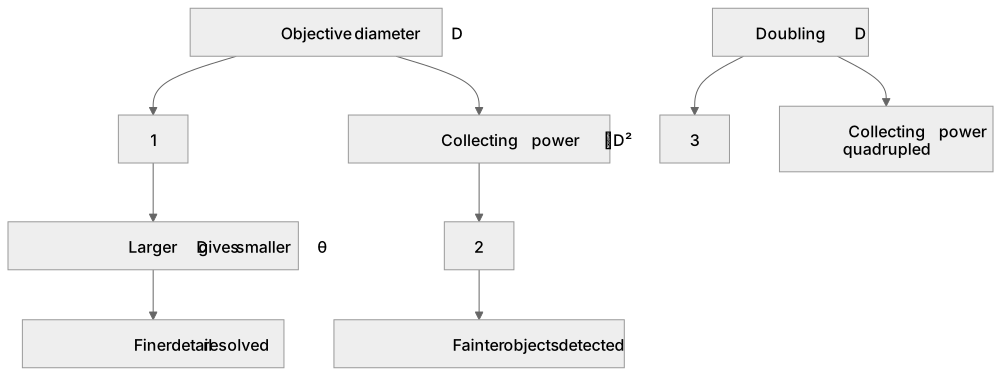
Some boxes have lost their names. Pick the right name for each number.
1Box 1
2Box 2
3Box 3
There is more to this lesson
The full lesson goes on to check your understanding and help you earn the marks. Create a free account to carry on, with your progress saved.
A week of Premium from your first lesson · Then the free plan continues · No card, no charge
Test your understanding of Advantages of large diameter telescopes (A-level only): λ Rayleigh criterion, θ ≈ D Collecting power is proportional to diameter .
Active recall beats re-reading. Take an instant quiz now to test what you’ve learned and lock it into long-term memory.
A week of Premium from your first lesson · Then the free plan continues · No card, no charge