AQA · A-Level · Physics
Course version: 7408 · Version from Sept 2016
No details of the structure of the instrument are required but familiarity…
Full specification wording
Alternating currents (A-level only): No details of the structure of the instrument are required but familiarity with the operation of the controls is expected.
You are not expected to explain how an oscilloscope is constructed inside, such as the electron gun, deflection plates or phosphor screen.
Checked against the AQA 7408 specification (opens in a new tab) on .
- Point 3 of 3
- 4 key terms
Study notes
From the checked teaching notes for this specification point.
The idea
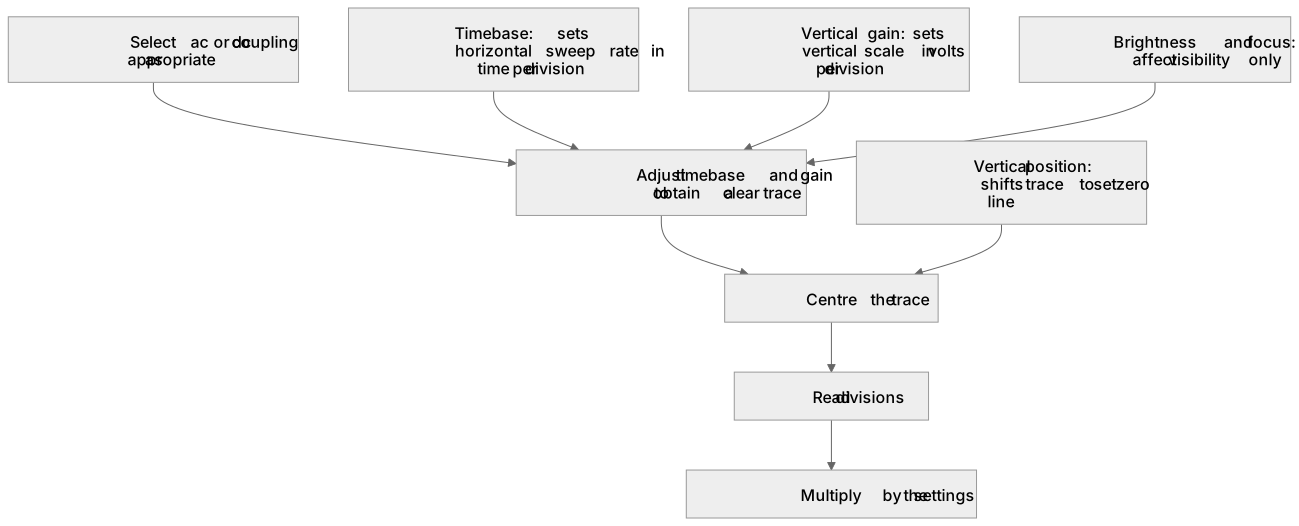
You are not expected to explain how an oscilloscope is constructed inside, such as the electron gun, deflection plates or phosphor screen. Instead, you must know what the main controls do and how to operate them to obtain a usable trace. The timebase control sets the horizontal sweep speed in time per division, so it controls the time scale. The vertical gain or volts-per-division control sets the vertical scale, so it controls the voltage scale. The vertical position control shifts the trace up or down to set a convenient zero line. The brightness and focus controls adjust the visible spot. To make a measurement, adjust the timebase and gain so the trace fills the screen, centre the trace, then read divisions and multiply by the settings.
What earns the marks
- State the function of the timebase control: it sets the horizontal sweep rate in time per division and therefore the time scale of the display.
- State the function of the vertical gain or volts-per-division control: it sets the vertical scale in volts per division and therefore the voltage scale.
- Explain that the vertical position control shifts the trace without changing the measured potential difference, so it is used to set a reference or zero line.
- Describe a sensible operating sequence: select ac or dc coupling as appropriate, adjust timebase and gain to obtain a clear trace, centre the trace, then measure.
- Recognise that brightness and focus controls affect visibility only and do not change the voltage or time measurements.
- Explain that changing the timebase changes the horizontal width of a cycle but not the amplitude, while changing the gain changes the vertical height but not the period.
Common mistakes and how to put them right
Confusing the timebase and gain controls.
Put it right: Associate timebase with horizontal time per division and gain with vertical volts per division.
Believing the vertical position control changes the voltage reading.
Put it right: Treat it as a display offset that must be allowed for when reading from the zero line.
Attempting to describe internal electron optics when asked only about controls.
Put it right: Focus on the function and effect of each control on the trace.
Exam tips
- Use the phrase 'time per division' for the timebase and 'volts per division' for the gain; these precise terms show understanding of the controls.
- When describing a measurement, state the control settings you would choose and why, such as increasing the timebase to spread out a high-frequency waveform.
- Link each control to its effect on the trace: timebase changes horizontal scale, gain changes vertical scale, position shifts the trace.
Try the lesson
The start of the Alternating currents (A-level only): No details of the structure of the instrument are required but familiarity with the operation of the controls is expected. lesson, made from checked teaching notes for this specification point.
Have a go first
A student wants a steady horizontal line to appear on the oscilloscope screen when a dc supply is connected. Which control should be adjusted to move the line up or down the screen?
Listen
You are not expected to explain how an oscilloscope is constructed inside, such as the electron gun, deflection plates or phosphor screen. Instead, you must know what the main controls do and how to operate them to obtain a usable trace. The timebase control sets the horizontal sweep speed in time per division, so it controls the time scale. The vertical gain or volts-per-division control sets the vertical scale, so it controls the voltage scale. The vertical position control shifts the trace up or down to set a convenient zero line. The brightness and focus controls adjust the visible spot. To make a measurement, adjust the timebase and gain so the trace fills the screen, centre the trace, then read divisions and multiply by the settings. A strong answer earns marks for these points. State the function of the timebase control: it sets the horizontal sweep rate in time per division and therefore the time scale of the display. State the function of the vertical gain or volts-per-division control: it sets the vertical scale in volts per division and therefore the voltage scale. Explain that the vertical position control shifts the trace without changing the measured potential difference, so it is used to set a reference or zero line. Describe a sensible operating sequence: select ac or dc coupling as appropriate, adjust timebase and gain to obtain a clear trace, centre the trace, then measure. A common slip: Confusing the timebase and gain controls. Instead, associate timebase with horizontal time per division and gain with vertical volts per division. Exam tip: Use the phrase 'time per division' for the timebase and 'volts per division' for the gain; these precise terms show understanding of the controls.
See it
Key words
Say what each word means before you turn the card.
Timebase control
Try answering aloud or in your head before turning the card.
Vertical gain control
Try answering aloud or in your head before turning the card.
Vertical position control
Try answering aloud or in your head before turning the card.
Brightness and focus controls
Try answering aloud or in your head before turning the card.
See every definition
- Timebase control
- Sets the horizontal sweep speed in time per division, so it controls the time scale of the display.
- Vertical gain control
- Sets the vertical scale in volts per division, so it controls the voltage scale of the display.
- Vertical position control
- Shifts the trace up or down to set a convenient zero line, without changing the measured potential difference.
- Brightness and focus controls
- Adjust the visible spot and affect visibility only, not the voltage or time measurements.
Label the diagram
Some boxes have lost their names. Pick the right name for each number.
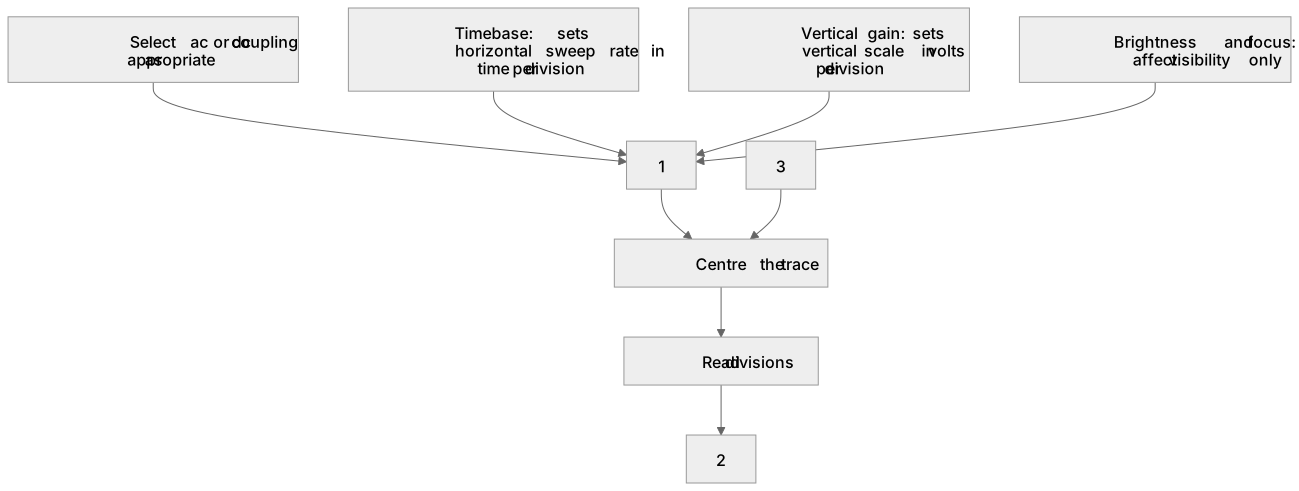
1Box 1
2Box 2
3Box 3
There is more to this lesson
The full lesson goes on to check your understanding and help you earn the marks. Create a free account to carry on, with your progress saved.
A week of Premium from your first lesson · Then the free plan continues · No card, no charge
Test your understanding of Alternating currents (A-level only): No details of the structure of the instrument are required but familiarity with the operation of the controls is expected.
Active recall beats re-reading. Take an instant quiz now to test what you’ve learned and lock it into long-term memory.
A week of Premium from your first lesson · Then the free plan continues · No card, no charge