AQA · A-Level · Physics
Course version: 7408 · Version from Sept 2016
Angular impulse = change in angular momentum; T ∆t = ∆ Iω where T is…
Full specification wording
Angular momentum (A-level only): Angular impulse = change in angular momentum; T ∆t = ∆ Iω where T is constant.
Angular impulse is the rotational analogue of linear impulse.
Checked against the AQA 7408 specification (opens in a new tab) on .
- Point 2 of 3
- 3 key terms
Study notes
From the checked teaching notes for this specification point.
The idea
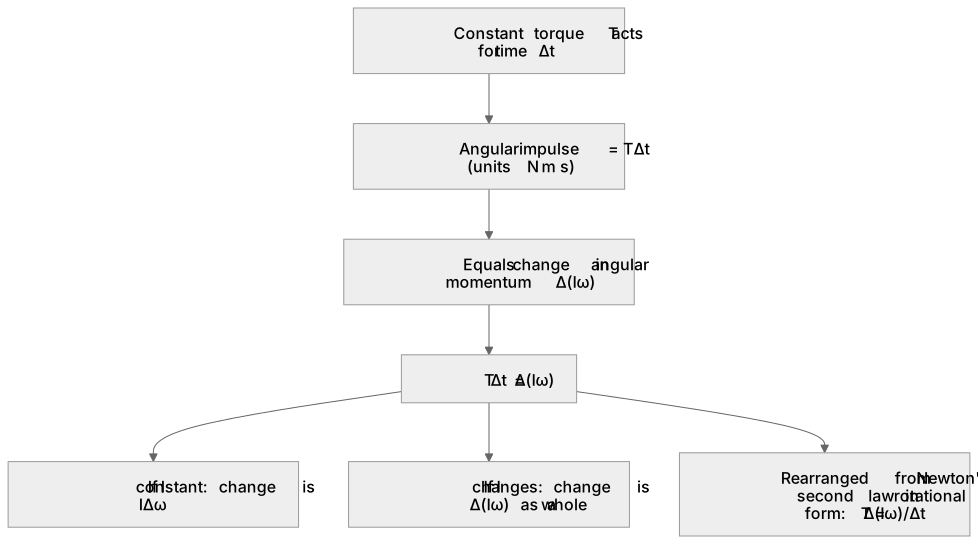
Angular impulse is the rotational analogue of linear impulse. When a constant torque T acts for a time ∆t, the angular impulse is T ∆t and it equals the change in angular momentum, ∆(Iω). This follows from Newton's second law in rotational form, T = ∆(Iω)/∆t, rearranged to T ∆t = ∆(Iω). If I is constant, the change is I∆ω; if I changes, the change is ∆(Iω) as a whole. For example, a flywheel with I = 0.50 kg m² accelerated from rest to 12 rad s⁻¹ by a constant torque of 3.0 N m takes ∆t = I∆ω/T = (0.50 × 12)/3.0 = 2.0 s. To solve problems, identify the torque, the time interval, and the initial and final angular momenta, then apply T ∆t = ∆(Iω) with consistent signs.
What earns the marks
- State that angular impulse is the product of torque and the time for which it acts, with units N m s.
- Apply the relationship T ∆t = ∆(Iω) for a constant torque, recognising that ∆(Iω) may involve changes in I, ω, or both.
- Rearrange the equation to find torque, time interval, or change in angular momentum as required.
- Use consistent sign conventions for torque and angular momentum about the chosen axis.
- Link the equation to Newton's second law in rotational form, T = ∆(Iω)/∆t, to justify why angular impulse equals the change in angular momentum.
- Calculate ∆ω from initial and final angular velocities in rad s⁻¹, converting units where necessary.
Common mistakes and how to put them right
Confusing angular impulse with linear impulse.
Put it right by using torque T and angular momentum Iω rather than force F and linear momentum mv.
Assuming T ∆t = I∆ω always, even when I changes.
Put it right by writing the change as ∆(Iω) and evaluating initial and final values separately.
Forgetting that torque must be constant for the simple form T ∆t = ∆(Iω).
Put it right by checking the question states or implies a constant torque.
Exam tips
- Show the substitution into T ∆t = ∆(Iω) with units, so the examiner can follow the calculation and check the final unit.
- If the torque is not constant, do not use T ∆t directly; instead consider the area under a torque–time graph or use the average torque.
- Keep angular velocities in rad s⁻¹ and torques in N m throughout to avoid unit conversion errors.
Try the lesson
The start of the Angular momentum (A-level only): Angular impulse = change in angular momentum; T ∆t = ∆ Iω where T is constant. lesson, made from checked teaching notes for this specification point.
Have a go first
A constant torque of 6.0 N m acts on a wheel for 2.0 s. What is the angular impulse delivered to the wheel?
Listen
Angular impulse is the rotational analogue of linear impulse. When a constant torque T acts for a time ∆t, the angular impulse is T ∆t and it equals the change in angular momentum, ∆(Iω). This follows from Newton's second law in rotational form, T = ∆(Iω)/∆t, rearranged to T ∆t = ∆(Iω). If I is constant, the change is I∆ω; if I changes, the change is ∆(Iω) as a whole. For example, a flywheel with I = 0.50 kg m² accelerated from rest to 12 rad s⁻¹ by a constant torque of 3.0 N m takes ∆t = I∆ω/T = (0.50 × 12)/3.0 = 2.0 s. To solve problems, identify the torque, the time interval, and the initial and final angular momenta, then apply T ∆t = ∆(Iω) with consistent signs. A strong answer earns marks for these points. State that angular impulse is the product of torque and the time for which it acts, with units N m s. Apply the relationship T ∆t = ∆(Iω) for a constant torque, recognising that ∆(Iω) may involve changes in I, ω, or both. Rearrange the equation to find torque, time interval, or change in angular momentum as required. Use consistent sign conventions for torque and angular momentum about the chosen axis. A common slip: Confusing angular impulse with linear impulse. Instead, using torque T and angular momentum Iω rather than force F and linear momentum mv. Exam tip: Show the substitution into T ∆t = ∆(Iω) with units, so the examiner can follow the calculation and check the final unit.
See it
Key words
Say what each word means before you turn the card.
Angular impulse
Try answering aloud or in your head before turning the card.
Newton's second law for rotation
Try answering aloud or in your head before turning the card.
Change in angular momentum
Try answering aloud or in your head before turning the card.
See every definition
- Angular impulse
- The product of torque and the time for which it acts, with units N m s.
- Newton's second law for rotation
- Written as T = ∆(Iω)/∆t, and rearranged to T ∆t = ∆(Iω).
- Change in angular momentum
- Written as ∆(Iω), which may involve changes in I, ω, or both.
Label the diagram
Some boxes have lost their names. Pick the right name for each number.
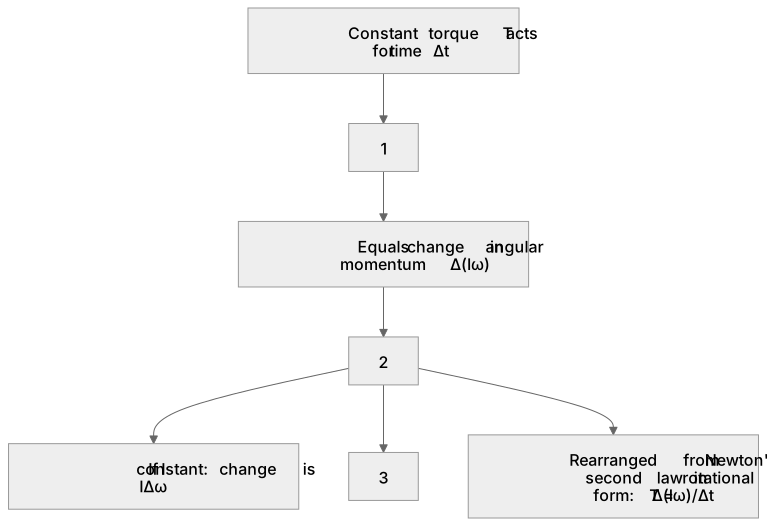
1Box 1
2Box 2
3Box 3
There is more to this lesson
The full lesson goes on to check your understanding and help you earn the marks. Create a free account to carry on, with your progress saved.
A week of Premium from your first lesson · Then the free plan continues · No card, no charge
Test your understanding of Angular momentum (A-level only): Angular impulse = change in angular momentum; T ∆t = ∆ Iω where T is constant.
Active recall beats re-reading. Take an instant quiz now to test what you’ve learned and lock it into long-term memory.
A week of Premium from your first lesson · Then the free plan continues · No card, no charge