AQA · A-Level · Physics
Course version: 7408 · Version from Sept 2016
Angular momentum = Iω Conservation of angular momentum.
Full specification wording
Angular momentum (A-level only): angular momentum = Iω Conservation of angular momentum.
Angular momentum is the rotational analogue of linear momentum.
Checked against the AQA 7408 specification (opens in a new tab) on .
- Point 1 of 3
- 4 key terms
Study notes
From the checked teaching notes for this specification point.
The idea
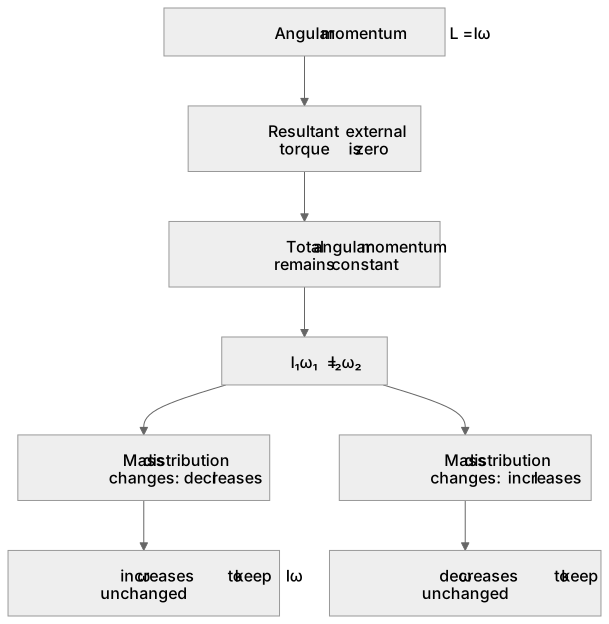
Angular momentum is the rotational analogue of linear momentum. For a rigid body rotating about a fixed axis, it equals the product of moment of inertia I and angular velocity ω, so L = Iω. I depends on mass distribution about the axis; ω is the angular velocity in rad s⁻¹. Conservation of angular momentum states that if the resultant external torque on a system is zero, its total angular momentum remains constant. A skater pulling in their arms reduces I, so ω increases to keep Iω unchanged. Similarly, a planet in an elliptical orbit moves faster when closer to the Sun because its moment of inertia about the Sun is smaller. To solve problems, identify the axis, calculate I for the given shape, convert ω to rad s⁻¹, then apply L = Iω before and after any change.
What earns the marks
- State that angular momentum L is the product of moment of inertia I and angular velocity ω, with L = Iω and units kg m² rad s⁻¹ or kg m² s⁻¹.
- Explain that moment of inertia I depends on mass and how that mass is distributed about the chosen axis, so the same body can have different I values for different axes.
- Apply conservation of angular momentum when the resultant external torque is zero, setting I₁ω₁ = I₂ω₂ for a system whose mass distribution changes.
- Convert angular velocity between rev s⁻¹ and rad s⁻¹ using ω = 2πf before substituting into L = Iω.
- Interpret a decrease in I as causing an increase in ω when L is conserved, and link this to the skater or collapsing-star example.
- Use consistent sign conventions for clockwise and anticlockwise rotation when combining angular momenta of interacting bodies.
Common mistakes and how to put them right
Treating angular momentum as a scalar and ignoring direction.
Put it right by assigning positive and negative signs to opposite senses of rotation about the chosen axis.
Using linear momentum p = mv instead of L = Iω for a rotating rigid body.
Put it right by identifying the rotational variables and the axis of rotation.
Assuming I is always mr² for any body.
Put it right by selecting the appropriate expression for the shape, such as ½mr² for a solid disc about its central axis.
Exam tips
- Write the conservation equation explicitly as I₁ω₁ = I₂ω₂ before substituting values, so the examiner can see the physical principle being applied.
- Check that ω is in rad s⁻¹; if a frequency in Hz or rev s⁻¹ is given, convert using ω = 2πf.
- State the condition for conservation clearly: resultant external torque is zero, not merely that no forces act.
Try the lesson
The start of the Angular momentum (A-level only): angular momentum = Iω Conservation of angular momentum. lesson, made from checked teaching notes for this specification point.
Have a go first
A flywheel has a moment of inertia of 4.0 kg m² and spins at an angular velocity of 3.0 rad/s. What is the magnitude of its angular momentum?
Listen
Angular momentum is the rotational analogue of linear momentum. For a rigid body rotating about a fixed axis, it equals the product of moment of inertia I and angular velocity ω, so L = Iω. I depends on mass distribution about the axis; ω is the angular velocity in rad s⁻¹. Conservation of angular momentum states that if the resultant external torque on a system is zero, its total angular momentum remains constant. A skater pulling in their arms reduces I, so ω increases to keep Iω unchanged. Similarly, a planet in an elliptical orbit moves faster when closer to the Sun because its moment of inertia about the Sun is smaller. To solve problems, identify the axis, calculate I for the given shape, convert ω to rad s⁻¹, then apply L = Iω before and after any change. A strong answer earns marks for these points. State that angular momentum L is the product of moment of inertia I and angular velocity ω, with L = Iω and units kg m² rad s⁻¹ or kg m² s⁻¹. Explain that moment of inertia I depends on mass and how that mass is distributed about the chosen axis, so the same body can have different I values for different axes. Apply conservation of angular momentum when the resultant external torque is zero, setting I₁ω₁ = I₂ω₂ for a system whose mass distribution changes. Convert angular velocity between rev s⁻¹ and rad s⁻¹ using ω = 2πf before substituting into L = Iω. A common slip: Treating angular momentum as a scalar and ignoring direction. Instead, assigning positive and negative signs to opposite senses of rotation about the chosen axis. Exam tip: Write the conservation equation explicitly as I₁ω₁ = I₂ω₂ before substituting values, so the examiner can see the physical principle being applied.
See it
Key words
Say what each word means before you turn the card.
Angular momentum
Try answering aloud or in your head before turning the card.
Moment of inertia
Try answering aloud or in your head before turning the card.
Conservation of angular momentum
Try answering aloud or in your head before turning the card.
Angular velocity
Try answering aloud or in your head before turning the card.
See every definition
- Angular momentum
- The product of moment of inertia I and angular velocity ω, so L = Iω, with units kg m² rad s⁻¹ or kg m² s⁻¹.
- Moment of inertia
- A quantity that depends on mass and how that mass is distributed about the chosen axis, so the same body can have different values for different axes.
- Conservation of angular momentum
- If the resultant external torque on a system is zero, its total angular momentum remains constant, so I₁ω₁ = I₂ω₂.
- Angular velocity
- A quantity in rad s⁻¹, converted between rev s⁻¹ and rad s⁻¹ using ω = 2πf before substituting into L = Iω.
Label the diagram
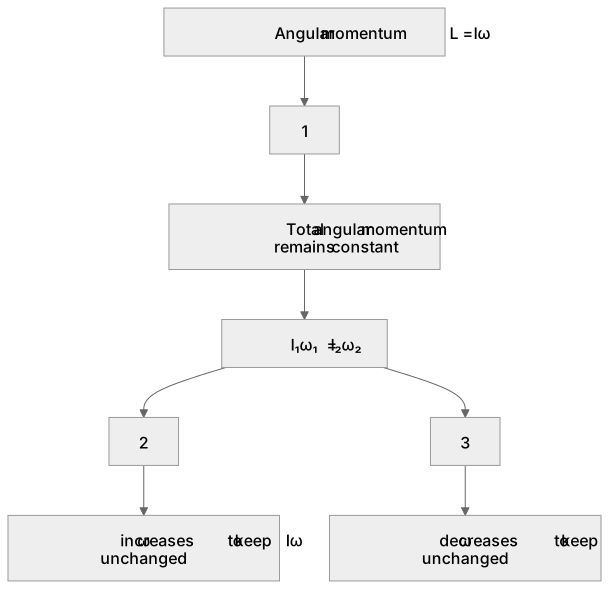
Some boxes have lost their names. Pick the right name for each number.
1Box 1
2Box 2
3Box 3
There is more to this lesson
The full lesson goes on to check your understanding and help you earn the marks. Create a free account to carry on, with your progress saved.
A week of Premium from your first lesson · Then the free plan continues · No card, no charge
Test your understanding of Angular momentum (A-level only): angular momentum = Iω Conservation of angular momentum.
Active recall beats re-reading. Take an instant quiz now to test what you’ve learned and lock it into long-term memory.
A week of Premium from your first lesson · Then the free plan continues · No card, no charge