AQA · A-Level · Physics
Course version: 7408 · Version from Sept 2016
Appreciation of energy conservation issues in the context of ethical…
Full specification wording
Bulk properties of solids: Appreciation of energy conservation issues in the context of ethical transport design.
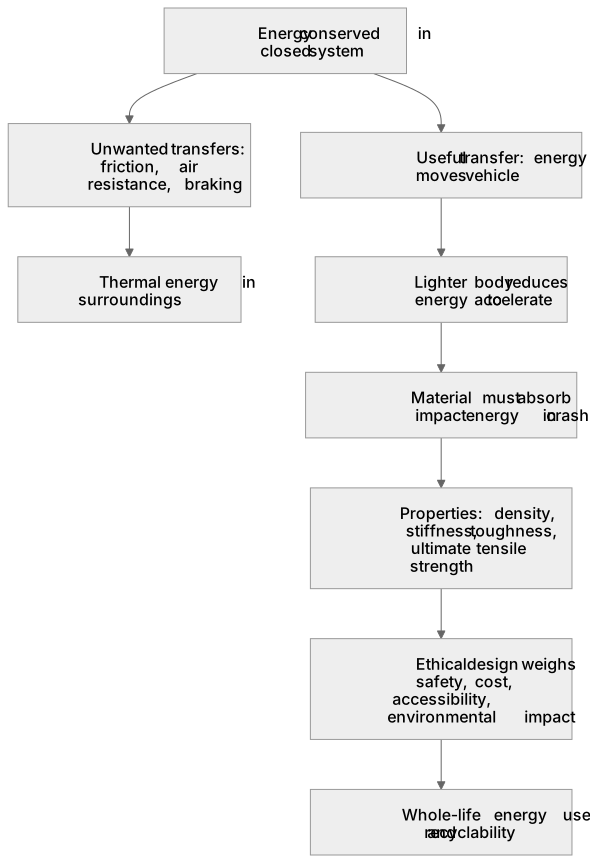
Energy conservation means the total energy in a closed system stays constant; energy is transferred between stores but never created or destroyed.
Checked against the AQA 7408 specification (opens in a new tab) on .
- Point 8 of 8
- 4 key terms
Study notes
From the checked teaching notes for this specification point.
The idea
Energy conservation means the total energy in a closed system stays constant; energy is transferred between stores but never created or destroyed. In transport design, useful energy moves a vehicle, while unwanted transfers include heating due to friction, air resistance and braking. Ethical design weighs these transfers against safety, cost, accessibility and environmental impact. For example, a lighter body made from a high-strength steel or aluminium alloy reduces the energy needed to accelerate, but the material must still absorb impact energy in a crash. Material choice therefore links to properties such as density, stiffness, toughness and ultimate tensile strength. A designer compares options using data, considering whole-life energy use, recyclability and the effect on different groups of people.
What earns the marks
- State that energy is conserved overall and identify useful and wasted transfers in a moving vehicle, such as kinetic energy to thermal energy in brakes.
- Link material properties, including density, stiffness and toughness, to the energy needed to accelerate a vehicle and to crash protection.
- Explain that reducing mass lowers the energy required for a given speed change, while safety requires materials that absorb impact energy.
- Discuss ethical factors such as safety for occupants and pedestrians, affordability, accessibility, recyclability and environmental impact.
- Use data or a calculation, such as kinetic energy E = ½mv², to compare design choices rather than relying on assertion.
Common mistakes and how to put them right
Claiming energy is used up or lost.
Put it right by saying energy is transferred to less useful stores such as thermal energy in the surroundings.
Assuming the lightest material is always best.
Put it right by balancing lower mass against the strength and toughness needed for crash protection.
Ignoring the energy cost of producing and recycling materials.
Put it right by considering whole-life energy use, not just energy in motion.
Exam tips
- Name the energy stores and the transfer pathway at each stage, for example chemical to kinetic, then kinetic to thermal by heating.
- Support ethical arguments with a specific material property or a numerical comparison rather than a general opinion.
- Structure longer answers around distinct issues such as safety, environment, cost and fairness, keeping each point linked to energy conservation.
Try the lesson
The start of the Bulk properties of solids: Appreciation of energy conservation issues in the context of ethical transport design. lesson, made from checked teaching notes for this specification point.
Have a go first
In ethical transport design, why is reducing the total energy used per journey considered important?
Listen
Energy conservation means the total energy in a closed system stays constant; energy is transferred between stores but never created or destroyed. In transport design, useful energy moves a vehicle, while unwanted transfers include heating due to friction, air resistance and braking. Ethical design weighs these transfers against safety, cost, accessibility and environmental impact. For example, a lighter body made from a high-strength steel or aluminium alloy reduces the energy needed to accelerate, but the material must still absorb impact energy in a crash. Material choice therefore links to properties such as density, stiffness, toughness and ultimate tensile strength. A designer compares options using data, considering whole-life energy use, recyclability and the effect on different groups of people. A strong answer earns marks for these points. State that energy is conserved overall and identify useful and wasted transfers in a moving vehicle, such as kinetic energy to thermal energy in brakes. Link material properties, including density, stiffness and toughness, to the energy needed to accelerate a vehicle and to crash protection. Explain that reducing mass lowers the energy required for a given speed change, while safety requires materials that absorb impact energy. Discuss ethical factors such as safety for occupants and pedestrians, affordability, accessibility, recyclability and environmental impact. A common slip: Claiming energy is used up or lost. Instead, saying energy is transferred to less useful stores such as thermal energy in the surroundings. Exam tip: Name the energy stores and the transfer pathway at each stage, for example chemical to kinetic, then kinetic to thermal by heating.
See it
Key words
Say what each word means before you turn the card.
Conservation of energy
Try answering aloud or in your head before turning the card.
Useful and wasted transfers
Try answering aloud or in your head before turning the card.
Material properties in vehicle design
Try answering aloud or in your head before turning the card.
Whole-life environmental impact and recyclability
Try answering aloud or in your head before turning the card.
See every definition
- Conservation of energy
- The total energy in a closed system stays constant; energy is transferred between stores but never created or destroyed.
- Useful and wasted transfers
- Useful energy moves a vehicle, while unwanted transfers include heating due to friction, air resistance and braking.
- Material properties in vehicle design
- Material choice links to properties such as density, stiffness, toughness and ultimate tensile strength, balancing lower mass against crash protection.
- Whole-life environmental impact and recyclability
- A designer compares options using data, considering whole-life energy use, recyclability and the effect on different groups of people.
Label the diagram
Some boxes have lost their names. Pick the right name for each number.
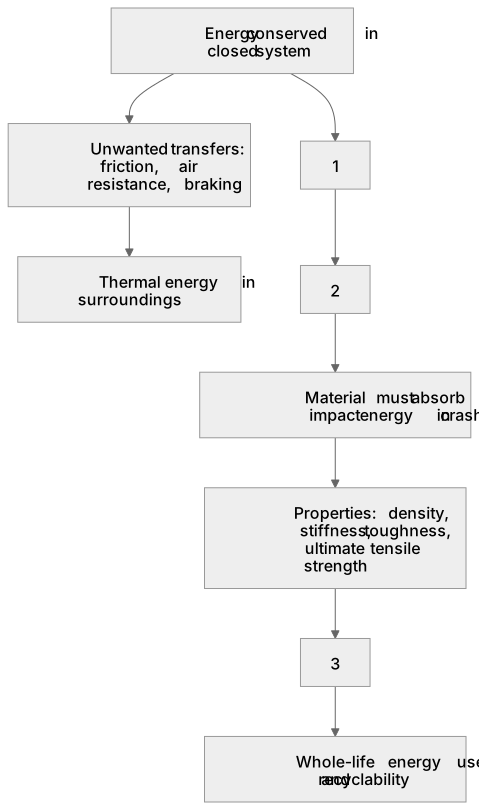
1Box 1
2Box 2
3Box 3
There is more to this lesson
The full lesson goes on to check your understanding and help you earn the marks. Create a free account to carry on, with your progress saved.
A week of Premium from your first lesson · Then the free plan continues · No card, no charge
Test your understanding of Bulk properties of solids: Appreciation of energy conservation issues in the context of ethical transport design.
Active recall beats re-reading. Take an instant quiz now to test what you’ve learned and lock it into long-term memory.
A week of Premium from your first lesson · Then the free plan continues · No card, no charge