AQA · A-Level · Physics
Course version: 7408 · Version from Sept 2016
M Density, ρ = V Hooke’s law, elastic limit, F = k∆L , k as stiffness and…
Full specification wording
Bulk properties of solids: m Density, ρ = V Hooke’s law, elastic limit, F = k∆L , k as stiffness and spring constant.
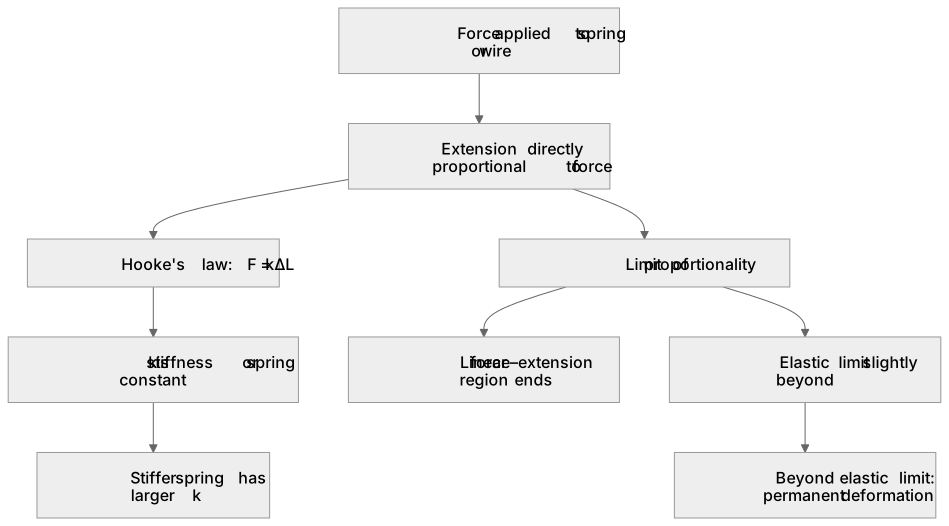
Hooke's law states that the extension of a spring or wire is directly proportional to the applied force, provided the limit of proportionality is not exceeded.
Checked against the AQA 7408 specification (opens in a new tab) on .
- Point 1 of 8
- 4 key terms
Study notes
From the checked teaching notes for this specification point.
The idea
Hooke's law states that the extension of a spring or wire is directly proportional to the applied force, provided the limit of proportionality is not exceeded. The constant of proportionality is the stiffness or spring constant k, defined by F = k∆L, where ∆L is the extension. A stiffer spring has a larger k. Density is mass per unit volume, ρ = m/V, so a 2.0 kg block of volume 5.0 × 10⁻⁴ m³ has ρ = 4.0 × 10³ kg m⁻³. The limit of proportionality marks the end of the linear force-extension region. Slightly beyond this lies the elastic limit, the maximum force beyond which the material does not return to its original length when the force is removed, resulting in permanent deformation.
What earns the marks
- Density is defined as mass per unit volume and calculated using ρ = m/V, with consistent units such as kg m⁻³.
- Hooke’s law applies when extension is directly proportional to force, which is true only up to the limit of proportionality.
- The spring constant k is the force per unit extension, measured in N m⁻¹, and is a measure of stiffness.
- A force–extension graph is linear through the origin up to the limit of proportionality; the gradient equals k.
- The elastic limit is distinct from the limit of proportionality; exceeding it causes permanent deformation.
Common mistakes and how to put them right
Using total length instead of extension in F = k∆L.
Put it right by calculating ∆L = final length − original length before substituting.
Conflating the limit of proportionality with the elastic limit.
Put it right by noting Hooke's law ends at the limit of proportionality, while permanent deformation begins beyond the elastic limit.
Confusing stiffness with strength.
Put it right by stating that k measures resistance to extension, while strength relates to breaking stress.
Exam tips
- When calculating density, write the equation, substitute mass and volume with units, and give the answer in kg m⁻³ unless asked otherwise.
- If a graph is provided, read the gradient to find k and state that the linear region ends at the limit of proportionality, not the elastic limit.
Try the lesson
The start of the Bulk properties of solids: m Density, ρ = V Hooke’s law, elastic limit, F = k∆L , k as stiffness and spring constant. lesson, made from checked teaching notes for this specification point.
Have a go first
A mass of 300 g is suspended from a vertical spring, which obeys Hooke's law. The spring constant is 150 N m⁻¹. What is the extension of the spring? (Use g = 9.81 m s⁻²)
Listen
Hooke's law states that the extension of a spring or wire is directly proportional to the applied force, provided the limit of proportionality is not exceeded. The constant of proportionality is the stiffness or spring constant k, defined by F = k∆L, where ∆L is the extension. A stiffer spring has a larger k. Density is mass per unit volume, ρ = m/V, so a 2.0 kg block of volume 5.0 × 10⁻⁴ m³ has ρ = 4.0 × 10³ kg m⁻³. The limit of proportionality marks the end of the linear force-extension region. Slightly beyond this lies the elastic limit, the maximum force beyond which the material does not return to its original length when the force is removed, resulting in permanent deformation. A strong answer earns marks for these points. Density is defined as mass per unit volume and calculated using ρ = m/V, with consistent units such as kg m⁻³. Hooke’s law applies when extension is directly proportional to force, which is true only up to the limit of proportionality. The spring constant k is the force per unit extension, measured in N m⁻¹, and is a measure of stiffness. A force–extension graph is linear through the origin up to the limit of proportionality; the gradient equals k. A common slip: Using total length instead of extension in F = k∆L. Instead, calculating ∆L = final length − original length before substituting. Exam tip: When calculating density, write the equation, substitute mass and volume with units, and give the answer in kg m⁻³ unless asked otherwise.
See it
Key words
Say what each word means before you turn the card.
Density
Try answering aloud or in your head before turning the card.
Hooke's law
Try answering aloud or in your head before turning the card.
Spring constant
Try answering aloud or in your head before turning the card.
Elastic limit
Try answering aloud or in your head before turning the card.
See every definition
- Density
- Mass per unit volume, calculated using ρ = m/V, with consistent units such as kg m⁻³.
- Hooke's law
- The extension of a spring or wire is directly proportional to the applied force, provided the limit of proportionality is not exceeded.
- Spring constant
- The constant of proportionality k, defined by F = k∆L, where ∆L is the extension; a stiffer spring has a larger k.
- Elastic limit
- The maximum force beyond which the material does not return to its original length when the force is removed, resulting in permanent deformation.
Label the diagram
Some boxes have lost their names. Pick the right name for each number.
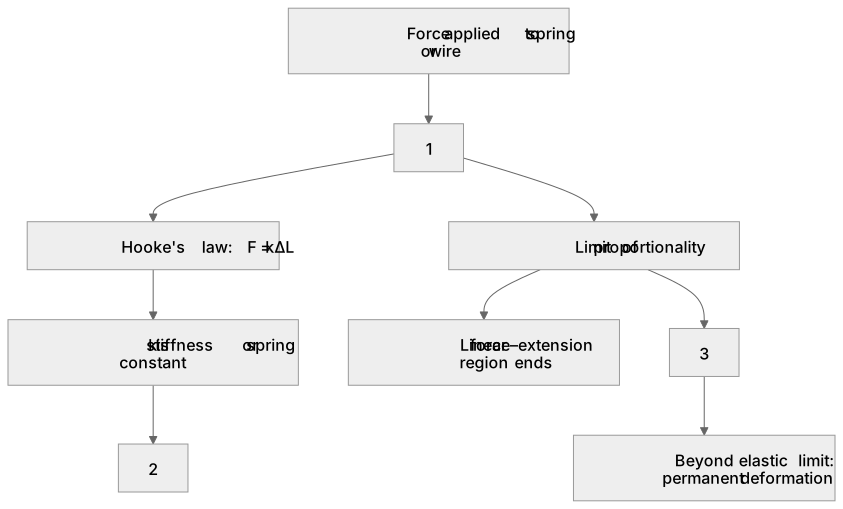
1Box 1
2Box 2
3Box 3
There is more to this lesson
The full lesson goes on to check your understanding and help you earn the marks. Create a free account to carry on, with your progress saved.
A week of Premium from your first lesson · Then the free plan continues · No card, no charge
Test your understanding of Bulk properties of solids: m Density, ρ = V Hooke’s law, elastic limit, F = k∆L , k as stiffness and spring constant.
Active recall beats re-reading. Take an instant quiz now to test what you’ve learned and lock it into long-term memory.
A week of Premium from your first lesson · Then the free plan continues · No card, no charge