AQA · A-Level · Physics
Course version: 7408 · Version from Sept 2016
Bulk properties of solids: Tensile strain and tensile stress.
Tensile stress is the force applied per unit cross-sectional area, σ = F/A, measured in pascals (Pa), where 1 Pa = 1 N m⁻².
Checked against the AQA 7408 specification (opens in a new tab) on .
- Point 2 of 8
- 4 key terms
Study notes
From the checked teaching notes for this specification point.
The idea
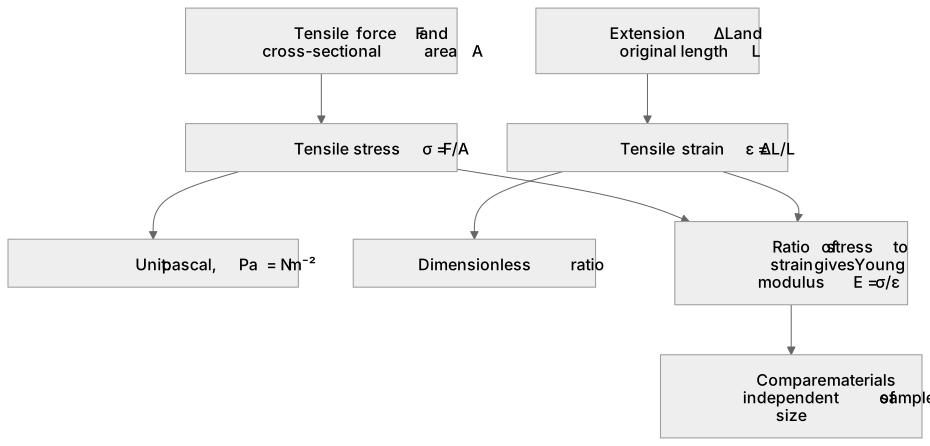
Tensile stress is the force applied per unit cross-sectional area, σ = F/A, measured in pascals (Pa), where 1 Pa = 1 N m⁻². Tensile strain is the extension per unit original length, ε = ∆L/L, and has no unit because it is a ratio of two lengths. For example, a wire of original length 2.00 m that extends by 4.0 mm has strain ε = 0.0040 m / 2.00 m = 2.0 × 10⁻³. If the same wire has cross-sectional area 1.0 × 10⁻⁶ m² and carries a force of 20 N, the stress is σ = 20 N / 1.0 × 10⁻⁶ m² = 2.0 × 10⁷ Pa. Stress and strain allow comparison of materials independent of sample size, and their ratio gives the Young modulus.
What earns the marks
- Tensile stress is defined as force per unit cross-sectional area, σ = F/A, with the force perpendicular to the area.
- The unit of stress is the pascal, Pa, equivalent to N m⁻².
- Tensile strain is defined as extension divided by original length, ε = ∆L/L, and is dimensionless.
- Extension ∆L must be the change in length, not the total length, and original length L must be used in the denominator.
- Stress and strain are proportional in the linear region of a force–extension graph, which is the region where Hooke’s law applies.
- The ratio of tensile stress to tensile strain gives the Young modulus, E = σ/ε, for a material obeying Hooke’s law.
Common mistakes and how to put them right
Using total length instead of extension when calculating strain.
Put it right by using ∆L = final length − original length.
Forgetting to convert area from mm² or cm² to m².
Put it right by converting to m² before dividing force by area.
Mixing up stress and strain.
Put it right by remembering stress is force per area and strain is extension per original length.
Omitting units for stress or giving strain a unit.
Put it right by stating stress in Pa and strain as a dimensionless ratio.
Exam tips
- Write the defining equation for stress or strain before substituting values, and show the conversion of any non-SI units.
- For strain, ensure the extension and original length are in the same unit so the ratio is dimensionless.
- When comparing materials, calculate stress and strain separately and then use E = σ/ε if the Young modulus is required.
- Check that the force used in stress calculations is the tensile force along the material, not a perpendicular or compressive force.
Try the lesson
The start of the Bulk properties of solids: Tensile strain and tensile stress. lesson, made from checked teaching notes for this specification point.
Have a go first
A wire of original length 2.5 m is stretched by an extension of 1.5 mm. What is the tensile strain of the wire?
Listen
Tensile stress is the force applied per unit cross-sectional area, σ = F/A, measured in pascals (Pa), where 1 Pa = 1 N m⁻². Tensile strain is the extension per unit original length, ε = ∆L/L, and has no unit because it is a ratio of two lengths. For example, a wire of original length 2.00 m that extends by 4.0 mm has strain ε = 0.0040 m / 2.00 m = 2.0 × 10⁻³. If the same wire has cross-sectional area 1.0 × 10⁻⁶ m² and carries a force of 20 N, the stress is σ = 20 N / 1.0 × 10⁻⁶ m² = 2.0 × 10⁷ Pa. Stress and strain allow comparison of materials independent of sample size, and their ratio gives the Young modulus. A strong answer earns marks for these points. Tensile stress is defined as force per unit cross-sectional area, σ = F/A, with the force perpendicular to the area. The unit of stress is the pascal, Pa, equivalent to N m⁻². Tensile strain is defined as extension divided by original length, ε = ∆L/L, and is dimensionless. Extension ∆L must be the change in length, not the total length, and original length L must be used in the denominator. A common slip: Using total length instead of extension when calculating strain. Instead, using ∆L = final length − original length. Exam tip: Write the defining equation for stress or strain before substituting values, and show the conversion of any non-SI units.
See it
Key words
Say what each word means before you turn the card.
Tensile stress
Try answering aloud or in your head before turning the card.
Tensile strain
Try answering aloud or in your head before turning the card.
Pascal
Try answering aloud or in your head before turning the card.
Young modulus
Try answering aloud or in your head before turning the card.
See every definition
- Tensile stress
- The force applied per unit cross-sectional area, σ = F/A, measured in pascals (Pa), where 1 Pa = 1 N m⁻².
- Tensile strain
- The extension per unit original length, ε = ∆L/L, which has no unit because it is a ratio of two lengths.
- Pascal
- The unit of stress, Pa, equivalent to N m⁻².
- Young modulus
- The ratio of tensile stress to tensile strain, E = σ/ε, for a material obeying Hooke’s law.
Label the diagram
Some boxes have lost their names. Pick the right name for each number.
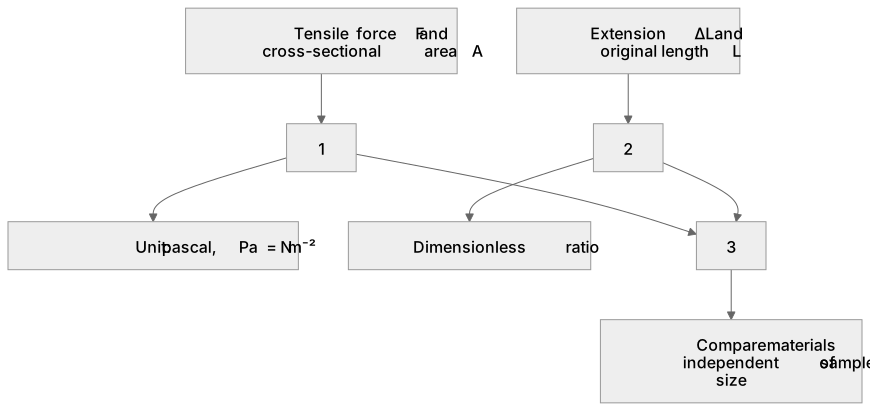
1Box 1
2Box 2
3Box 3
There is more to this lesson
The full lesson goes on to check your understanding and help you earn the marks. Create a free account to carry on, with your progress saved.
A week of Premium from your first lesson · Then the free plan continues · No card, no charge
Test your understanding of Bulk properties of solids: Tensile strain and tensile stress.
Active recall beats re-reading. Take an instant quiz now to test what you’ve learned and lock it into long-term memory.
A week of Premium from your first lesson · Then the free plan continues · No card, no charge