AQA · A-Level · Physics
Course version: 7408 · Version from Sept 2016
Spring energy transformed to kinetic and gravitational potential energy.
Full specification wording
Bulk properties of solids: Spring energy transformed to kinetic and gravitational potential energy.
A stretched or compressed spring stores elastic potential energy.
Checked against the AQA 7408 specification (opens in a new tab) on .
- Point 6 of 8
- 4 key terms
Study notes
From the checked teaching notes for this specification point.
The idea
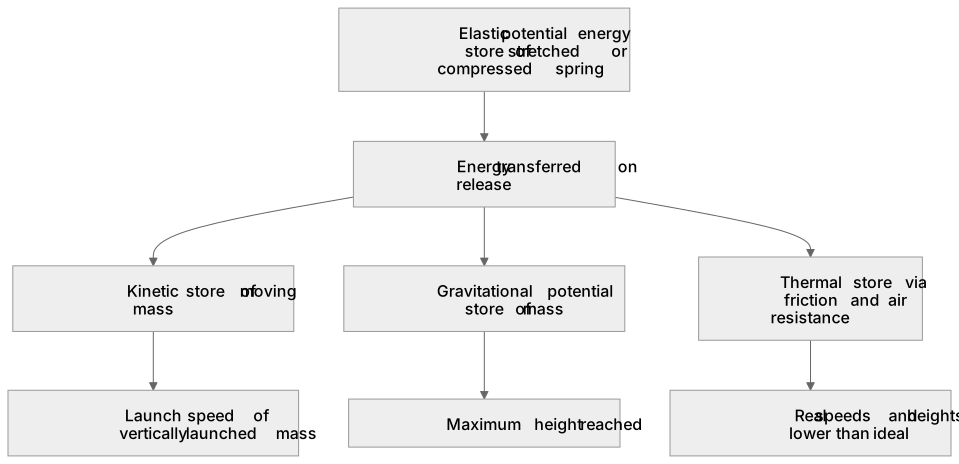
A stretched or compressed spring stores elastic potential energy. When released, this store transfers energy to the kinetic store of a moving object and its gravitational potential store. Conservation of energy links these stores: for a spring of stiffness k compressed by ΔL launching a mass m vertically, ½k(ΔL)² = ½mv² + mgΔL at the point the mass leaves the spring, accounting for the height gained during decompression. At the highest point h above the uncompressed position, ½k(ΔL)² = mg(h + ΔL). In practice, some energy transfers to the thermal store via friction and air resistance, so calculated speeds or heights are maximum ideal values.
What earns the marks
- Identify the elastic potential energy store of the stretched or compressed spring as the initial energy source.
- Equate elastic potential energy to kinetic and gravitational potential energy, ½k(ΔL)² = ½mv² + mgΔL, to find the launch speed of a vertically launched mass.
- Equate elastic potential energy to total gravitational potential energy to find the maximum height reached.
- Recognise that friction and air resistance transfer some energy to the thermal store, so real speeds and heights are lower than ideal calculations predict.
Common mistakes and how to put them right
Omitting the gravitational potential energy gained during the spring's contraction.
Put it right by including mgΔL in the energy equation for vertical launches.
Using the total length of the spring instead of the extension ΔL in ½k(ΔL)².
Put it right: The extension is the change in length from the natural length.
Omitting the mass when calculating gravitational potential energy, writing mgh as gh, which loses the dependence on the object's mass.
Exam tips
- Write the energy conservation equation in full before substituting numbers, ensuring GPE changes during spring contraction are accounted for.
- State clearly which point in the motion you are analysing, because the split between kinetic and gravitational potential energy changes continuously.
Try the lesson
The start of the Bulk properties of solids: Spring energy transformed to kinetic and gravitational potential energy. lesson, made from checked teaching notes for this specification point.
Have a go first
A compressed spring is released and launches a toy car vertically upwards. Ignoring air resistance, which energy transfer takes place as the car rises after leaving the spring?
Listen
A stretched or compressed spring stores elastic potential energy. When released, this store transfers energy to the kinetic store of a moving object and its gravitational potential store. Conservation of energy links these stores: for a spring of stiffness k compressed by ΔL launching a mass m vertically, ½k(ΔL)² = ½mv² + mgΔL at the point the mass leaves the spring, accounting for the height gained during decompression. At the highest point h above the uncompressed position, ½k(ΔL)² = mg(h + ΔL). In practice, some energy transfers to the thermal store via friction and air resistance, so calculated speeds or heights are maximum ideal values. A strong answer earns marks for these points. Identify the elastic potential energy store of the stretched or compressed spring as the initial energy source. Equate elastic potential energy to kinetic and gravitational potential energy, ½k(ΔL)² = ½mv² + mgΔL, to find the launch speed of a vertically launched mass. Equate elastic potential energy to total gravitational potential energy to find the maximum height reached. Recognise that friction and air resistance transfer some energy to the thermal store, so real speeds and heights are lower than ideal calculations predict. A common slip: Omitting the gravitational potential energy gained during the spring's contraction. Instead, including mgΔL in the energy equation for vertical launches. Exam tip: Write the energy conservation equation in full before substituting numbers, ensuring GPE changes during spring contraction are accounted for.
See it
Key words
Say what each word means before you turn the card.
Conservation of energy
Try answering aloud or in your head before turning the card.
Elastic potential energy store
Try answering aloud or in your head before turning the card.
Thermal store
Try answering aloud or in your head before turning the card.
Maximum height
Try answering aloud or in your head before turning the card.
See every definition
- Conservation of energy
- Links the stores so that the elastic potential energy of the spring equals the kinetic and gravitational potential energy of the launched mass.
- Elastic potential energy store
- The initial energy source of the stretched or compressed spring, given by ½k(ΔL)².
- Thermal store
- The store to which friction and air resistance transfer some energy, so real speeds and heights are lower than ideal calculations predict.
- Maximum height
- Found by equating elastic potential energy to total gravitational potential energy, ½k(ΔL)² = mg(h + ΔL).
Label the diagram
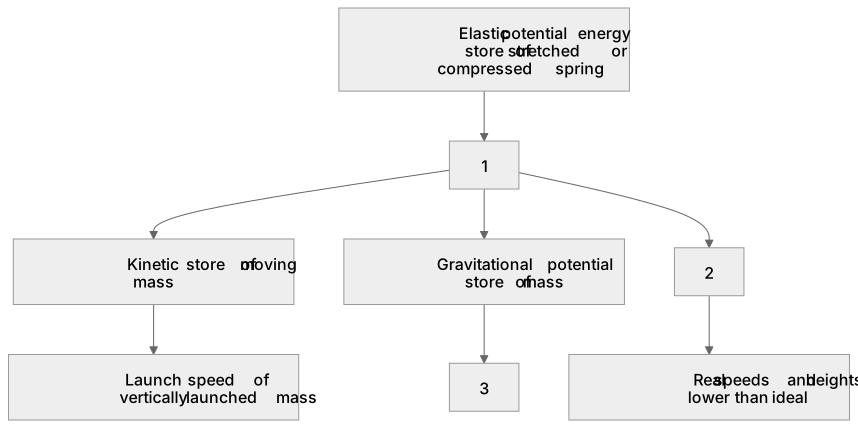
Some boxes have lost their names. Pick the right name for each number.
1Box 1
2Box 2
3Box 3
There is more to this lesson
The full lesson goes on to check your understanding and help you earn the marks. Create a free account to carry on, with your progress saved.
A week of Premium from your first lesson · Then the free plan continues · No card, no charge
Test your understanding of Bulk properties of solids: Spring energy transformed to kinetic and gravitational potential energy.
Active recall beats re-reading. Take an instant quiz now to test what you’ve learned and lock it into long-term memory.
A week of Premium from your first lesson · Then the free plan continues · No card, no charge