AQA · A-Level · Physics
Course version: 7408 · Version from Sept 2016
Inverse square law, assumptions in its application.
Full specification wording
Classification by temperature, black-body radiation (A-level only): Inverse square law, assumptions in its application.
The inverse square law says a quantity such as intensity or radiation flux falls in proportion to 1/r², where r is distance from a point source.
Checked against the AQA 7408 specification (opens in a new tab) on .
- Point 3 of 4
- 4 key terms
Study notes
From the checked teaching notes for this specification point.
The idea
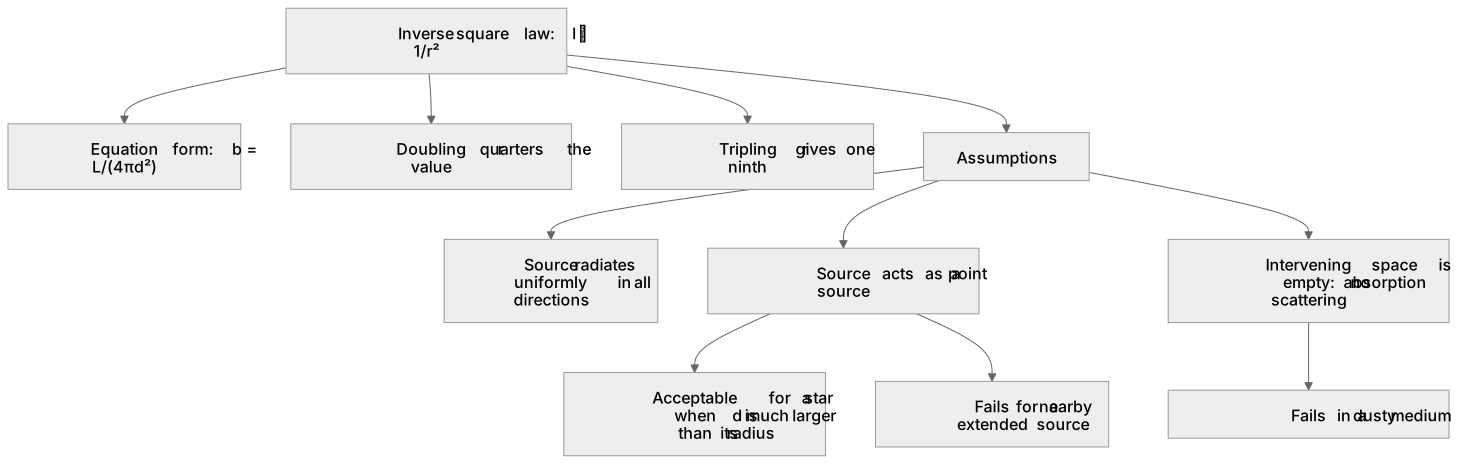
The inverse square law says a quantity such as intensity or radiation flux falls in proportion to 1/r², where r is distance from a point source. Doubling r quarters the value; tripling r reduces it to one ninth. In astrophysics it links apparent brightness b, luminosity L and distance d by b = L/(4πd²). The law holds only under stated assumptions: the source radiates uniformly in all directions, acts as a point source, and the intervening space is empty so no absorption or scattering occurs. For a star, the point-source assumption is acceptable when d is much larger than the star's radius.
What earns the marks
- States that intensity or flux is inversely proportional to the square of the distance from a point source, written as I ∝ 1/r² or b = L/(4πd²).
- Applies the law quantitatively, for example showing that moving from distance r to 2r reduces received intensity to one quarter of its original value.
- Identifies the point-source assumption: the source must be small compared with the distance at which it is observed, so that rays are effectively radial.
- Identifies the isotropic-emission assumption: power is radiated uniformly in all directions, so the same total power passes through every sphere of radius r.
- Explains that the intervening medium must be transparent, with no absorption or scattering, so that all emitted radiation reaches the observer.
- Uses the law to compare two situations by forming a ratio, such as b₁/b₂ = (d₂/d₁)², avoiding unnecessary substitution of constants.
- Recognises that the law is a limiting case and states a realistic condition under which it fails, such as observing a star from within its own planetary system or through dense interstellar dust.
Common mistakes and how to put them right
Treating intensity as inversely proportional to distance rather than to distance squared.
Put it right: Write I ∝ 1/r² and check that doubling distance quarters the value.
Applying the law to an extended source at close range without commenting on the point-source assumption.
Put it right: State that the source must be far enough away that its angular size is negligible.
Ignoring absorption or scattering by dust and gas and assuming all emitted power arrives.
Put it right: State that the medium must be transparent for the inverse square law to apply directly.
Confusing luminosity, a property of the source, with intensity or flux, which depends on distance.
Put it right: Define each symbol clearly before substituting.
Exam tips
- Write the relationship as a proportionality first, then convert to an equation with the 4πd² factor, so the geometry behind the law is visible.
- When comparing two distances, use ratios and cancel constants; this reduces arithmetic and shows understanding of the inverse square behaviour.
- Always name the assumptions explicitly when a question asks why a calculated value may be unreliable, linking each assumption to a physical situation.
- Check units and significant figures at the end, and ensure distance is in metres before squaring.
Try the lesson
The start of the Classification by temperature, black-body radiation (A-level only): Inverse square law, assumptions in its application. lesson, made from checked teaching notes for this specification point.
Have a go first
A star radiates uniformly in all directions. At a distance r from the star, the intensity is I. What is the intensity at a distance 2r from the same star?
Listen
The inverse square law says a quantity such as intensity or radiation flux falls in proportion to 1/r², where r is distance from a point source. Doubling r quarters the value; tripling r reduces it to one ninth. In astrophysics it links apparent brightness b, luminosity L and distance d by b = L/(4πd²). The law holds only under stated assumptions: the source radiates uniformly in all directions, acts as a point source, and the intervening space is empty so no absorption or scattering occurs. For a star, the point-source assumption is acceptable when d is much larger than the star's radius. A strong answer earns marks for these points. States that intensity or flux is inversely proportional to the square of the distance from a point source, written as I ∝ 1/r² or b = L/(4πd²). Applies the law quantitatively, for example showing that moving from distance r to 2r reduces received intensity to one quarter of its original value. Identifies the point-source assumption: the source must be small compared with the distance at which it is observed, so that rays are effectively radial. Identifies the isotropic-emission assumption: power is radiated uniformly in all directions, so the same total power passes through every sphere of radius r. A common slip: Treating intensity as inversely proportional to distance rather than to distance squared. Instead, write I ∝ 1/r² and check that doubling distance quarters the value. Exam tip: Write the relationship as a proportionality first, then convert to an equation with the 4πd² factor, so the geometry behind the law is visible.
See it
Key words
Say what each word means before you turn the card.
Inverse square law
Try answering aloud or in your head before turning the card.
Point-source assumption
Try answering aloud or in your head before turning the card.
Isotropic-emission assumption
Try answering aloud or in your head before turning the card.
Transparent medium
Try answering aloud or in your head before turning the card.
See every definition
- Inverse square law
- A quantity such as intensity or radiation flux falls in proportion to 1/r², where r is distance from a point source.
- Point-source assumption
- The source must be small compared with the distance at which it is observed, so that rays are effectively radial.
- Isotropic-emission assumption
- Power is radiated uniformly in all directions, so the same total power passes through every sphere of radius r.
- Transparent medium
- The intervening space is empty, with no absorption or scattering, so that all emitted radiation reaches the observer.
Label the diagram
Some boxes have lost their names. Pick the right name for each number.
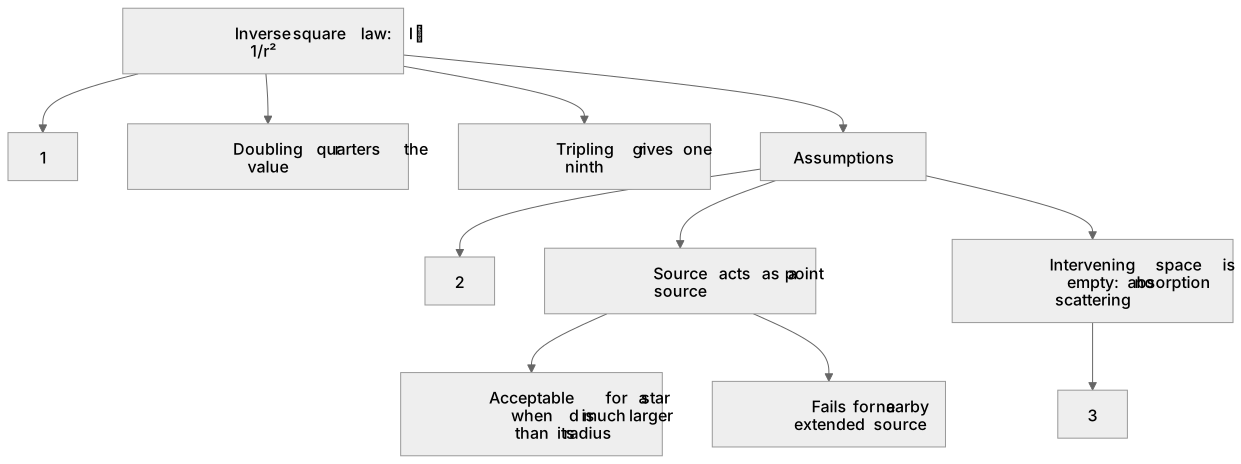
1Box 1
2Box 2
3Box 3
There is more to this lesson
The full lesson goes on to check your understanding and help you earn the marks. Create a free account to carry on, with your progress saved.
A week of Premium from your first lesson · Then the free plan continues · No card, no charge
Test your understanding of Classification by temperature, black-body radiation (A-level only): Inverse square law, assumptions in its application.
Active recall beats re-reading. Take an instant quiz now to test what you’ve learned and lock it into long-term memory.
A week of Premium from your first lesson · Then the free plan continues · No card, no charge