AQA · A-Level · Physics
Course version: 7408 · Version from Sept 2016
Use of Stefan’s law to compare the power output, temperature and size of…
Full specification wording
Classification by temperature, black-body radiation (A-level only): Use of Stefan’s law to compare the power output, temperature and size of stars P = σAT
Stefan's law states that a black body radiates power P = σAT⁴, where σ is the Stefan constant, A is surface area and T is absolute temperature in kelvin.
Checked against the AQA 7408 specification (opens in a new tab) on .
- Point 4 of 4
- 4 key terms
Study notes
From the checked teaching notes for this specification point.
The idea
Stefan's law states that a black body radiates power P = σAT⁴, where σ is the Stefan constant, A is surface area and T is absolute temperature in kelvin. For a spherical star, A = 4πr², so P = 4πσr²T⁴. This lets you compare stars: if two stars have the same luminosity but different temperatures, the cooler one must be larger. Form a ratio to cancel σ and 4π, for example P₁/P₂ = (r₁²T₁⁴)/(r₂²T₂⁴). Rearranged, r ∝ √P / T². Always convert temperatures to kelvin, use radius in metres, and remember that doubling temperature increases power by a factor of sixteen. The law assumes the star behaves as a black-body radiator.
What earns the marks
- States Stefan's law as P = σAT⁴ and identifies each symbol, including T in kelvin and A as the emitting surface area.
- Uses A = 4πr² for a spherical star to obtain P = 4πσr²T⁴ and rearranges for radius, temperature or power as required.
- Forms a ratio for two stars so that σ and 4π cancel, for example P₁/P₂ = (r₁²T₁⁴)/(r₂²T₂⁴), and solves for the unknown quantity.
- Applies the fourth-power dependence correctly, for example recognising that doubling absolute temperature multiplies radiated power by sixteen at constant area.
- Compares stars of different temperature and size, explaining that a cooler star must have a larger radius to emit the same power as a hotter star.
- Converts temperatures from degrees Celsius to kelvin by adding 273 before substitution, and keeps consistent SI units throughout.
- States that the star is modelled as a black-body radiator, so the law gives the total power radiated across all wavelengths.
Common mistakes and how to put them right
Substituting temperature in degrees Celsius instead of kelvin.
Put it right: Add 273 to convert to kelvin before raising to the fourth power.
Using the diameter or circumference in place of the radius when calculating surface area.
Put it right: Use A = 4πr² with the radius, halving a diameter if necessary.
Forgetting to square the radius when forming a ratio, or applying the fourth power to the radius.
Put it right: Keep r² and T⁴ separate in the ratio expression.
Treating σ as a variable that must be evaluated when comparing two stars.
Put it right: Cancel it, along with 4π, in the ratio.
Exam tips
- Write the full equation P = 4πσr²T⁴ before substituting, then rearrange symbolically to reduce arithmetic errors.
- For comparison questions, set up a ratio and cancel constants; this is quicker and less error-prone than calculating absolute values.
- Check whether the question gives diameter or radius, and whether temperature is in kelvin, before starting the calculation.
- Give the final answer with an appropriate unit and a sensible number of significant figures, and comment on whether the result is physically reasonable.
Try the lesson
The start of the Classification by temperature, black-body radiation (A-level only): Use of Stefan’s law to compare the power output, temperature and size of stars P = σAT lesson, made from checked teaching notes for this specification point.
Have a go first
Two stars have the same surface area, but star X has twice the surface temperature of star Y. According to Stefan’s law, what is the ratio of the power output of star X to that of star Y?
Listen
Stefan's law states that a black body radiates power P = σAT⁴, where σ is the Stefan constant, A is surface area and T is absolute temperature in kelvin. For a spherical star, A = 4πr², so P = 4πσr²T⁴. This lets you compare stars: if two stars have the same luminosity but different temperatures, the cooler one must be larger. Form a ratio to cancel σ and 4π, for example P₁/P₂ = (r₁²T₁⁴)/(r₂²T₂⁴). Rearranged, r ∝ √P / T². Always convert temperatures to kelvin, use radius in metres, and remember that doubling temperature increases power by a factor of sixteen. The law assumes the star behaves as a black-body radiator. A strong answer earns marks for these points. States Stefan's law as P = σAT⁴ and identifies each symbol, including T in kelvin and A as the emitting surface area. Uses A = 4πr² for a spherical star to obtain P = 4πσr²T⁴ and rearranges for radius, temperature or power as required. Forms a ratio for two stars so that σ and 4π cancel, for example P₁/P₂ = (r₁²T₁⁴)/(r₂²T₂⁴), and solves for the unknown quantity. Applies the fourth-power dependence correctly, for example recognising that doubling absolute temperature multiplies radiated power by sixteen at constant area. A common slip: Substituting temperature in degrees Celsius instead of kelvin. Instead, add 273 to convert to kelvin before raising to the fourth power. Exam tip: Write the full equation P = 4πσr²T⁴ before substituting, then rearrange symbolically to reduce arithmetic errors.
See it
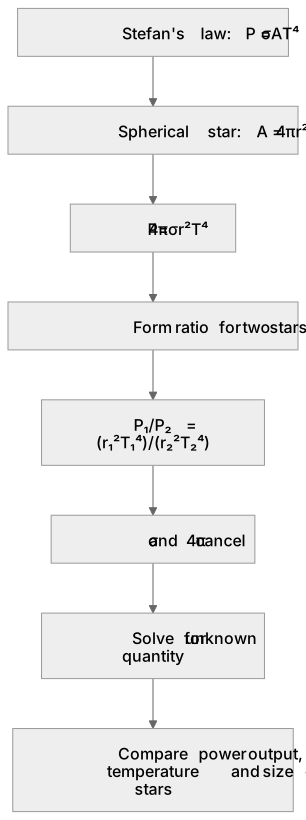
Put it in order
Put these steps in the order they happen.
- 1. P₁/P₂ = (r₁²T₁⁴)/(r₂²T₂⁴)
- 2. Compare power output, temperature and size of stars
- 3. σ and 4π cancel
- 4. Stefan's law: P = σAT⁴
- 5. Spherical star: A = 4πr²
- 6. Solve for unknown quantity
- 7. P = 4πσr²T⁴
- 8. Form ratio for two stars
Key words
Say what each word means before you turn the card.
Stefan's law
Try answering aloud or in your head before turning the card.
Stefan constant
Try answering aloud or in your head before turning the card.
Black-body radiator
Try answering aloud or in your head before turning the card.
Ratio method
Try answering aloud or in your head before turning the card.
See every definition
- Stefan's law
- A black body radiates power P = σAT⁴, where σ is the Stefan constant, A is surface area and T is absolute temperature in kelvin.
- Stefan constant
- The constant σ in Stefan's law, which cancels along with 4π when a ratio is formed for two stars.
- Black-body radiator
- The model assumed for the star, so that the law gives the total power radiated across all wavelengths.
- Ratio method
- Forming a ratio such as P₁/P₂ = (r₁²T₁⁴)/(r₂²T₂⁴) so that σ and 4π cancel, then solving for the unknown quantity.
Label the diagram
Some boxes have lost their names. Pick the right name for each number.
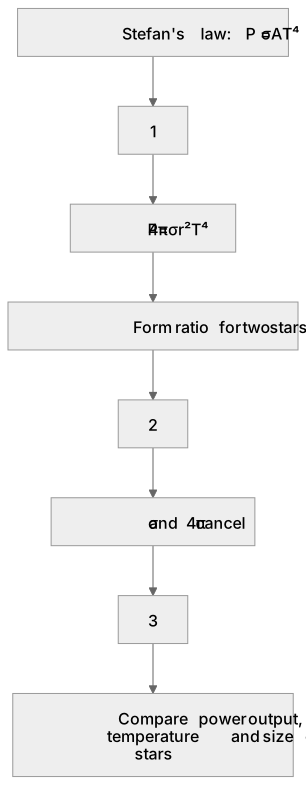
1Box 1
2Box 2
3Box 3
There is more to this lesson
The full lesson goes on to check your understanding and help you earn the marks. Create a free account to carry on, with your progress saved.
A week of Premium from your first lesson · Then the free plan continues · No card, no charge
Test your understanding of Classification by temperature, black-body radiation (A-level only): Use of Stefan’s law to compare the power output, temperature and size of stars P = σAT
Active recall beats re-reading. Take an instant quiz now to test what you’ve learned and lock it into long-term memory.
A week of Premium from your first lesson · Then the free plan continues · No card, no charge