AQA · A-Level · Physics
Course version: 7408 · Version from Sept 2016
Appreciation that particle physics relies on the collaborative efforts of…
Full specification wording
Classification of particles: Appreciation that particle physics relies on the collaborative efforts of large teams of scientists and engineers to validate new knowledge.
Modern particle physics addresses questions that no single researcher or small group can answer alone.
Checked against the AQA 7408 specification (opens in a new tab) on .
- Point 15 of 15
- 3 key terms
Study notes
From the checked teaching notes for this specification point.
The idea
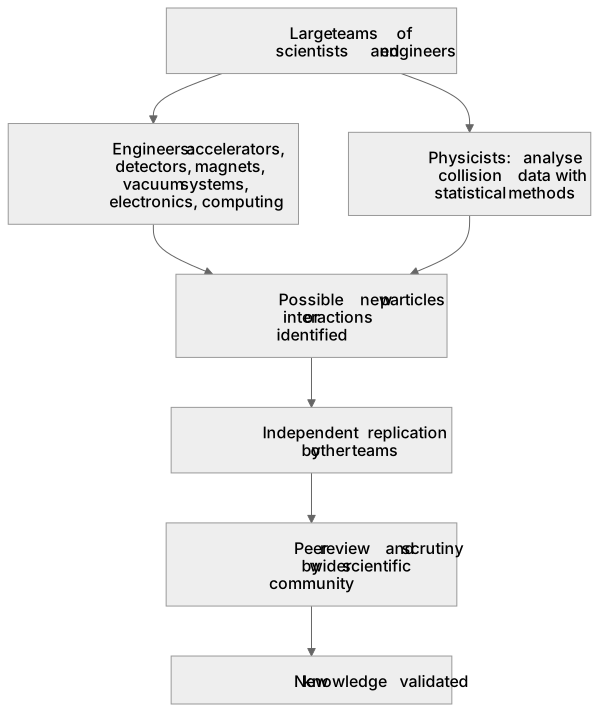
Modern particle physics addresses questions that no single researcher or small group can answer alone. Experiments such as those at the Large Hadron Collider require thousands of scientists and engineers to design detectors, build accelerator components, write analysis software and check results. Collaboration matters because a claimed discovery is only accepted when independent teams can reproduce it and when the statistical evidence is strong. Engineers contribute precision magnets, vacuum systems, electronics and computing, while physicists interpret collision data. Peer review, repeated measurement and open publication allow the community to validate new knowledge. This means progress depends on shared expertise, funding and international cooperation, not just individual insight.
What earns the marks
- Particle physics experiments are large-scale projects requiring many specialists working together over long periods.
- Engineers design and maintain accelerators, detectors, magnets, vacuum systems and data-handling equipment.
- Physicists analyse collision data, often using sophisticated statistical methods, to identify possible new particles or interactions.
- Validation requires independent replication of results and scrutiny by the wider scientific community, including peer review.
- International collaboration allows sharing of costs, expertise and data across countries and institutions.
- A single measurement is not usually enough; confidence grows when several experiments or analyses agree.
Common mistakes and how to put them right
Describing particle physics as the work of one brilliant individual.
Put it right by explaining that large teams and international collaborations are essential.
Confusing collaboration with mere funding.
Put it right by noting that collaboration includes shared scientific expertise, engineering design, data analysis and independent checking.
Claiming that a result is validated as soon as it is announced.
Put it right by stating that validation involves replication, peer review and agreement across independent teams.
Ignoring the engineering contribution.
Put it right by giving examples such as detector construction, cryogenics, magnet design or computing infrastructure.
Exam tips
- Use a named facility or experiment as a concrete example, then explain the roles of different specialists within it.
- Link collaboration directly to validation: say how independent teams and peer review reduce the chance of error or bias.
- Avoid vague phrases such as ‘scientists work together’; specify what engineers build and what physicists analyse.
- If asked to evaluate, weigh the benefits of shared expertise and cost against the challenges of coordination and long timescales.
Try the lesson
The start of the Classification of particles: Appreciation that particle physics relies on the collaborative efforts of large teams of scientists and engineers to validate new knowledge. lesson, made from checked teaching notes for this specification point.
Have a go first
Why do particle physics experiments often involve large teams of scientists and engineers?
Listen
Modern particle physics addresses questions that no single researcher or small group can answer alone. Experiments such as those at the Large Hadron Collider require thousands of scientists and engineers to design detectors, build accelerator components, write analysis software and check results. Collaboration matters because a claimed discovery is only accepted when independent teams can reproduce it and when the statistical evidence is strong. Engineers contribute precision magnets, vacuum systems, electronics and computing, while physicists interpret collision data. Peer review, repeated measurement and open publication allow the community to validate new knowledge. This means progress depends on shared expertise, funding and international cooperation, not just individual insight. A strong answer earns marks for these points. Particle physics experiments are large-scale projects requiring many specialists working together over long periods. Engineers design and maintain accelerators, detectors, magnets, vacuum systems and data-handling equipment. Physicists analyse collision data, often using sophisticated statistical methods, to identify possible new particles or interactions. Validation requires independent replication of results and scrutiny by the wider scientific community, including peer review. A common slip: Describing particle physics as the work of one brilliant individual. Instead, explaining that large teams and international collaborations are essential. Exam tip: Use a named facility or experiment as a concrete example, then explain the roles of different specialists within it.
See it
Key words
Say what each word means before you turn the card.
The collaborative nature of modern science
Try answering aloud or in your head before turning the card.
The role of engineering in experimental physics
Try answering aloud or in your head before turning the card.
International cooperation and large-scale facilities
Try answering aloud or in your head before turning the card.
See every definition
- The collaborative nature of modern science
- Particle physics relies on large teams of scientists and engineers working together over long periods, with shared expertise, funding and international cooperation.
- The role of engineering in experimental physics
- Engineers design and maintain accelerators, detectors, magnets, vacuum systems and data-handling equipment, contributing precision components and computing infrastructure.
- International cooperation and large-scale facilities
- Progress depends on sharing costs, expertise and data across countries and institutions, as in experiments such as those at the Large Hadron Collider.
Label the diagram
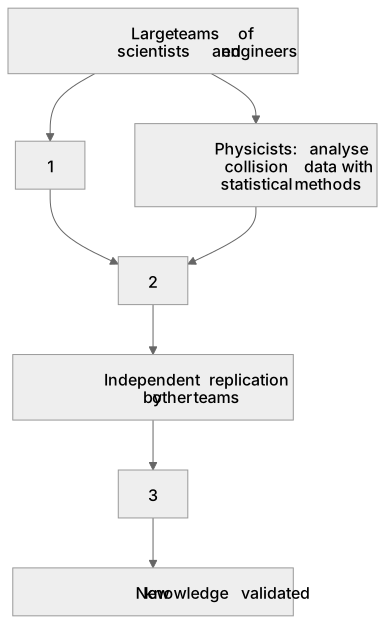
Some boxes have lost their names. Pick the right name for each number.
1Box 1
2Box 2
3Box 3
There is more to this lesson
The full lesson goes on to check your understanding and help you earn the marks. Create a free account to carry on, with your progress saved.
A week of Premium from your first lesson · Then the free plan continues · No card, no charge
Test your understanding of Classification of particles: Appreciation that particle physics relies on the collaborative efforts of large teams of scientists and engineers to validate new knowledge.
Active recall beats re-reading. Take an instant quiz now to test what you’ve learned and lock it into long-term memory.
A week of Premium from your first lesson · Then the free plan continues · No card, no charge