AQA · A-Level · Physics
Course version: 7408 · Version from Sept 2016
Strangeness can change by 0, +1 or -1 in weak interactions.
Full specification wording
Classification of particles: Strangeness can change by 0, +1 or -1 in weak interactions.
Strangeness is a quantum number assigned to hadrons to explain why certain strong interactions happen readily while others are never seen.
Checked against the AQA 7408 specification (opens in a new tab) on .
- Point 14 of 15
- 4 key terms
Study notes
From the checked teaching notes for this specification point.
The idea
Strangeness is a quantum number assigned to hadrons to explain why certain strong interactions happen readily while others are never seen. In strong and electromagnetic interactions strangeness is conserved. The weak interaction is different: it can change the strangeness of an individual quark, altering the overall strangeness. Permitted changes are 0, +1 or −1. A change of 0 occurs when strangeness is unaltered, as in beta-minus decay. A change of +1 occurs when a strange quark is removed or an anti-strange quark is created, for example in Λ → p + π⁻. A change of −1 occurs when a strange quark is created or an anti-strange quark removed, as in K⁺ → μ⁺ + ν_μ. Changes of magnitude greater than 1 are not observed in a single weak vertex.
What earns the marks
- Strangeness is conserved in strong and electromagnetic interactions but not necessarily in weak interactions.
- A weak interaction may leave total strangeness unchanged, giving a change of 0.
- A weak interaction may increase total strangeness by 1, for example when a strange quark is removed or an anti-strange quark is produced.
- A weak interaction may decrease total strangeness by 1, for example when a strange quark is produced or an anti-strange quark is removed.
- Changes of +2, −2 or larger are not permitted in a single weak interaction.
- When checking a decay, calculate total strangeness on each side using quark content and confirm the difference is 0, +1 or −1.
Common mistakes and how to put them right
Assuming strangeness is always conserved in every interaction.
Put it right by stating that conservation applies to strong and electromagnetic interactions, while weak interactions may change strangeness by 0, +1 or −1.
Treating a change of +1 and a change of −1 as interchangeable.
Put it right by tracking the sign carefully, since creating a strange quark lowers strangeness by 1 while removing one raises it by 1.
Believing any size of strangeness change is possible in a weak decay.
Put it right by remembering that only 0, +1 or −1 are observed.
Forgetting that antiparticles have opposite strangeness to their particles.
Put it right by assigning strangeness −1 to a strange quark and +1 to an anti-strange quark before summing.
Exam tips
- Write the strangeness of each particle underneath its symbol before and after the arrow, then subtract to find the change.
- If a question asks whether a decay is possible, check charge, baryon number and strangeness in turn and state which conservation rule is violated if it is not possible.
- Learn one example each of a strangeness-conserving weak decay and a strangeness-changing weak decay so you can reason by analogy.
- Use the sign convention consistently: strange quark has strangeness −1 and anti-strange quark has strangeness +1.
Try the lesson
The start of the Classification of particles: Strangeness can change by 0, +1 or -1 in weak interactions. lesson, made from checked teaching notes for this specification point.
Have a go first
Which interaction can change the strangeness of a particle by +1 or -1?
Listen
Strangeness is a quantum number assigned to hadrons to explain why certain strong interactions happen readily while others are never seen. In strong and electromagnetic interactions strangeness is conserved. The weak interaction is different: it can change the strangeness of an individual quark, altering the overall strangeness. Permitted changes are 0, +1 or −1. A change of 0 occurs when strangeness is unaltered, as in beta-minus decay. A change of +1 occurs when a strange quark is removed or an anti-strange quark is created, for example in Λ → p + π⁻. A change of −1 occurs when a strange quark is created or an anti-strange quark removed, as in K⁺ → μ⁺ + ν_μ. Changes of magnitude greater than 1 are not observed in a single weak vertex. A strong answer earns marks for these points. Strangeness is conserved in strong and electromagnetic interactions but not necessarily in weak interactions. A weak interaction may leave total strangeness unchanged, giving a change of 0. A weak interaction may increase total strangeness by 1, for example when a strange quark is removed or an anti-strange quark is produced. A weak interaction may decrease total strangeness by 1, for example when a strange quark is produced or an anti-strange quark is removed. A common slip: Assuming strangeness is always conserved in every interaction. Instead, stating that conservation applies to strong and electromagnetic interactions, while weak interactions may change strangeness by 0, +1 or −1. Exam tip: Write the strangeness of each particle underneath its symbol before and after the arrow, then subtract to find the change.
See it
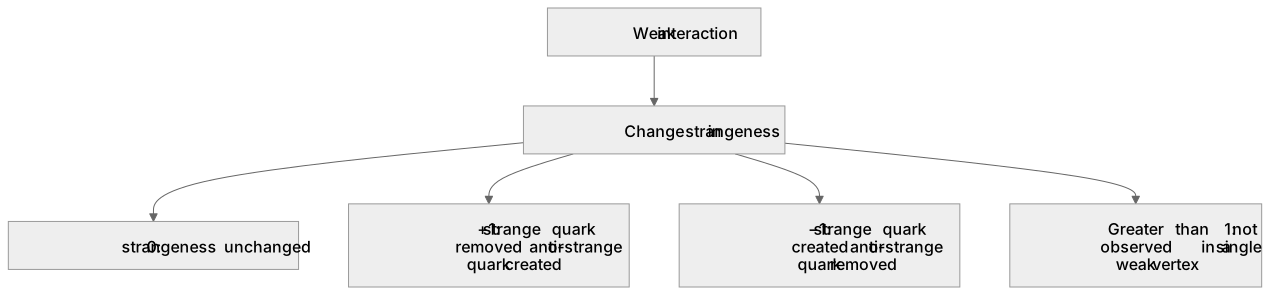
Key words
Say what each word means before you turn the card.
Strangeness
Try answering aloud or in your head before turning the card.
Conservation of strangeness
Try answering aloud or in your head before turning the card.
Permitted changes in strangeness
Try answering aloud or in your head before turning the card.
Change of +1
Try answering aloud or in your head before turning the card.
See every definition
- Strangeness
- A quantum number assigned to hadrons to explain why certain strong interactions happen readily while others are never seen.
- Conservation of strangeness
- In strong and electromagnetic interactions strangeness is conserved, but the weak interaction can change the strangeness of an individual quark.
- Permitted changes in strangeness
- In weak interactions the permitted changes are 0, +1 or −1; changes of magnitude greater than 1 are not observed in a single weak vertex.
- Change of +1
- Occurs when a strange quark is removed or an anti-strange quark is created, for example in Λ → p + π⁻.
Label the diagram
Some boxes have lost their names. Pick the right name for each number.
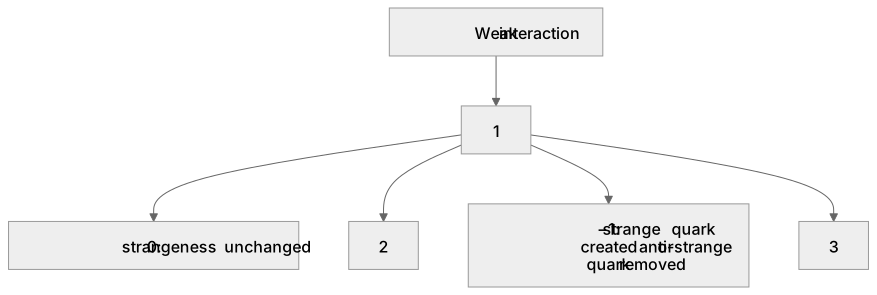
1Box 1
2Box 2
3Box 3
There is more to this lesson
The full lesson goes on to check your understanding and help you earn the marks. Create a free account to carry on, with your progress saved.
A week of Premium from your first lesson · Then the free plan continues · No card, no charge
Test your understanding of Classification of particles: Strangeness can change by 0, +1 or -1 in weak interactions.
Active recall beats re-reading. Take an instant quiz now to test what you’ve learned and lock it into long-term memory.
A week of Premium from your first lesson · Then the free plan continues · No card, no charge