AQA · A-Level · Physics
Course version: 7408 · Version from Sept 2016
The gates should be treated as building blocks. The internal structure or…
Full specification wording
Combinational logic (A-level only): The gates should be treated as building blocks. The internal structure or circuit of the gates is not required.
In this topic, AND, OR, NOT, NAND, NOR and XOR gates are treated as indivisible building blocks with defined truth tables.
Checked against the AQA 7408 specification (opens in a new tab) on .
- Point 4 of 4
- 4 key terms
Study notes
From the checked teaching notes for this specification point.
The idea
In this topic, AND, OR, NOT, NAND, NOR and XOR gates are treated as indivisible building blocks with defined truth tables. You use their input-output behaviour to build and analyse larger combinational circuits, without needing to know how each gate is made from transistors or other components. For example, a NAND gate is used simply as a two-input device whose output is 0 only when both inputs are 1; its internal transistor arrangement is outside the specification. This lets you focus on connecting gates correctly, reading and writing truth tables, and simplifying expressions, rather than on semiconductor physics. Assessment therefore targets circuit behaviour and logic, not gate construction.
What earns the marks
- Use the standard truth table of each gate as its definition when analysing or building circuits.
- Treat each gate as a single functional block with defined inputs and outputs.
- Combine gates by connecting the output of one to the input of another to form larger circuits.
- Explain circuit behaviour in terms of gate functions rather than internal electronic components.
- Recognise that questions on internal gate structure are outside the scope of this specification.
Common mistakes and how to put them right
Attempting to describe transistor-level construction of a gate.
Put it right by describing only the gate's truth table and function.
Confusing the truth table of one gate with another, such as NAND with NOR.
Put it right by learning each gate's output for every input combination.
Treating a gate as having more inputs or outputs than its symbol shows.
Put it right by using only the inputs and single output defined for that gate.
Exam tips
- Learn the truth tables of all standard gates so you can apply them quickly without deriving them.
- When explaining a circuit, refer to gate names and their input-output behaviour rather than internal structure.
- If a question asks for a circuit, use standard gate symbols and connect them clearly, showing inputs on the left and outputs on the right.
Try the lesson
The start of the Combinational logic (A-level only): The gates should be treated as building blocks. The internal structure or circuit of the gates is not required. lesson, made from checked teaching notes for this specification point.
Have a go first
A logic circuit is constructed using standard logic gates as building blocks. The circuit must produce an output of 1 if and only if input A is 1 and input B is 0. Which arrangement of gates provides this function?
Listen
In this topic, AND, OR, NOT, NAND, NOR and XOR gates are treated as indivisible building blocks with defined truth tables. You use their input-output behaviour to build and analyse larger combinational circuits, without needing to know how each gate is made from transistors or other components. For example, a NAND gate is used simply as a two-input device whose output is 0 only when both inputs are 1; its internal transistor arrangement is outside the specification. This lets you focus on connecting gates correctly, reading and writing truth tables, and simplifying expressions, rather than on semiconductor physics. Assessment therefore targets circuit behaviour and logic, not gate construction. A strong answer earns marks for these points. Use the standard truth table of each gate as its definition when analysing or building circuits. Treat each gate as a single functional block with defined inputs and outputs. Combine gates by connecting the output of one to the input of another to form larger circuits. Explain circuit behaviour in terms of gate functions rather than internal electronic components. A common slip: Attempting to describe transistor-level construction of a gate. Instead, describing only the gate's truth table and function. Exam tip: Learn the truth tables of all standard gates so you can apply them quickly without deriving them.
See it
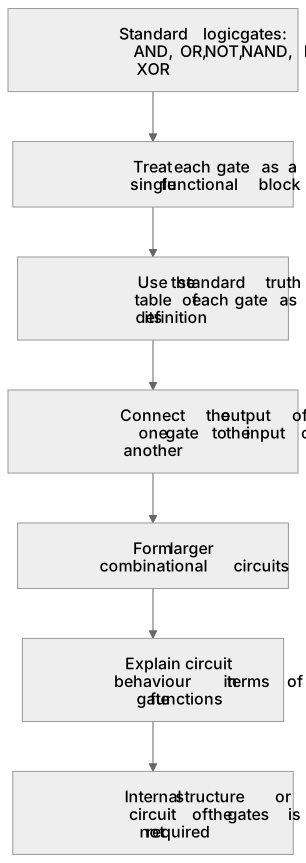
Put it in order
Put these steps in the order they happen.
- 1. Internal structure or circuit of the gates is not required
- 2. Explain circuit behaviour in terms of gate functions
- 3. Use the standard truth table of each gate as its definition
- 4. Form larger combinational circuits
- 5. Standard logic gates: AND, OR, NOT, NAND, NOR, XOR
- 6. Treat each gate as a single functional block
- 7. Connect the output of one gate to the input of another
Key words
Say what each word means before you turn the card.
Gates as functional building blocks
Try answering aloud or in your head before turning the card.
Standard truth tables of logic gates
Try answering aloud or in your head before turning the card.
Combinational circuit construction
Try answering aloud or in your head before turning the card.
Scope of the specification
Try answering aloud or in your head before turning the card.
See every definition
- Gates as functional building blocks
- Each gate is treated as a single functional block with defined inputs and outputs, and its internal structure or circuit is not required.
- Standard truth tables of logic gates
- The standard truth table of each gate is used as its definition when analysing or building circuits.
- Combinational circuit construction
- Gates are combined by connecting the output of one to the input of another to form larger circuits.
- Scope of the specification
- Questions on internal gate structure are outside the scope of this specification.
Label the diagram
Some boxes have lost their names. Pick the right name for each number.
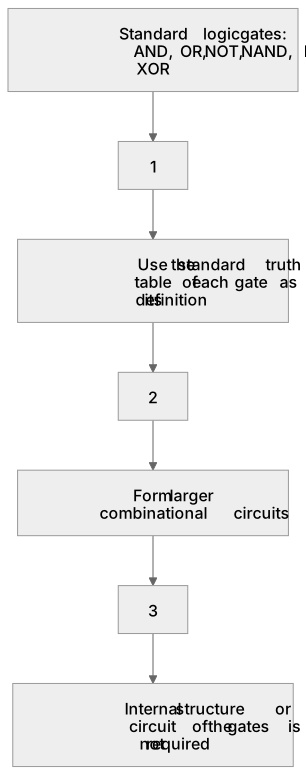
1Box 1
2Box 2
3Box 3
There is more to this lesson
The full lesson goes on to check your understanding and help you earn the marks. Create a free account to carry on, with your progress saved.
A week of Premium from your first lesson · Then the free plan continues · No card, no charge
Test your understanding of Combinational logic (A-level only): The gates should be treated as building blocks. The internal structure or circuit of the gates is not required.
Active recall beats re-reading. Take an instant quiz now to test what you’ve learned and lock it into long-term memory.
A week of Premium from your first lesson · Then the free plan continues · No card, no charge