AQA · A-Level · Physics
Course version: 7408 · Version from Sept 2016
Expressions for moment of inertia will be given where necessary.
Full specification wording
Concept of moment of inertia (A-level only): Expressions for moment of inertia will be given where necessary.
Moment of inertia, symbol I, measures how a body's mass is distributed about a chosen axis and therefore how strongly it resists angular acceleration.
Checked against the AQA 7408 specification (opens in a new tab) on .
- Point 2 of 2
- 4 key terms
Study notes
From the checked teaching notes for this specification point.
The idea
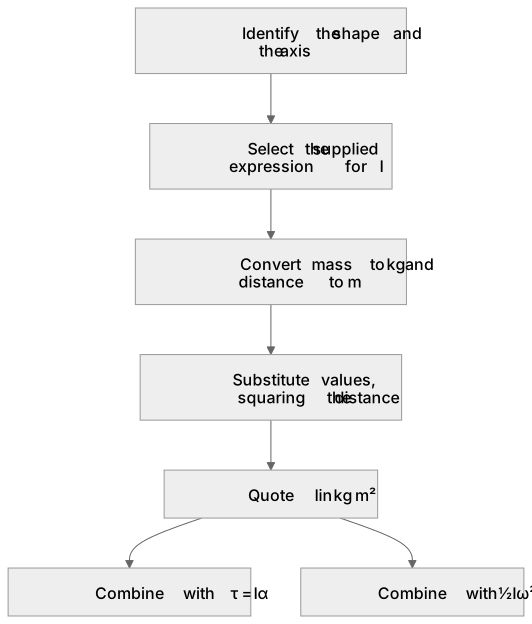
Moment of inertia, symbol I, measures how a body's mass is distributed about a chosen axis and therefore how strongly it resists angular acceleration. For a point mass, I = mr², where m is mass and r is perpendicular distance from the axis. Extended bodies have expressions such as I = ½mr² for a uniform solid disc about its central axis, I = mr² for a thin ring, and I = (2/5)mr² for a uniform solid sphere about a diameter. You are not expected to derive these standard results; where a question needs one, it will be supplied. Your task is to select the correct expression, substitute values in SI units, and combine it with τ = Iα or rotational kinetic energy ½Iω².
For example: A 2.0 kg solid disc of radius 0.10 m has I = ½ × 2.0 × (0.10)² = 0.010 kg m².
What earns the marks
- State that moment of inertia depends on both the total mass and how that mass is distributed relative to the axis of rotation.
- Use a supplied expression correctly, substituting mass in kg and distance in m so that I is quoted in kg m².
- Recognise that the same body has different moments of inertia about different axes, so the axis must be identified before choosing an expression.
- Combine a given I with τ = Iα to find angular acceleration, or with ½Iω² to find rotational kinetic energy.
- Check that the expression supplied matches the shape and axis described, for example a solid disc about its central axis rather than about a rim.
Common mistakes and how to put them right
Using the wrong radius.
Put it right: Halve any diameter before squaring.
Forgetting to square the distance.
Put it right: Apply the squared term before multiplying by mass.
Mixing units: the error is leaving mass in g or radius in cm; the correction is to convert to kg and m so the answer is in kg m².
Exam tips
- Read the axis description carefully; a disc about its centre and a disc about its rim have different expressions.
- Write the supplied expression first, then substitute numbers, so the examiner can follow your method.
- Carry units through the calculation and give the final answer in kg m² to an appropriate number of significant figures.
Try the lesson
The start of the Concept of moment of inertia (A-level only): Expressions for moment of inertia will be given where necessary. lesson, made from checked teaching notes for this specification point.
Have a go first
A solid disc of mass 4.0 kg and radius 0.50 m rotates about its central axis. Using the given expression I = ½mr², what is the moment of inertia of the disc?
Listen
Moment of inertia, symbol I, measures how a body's mass is distributed about a chosen axis and therefore how strongly it resists angular acceleration. For a point mass, I = mr², where m is mass and r is perpendicular distance from the axis. Extended bodies have expressions such as I = ½mr² for a uniform solid disc about its central axis, I = mr² for a thin ring, and I = (2/5)mr² for a uniform solid sphere about a diameter. You are not expected to derive these standard results; where a question needs one, it will be supplied. Your task is to select the correct expression, substitute values in SI units, and combine it with τ = Iα or rotational kinetic energy ½Iω². For example, a 2.0 kg solid disc of radius 0.10 m has I = ½ × 2.0 × (0.10)² = 0.010 kg m². A strong answer earns marks for these points. State that moment of inertia depends on both the total mass and how that mass is distributed relative to the axis of rotation. Use a supplied expression correctly, substituting mass in kg and distance in m so that I is quoted in kg m². Recognise that the same body has different moments of inertia about different axes, so the axis must be identified before choosing an expression. Combine a given I with τ = Iα to find angular acceleration, or with ½Iω² to find rotational kinetic energy. A common slip: Using the wrong radius: the error is substituting diameter for r. Instead, halve any diameter before squaring. Exam tip: Read the axis description carefully; a disc about its centre and a disc about its rim have different expressions.
See it
Key words
Say what each word means before you turn the card.
Moment of inertia
Try answering aloud or in your head before turning the card.
Mass distribution
Try answering aloud or in your head before turning the card.
Angular acceleration
Try answering aloud or in your head before turning the card.
Use of standard results
Try answering aloud or in your head before turning the card.
See every definition
- Moment of inertia
- Measures how a body's mass is distributed about a chosen axis and therefore how strongly it resists angular acceleration.
- Mass distribution
- How a body's mass is spread about a chosen axis, which moment of inertia measures.
- Angular acceleration
- The quantity that moment of inertia measures how strongly a body resists.
- Use of standard results
- Standard expressions are not derived; where a question needs one, it will be supplied, and the correct expression must be selected.
Label the diagram
Some boxes have lost their names. Pick the right name for each number.
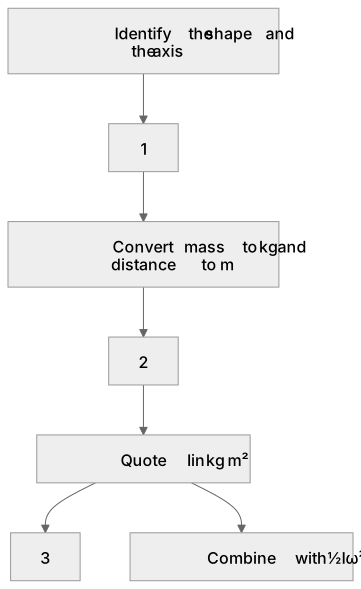
1Box 1
2Box 2
3Box 3
There is more to this lesson
The full lesson goes on to check your understanding and help you earn the marks. Create a free account to carry on, with your progress saved.
A week of Premium from your first lesson · Then the free plan continues · No card, no charge
Test your understanding of Concept of moment of inertia (A-level only): Expressions for moment of inertia will be given where necessary.
Active recall beats re-reading. Take an instant quiz now to test what you’ve learned and lock it into long-term memory.
A week of Premium from your first lesson · Then the free plan continues · No card, no charge