AQA · A-Level · Physics
Course version: 7408 · Version from Sept 2016
Qualitative knowledge of the factors that affect the moment of inertia of…
Full specification wording
Concept of moment of inertia (A-level only): Qualitative knowledge of the factors that affect the moment of inertia of a rotating object.
Moment of inertia measures how strongly an object resists changes to its rotational motion, playing the same role in rotation that mass plays in linear motion.
Checked against the AQA 7408 specification (opens in a new tab) on .
- Point 1 of 2
- 4 key terms
Study notes
From the checked teaching notes for this specification point.
The idea
Moment of inertia measures how strongly an object resists changes to its rotational motion, playing the same role in rotation that mass plays in linear motion. Qualitatively, it depends on how mass is distributed relative to the axis of rotation. Mass placed further from the axis contributes more to the moment of inertia, so a hollow hoop has a larger moment of inertia than a solid disc of equal mass and radius. Total mass matters too: doubling the mass while keeping the distribution the same doubles the moment of inertia. The choice of axis is crucial, because the same object can have different moments of inertia about different axes. A useful method is to picture the mass as concentrated at a typical distance from the axis and judge how that distance changes when the shape, mass or axis changes.
What earns the marks
- States that moment of inertia depends on the total mass of the rotating object.
- Explains that mass further from the axis of rotation contributes more to the moment of inertia than mass close to the axis.
- Compares shapes of equal mass and radius, recognising that a hollow hoop has a greater moment of inertia than a solid disc about the same central axis.
- Recognises that the moment of inertia depends on the chosen axis of rotation, so the same object can have different values about different axes.
- Applies the qualitative idea to a practical example, such as a flywheel storing rotational energy or a figure skater changing spin rate by moving mass towards the axis.
Common mistakes and how to put them right
Confusing moment of inertia with mass alone.
Put it right by explaining that distribution of mass relative to the axis also matters.
Assuming a larger total mass always means a larger moment of inertia regardless of shape.
Put it right by comparing objects of equal mass but different mass distribution.
Ignoring the axis of rotation and quoting a single value for an object.
Put it right by specifying the axis and noting that moving the axis changes the moment of inertia.
Exam tips
- Always state the axis of rotation when discussing moment of inertia, because the value is meaningless without it.
- Use comparative language such as greater than and less than to show qualitative reasoning about mass distribution.
- Support your explanation with a familiar example, such as a hoop versus a disc or a skater pulling their arms in, to demonstrate understanding.
Try the lesson
The start of the Concept of moment of inertia (A-level only): Qualitative knowledge of the factors that affect the moment of inertia of a rotating object. lesson, made from checked teaching notes for this specification point.
Have a go first
A solid disc and a solid sphere have the same mass and the same radius. Which factor explains why they have different moments of inertia about an axis through their centres?
Listen
Moment of inertia measures how strongly an object resists changes to its rotational motion, playing the same role in rotation that mass plays in linear motion. Qualitatively, it depends on how mass is distributed relative to the axis of rotation. Mass placed further from the axis contributes more to the moment of inertia, so a hollow hoop has a larger moment of inertia than a solid disc of equal mass and radius. Total mass matters too: doubling the mass while keeping the distribution the same doubles the moment of inertia. The choice of axis is crucial, because the same object can have different moments of inertia about different axes. A useful method is to picture the mass as concentrated at a typical distance from the axis and judge how that distance changes when the shape, mass or axis changes. A strong answer earns marks for these points. States that moment of inertia depends on the total mass of the rotating object. Explains that mass further from the axis of rotation contributes more to the moment of inertia than mass close to the axis. Compares shapes of equal mass and radius, recognising that a hollow hoop has a greater moment of inertia than a solid disc about the same central axis. Recognises that the moment of inertia depends on the chosen axis of rotation, so the same object can have different values about different axes. A common slip: Confusing moment of inertia with mass alone. Instead, explaining that distribution of mass relative to the axis also matters. Exam tip: Always state the axis of rotation when discussing moment of inertia, because the value is meaningless without it.
See it
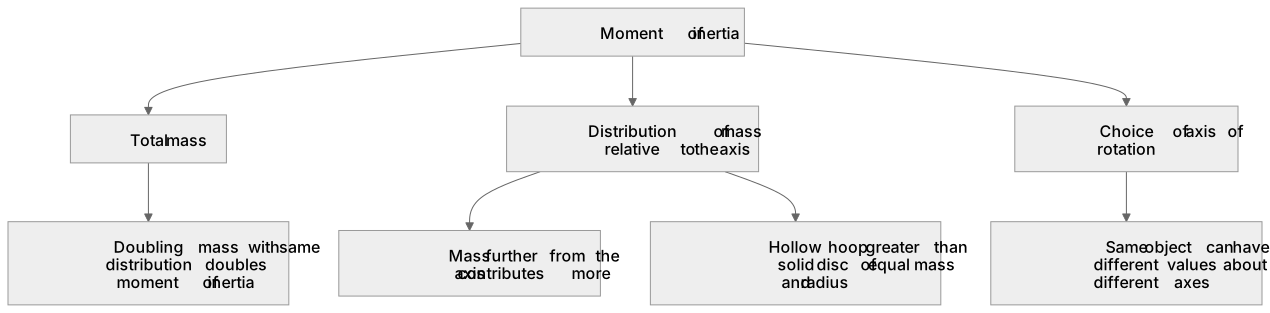
Key words
Say what each word means before you turn the card.
Moment of inertia
Try answering aloud or in your head before turning the card.
Mass distribution
Try answering aloud or in your head before turning the card.
Choice of axis
Try answering aloud or in your head before turning the card.
Total mass
Try answering aloud or in your head before turning the card.
See every definition
- Moment of inertia
- Measures how strongly an object resists changes to its rotational motion, playing the same role in rotation that mass plays in linear motion.
- Mass distribution
- Mass placed further from the axis contributes more to the moment of inertia, so a hollow hoop has a larger moment of inertia than a solid disc of equal mass and radius.
- Choice of axis
- The same object can have different moments of inertia about different axes, so the axis of rotation must always be stated.
- Total mass
- Doubling the mass while keeping the distribution the same doubles the moment of inertia.
Label the diagram
Some boxes have lost their names. Pick the right name for each number.
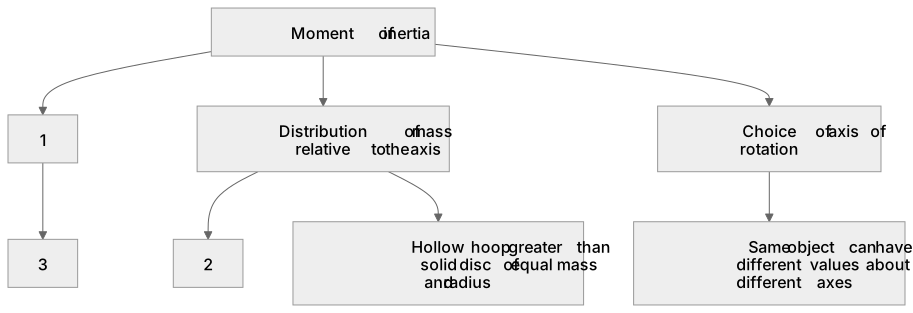
1Box 1
2Box 2
3Box 3
There is more to this lesson
The full lesson goes on to check your understanding and help you earn the marks. Create a free account to carry on, with your progress saved.
A week of Premium from your first lesson · Then the free plan continues · No card, no charge
Test your understanding of Concept of moment of inertia (A-level only): Qualitative knowledge of the factors that affect the moment of inertia of a rotating object.
Active recall beats re-reading. Take an instant quiz now to test what you’ve learned and lock it into long-term memory.
A week of Premium from your first lesson · Then the free plan continues · No card, no charge