AQA · A-Level · Physics
Course version: 7408 · Version from Sept 2016
Specific charge of the proton and the electron, and of nuclei and ions.
Full specification wording
Constituents of the atom: Specific charge of the proton and the electron, and of nuclei and ions.
Specific charge is the charge-to-mass ratio of a particle, calculated as charge divided by mass, with units C kg⁻¹.
Checked against the AQA 7408 specification (opens in a new tab) on .
- Point 3 of 5
- 3 key terms
Study notes
From the checked teaching notes for this specification point.
The idea
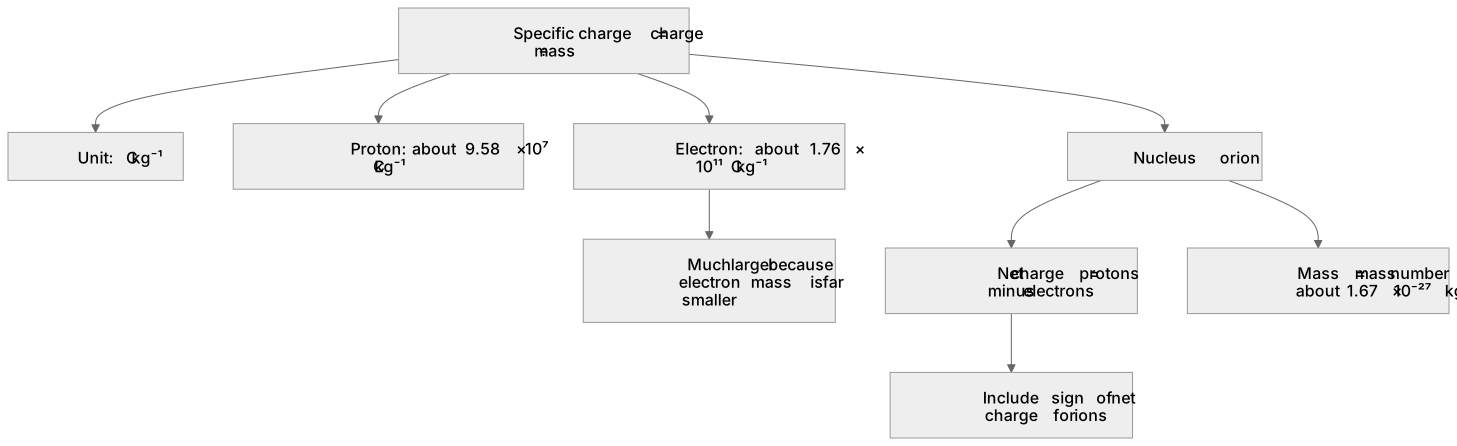
Specific charge is the charge-to-mass ratio of a particle, calculated as charge divided by mass, with units C kg⁻¹. For a proton, specific charge is about 9.58 × 10⁷ C kg⁻¹; for an electron it is about 1.76 × 10¹¹ C kg⁻¹, much larger because the electron has a far smaller mass. For a nucleus or ion, find the total charge from the number of protons minus the number of electrons, then divide by the total mass of the nucleons. For example, a helium nucleus has charge 2 × 1.60 × 10⁻¹⁹ C and mass about 4 × 1.67 × 10⁻²⁷ kg, giving a specific charge near 4.8 × 10⁷ C kg⁻¹. The sign of the charge must be included when the particle is an ion.
What earns the marks
- Defines specific charge as charge divided by mass and gives the unit C kg⁻¹.
- Calculates the charge on a nucleus or ion from the number of protons and electrons.
- Uses the mass number and the mass of a nucleon to estimate the mass of a nucleus or ion.
- Compares the specific charges of the proton and electron, explaining the electron's much larger value by its smaller mass.
- Handles positive and negative ions correctly by including the sign of the net charge.
Common mistakes and how to put them right
Dividing mass by charge instead of charge by mass.
Put it right: Write specific charge = charge ÷ mass.
Using the mass number as the mass in kilograms.
Put it right: Multiply the mass number by about 1.67 × 10⁻²⁷ kg.
Ignoring the charge contributed by electrons in an ion.
Put it right: Subtract the number of electrons from the number of protons to find the net charge.
Exam tips
- Write the formula specific charge = Q ÷ m before substituting values, so the structure of the calculation is clear.
- Keep powers of ten in standard form throughout to reduce arithmetic errors.
- Check the sign of the charge for ions and state it in your final answer.
Try the lesson
The start of the Constituents of the atom: Specific charge of the proton and the electron, and of nuclei and ions. lesson, made from checked teaching notes for this specification point.
Have a go first
Which particle has the largest specific charge?
Listen
Specific charge is the charge-to-mass ratio of a particle, calculated as charge divided by mass, with units C kg⁻¹. For a proton, specific charge is about 9.58 × 10⁷ C kg⁻¹; for an electron it is about 1.76 × 10¹¹ C kg⁻¹, much larger because the electron has a far smaller mass. For a nucleus or ion, find the total charge from the number of protons minus the number of electrons, then divide by the total mass of the nucleons. For example, a helium nucleus has charge 2 × 1.60 × 10⁻¹⁹ C and mass about 4 × 1.67 × 10⁻²⁷ kg, giving a specific charge near 4.8 × 10⁷ C kg⁻¹. The sign of the charge must be included when the particle is an ion. A strong answer earns marks for these points. Defines specific charge as charge divided by mass and gives the unit C kg⁻¹. Calculates the charge on a nucleus or ion from the number of protons and electrons. Uses the mass number and the mass of a nucleon to estimate the mass of a nucleus or ion. Compares the specific charges of the proton and electron, explaining the electron's much larger value by its smaller mass. A common slip: Dividing mass by charge instead of charge by mass. Instead, write specific charge = charge ÷ mass. Exam tip: Write the formula specific charge = Q ÷ m before substituting values, so the structure of the calculation is clear.
See it
Key words
Say what each word means before you turn the card.
Specific charge
Try answering aloud or in your head before turning the card.
Comparison of proton and electron properties
Try answering aloud or in your head before turning the card.
Ion formation and charge
Try answering aloud or in your head before turning the card.
See every definition
- Specific charge
- Charge divided by mass, with units C kg⁻¹.
- Comparison of proton and electron properties
- The electron has a much larger specific charge than the proton because the electron has a far smaller mass.
- Ion formation and charge
- The total charge is found from the number of protons minus the number of electrons, and the sign of the charge must be included for an ion.
Label the diagram
Some boxes have lost their names. Pick the right name for each number.
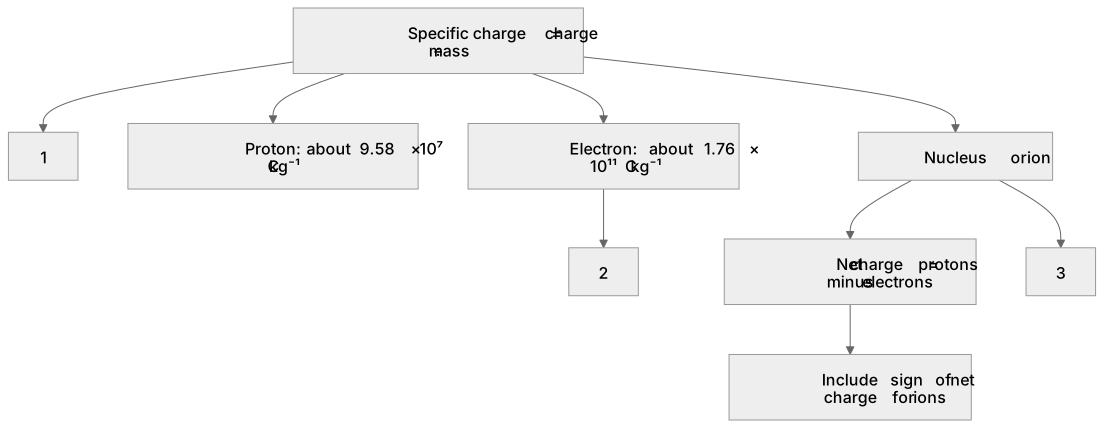
1Box 1
2Box 2
3Box 3
There is more to this lesson
The full lesson goes on to check your understanding and help you earn the marks. Create a free account to carry on, with your progress saved.
A week of Premium from your first lesson · Then the free plan continues · No card, no charge
Test your understanding of Constituents of the atom: Specific charge of the proton and the electron, and of nuclei and ions.
Active recall beats re-reading. Take an instant quiz now to test what you’ve learned and lock it into long-term memory.
A week of Premium from your first lesson · Then the free plan continues · No card, no charge