AQA · A-Level · Physics
Course version: 7408 · Version from Sept 2016
The atomic mass unit (amu) is included in the A-level Nuclear physics…
Full specification wording
Constituents of the atom: The atomic mass unit (amu) is included in the A-level Nuclear physics section.
Masses must be handled exclusively in kilograms (kg) using the values provided on the data sheet (e.g., the proton rest mass is 1.67 × 10⁻²⁷ kg).
Checked against the AQA 7408 specification (opens in a new tab) on .
- Point 2 of 5
- 3 key terms
Study notes
From the checked teaching notes for this specification point.
The idea
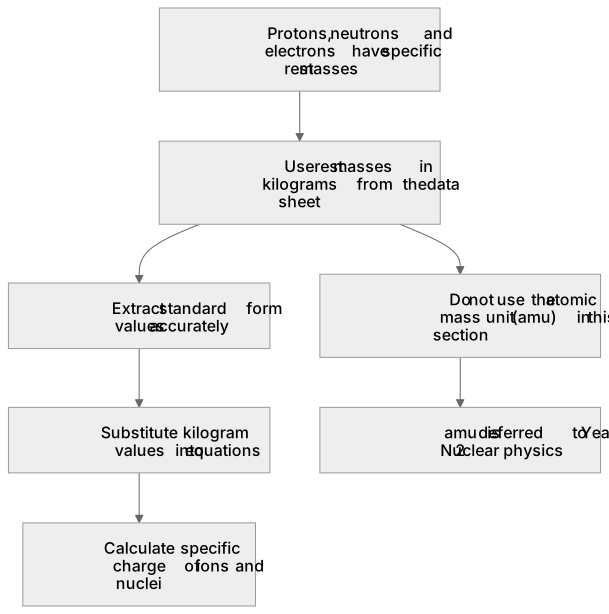
Masses must be handled exclusively in kilograms (kg) using the values provided on the data sheet (e.g., the proton rest mass is 1.67 × 10⁻²⁷ kg). The specification explicitly defers the introduction of the atomic mass unit (amu or u) to the Year 2 Nuclear physics section. Consequently, calculations involving specific charge or basic mass comparisons at this stage should rely on standard SI units. Teachers should ensure students are comfortable extracting these standard form values from the data booklet and inputting them accurately into calculators without prematurely introducing mass-energy equivalence.
What earns the marks
- Identifies the rest masses of protons, neutrons, and electrons in kilograms using the standard data sheet.
- Calculates the specific charge of ions and nuclei using mass values strictly in kilograms.
- Recognises that the atomic mass unit (amu) is not required for calculations in this introductory section.
- Applies standard form correctly when substituting kilogram mass values into equations for atomic constituents.
Common mistakes and how to put them right
Attempting to use the atomic mass unit (amu) for specific charge calculations.
Put it right: Use the exact rest mass values in kilograms from the data sheet.
Misreading the standard form values from the data sheet, such as using 10²⁷ instead of 10⁻²⁷ for the mass of a proton.
Put it right: Carefully input the negative exponent when using 1.67 × 10⁻²⁷ kg.
Confusing the mass number (nucleon number) with the actual mass in kilograms.
Put it right: Multiply the nucleon number by the approximate mass of one nucleon in kg (1.67 × 10⁻²⁷ kg) to find the total mass of the nucleus.
Exam tips
- Always use the exact rest mass values in kilograms from the data sheet for calculations in this section, avoiding the atomic mass unit until Year 2.
- When calculating specific charge, ensure the total mass of the nucleus or ion is calculated in kilograms before dividing the charge by the mass.
Try the lesson
The start of the Constituents of the atom: The atomic mass unit (amu) is included in the A-level Nuclear physics section. lesson, made from checked teaching notes for this specification point.
Have a go first
Which value is equal to one atomic mass unit (amu)?
Listen
Masses must be handled exclusively in kilograms (kg) using the values provided on the data sheet (e.g., the proton rest mass is 1.67 × 10⁻²⁷ kg). The specification explicitly defers the introduction of the atomic mass unit (amu or u) to the Year 2 Nuclear physics section. Consequently, calculations involving specific charge or basic mass comparisons at this stage should rely on standard SI units. Teachers should ensure students are comfortable extracting these standard form values from the data booklet and inputting them accurately into calculators without prematurely introducing mass-energy equivalence. A strong answer earns marks for these points. Identifies the rest masses of protons, neutrons, and electrons in kilograms using the standard data sheet. Calculates the specific charge of ions and nuclei using mass values strictly in kilograms. Recognises that the atomic mass unit (amu) is not required for calculations in this introductory section. Applies standard form correctly when substituting kilogram mass values into equations for atomic constituents. A common slip: Attempting to use the atomic mass unit (amu) for specific charge calculations. Instead, use the exact rest mass values in kilograms from the data sheet. Exam tip: Always use the exact rest mass values in kilograms from the data sheet for calculations in this section, avoiding the atomic mass unit until Year 2.
See it
Key words
Say what each word means before you turn the card.
Rest masses of atomic constituents
Try answering aloud or in your head before turning the card.
Standard SI units in atomic physics
Try answering aloud or in your head before turning the card.
Specific charge calculations
Try answering aloud or in your head before turning the card.
See every definition
- Rest masses of atomic constituents
- Protons, neutrons and electrons have specific rest masses, handled exclusively in kilograms using the values provided on the data sheet.
- Standard SI units in atomic physics
- Calculations involving specific charge or basic mass comparisons at this stage should rely on standard SI units, with masses handled in kilograms.
- Specific charge calculations
- Calculations of the specific charge of ions and nuclei use mass values strictly in kilograms, avoiding the atomic mass unit until Year 2.
Label the diagram
Some boxes have lost their names. Pick the right name for each number.
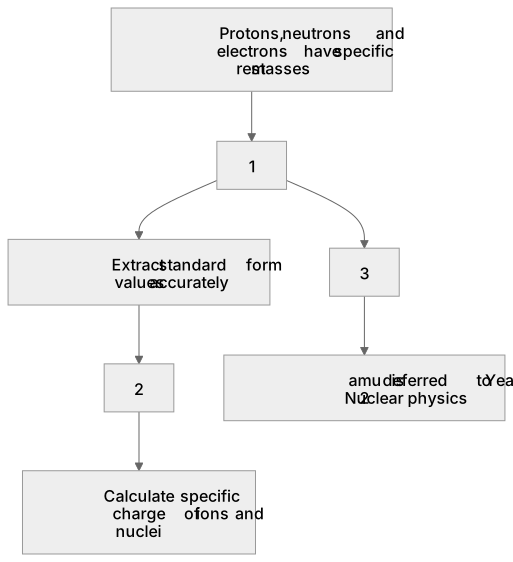
1Box 1
2Box 2
3Box 3
There is more to this lesson
The full lesson goes on to check your understanding and help you earn the marks. Create a free account to carry on, with your progress saved.
A week of Premium from your first lesson · Then the free plan continues · No card, no charge
Test your understanding of Constituents of the atom: The atomic mass unit (amu) is included in the A-level Nuclear physics section.
Active recall beats re-reading. Take an instant quiz now to test what you’ve learned and lock it into long-term memory.
A week of Premium from your first lesson · Then the free plan continues · No card, no charge