AQA · A-Level · Physics
Course version: 7408 · Version from Sept 2016
Comparison of magnitude of gravitational and electrostatic forces between…
Full specification wording
Coulomb's law (A-level only): Comparison of magnitude of gravitational and electrostatic forces between subatomic particles.
For two charged particles, the electrostatic force magnitude is F = kQ₁Q₂/r², where k = 1/(4πε₀), while the gravitational force magnitude is F = Gm₁m₂/r².
Checked against the AQA 7408 specification (opens in a new tab) on .
- Point 2 of 2
- 2 key terms
Study notes
From the checked teaching notes for this specification point.
The idea
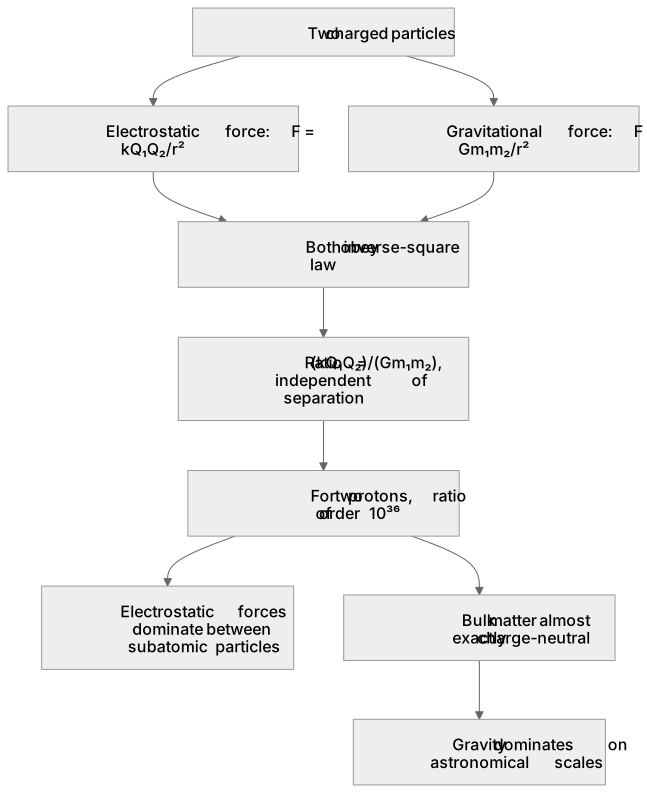
For two charged particles, the electrostatic force magnitude is F = kQ₁Q₂/r², where k = 1/(4πε₀), while the gravitational force magnitude is F = Gm₁m₂/r². Because both obey an inverse-square law, their ratio simplifies to (kQ₁Q₂)/(Gm₁m₂), independent of separation. For two protons, Q₁ = Q₂ = 1.60 × 10⁻¹⁹ C and m₁ = m₂ = 1.67 × 10⁻²⁷ kg, giving an electrostatic-to-gravitational ratio of order 10³⁶. Electrostatic forces therefore dominate between subatomic particles, yet gravity dominates on astronomical scales because bulk matter is almost exactly charge-neutral, so the much weaker gravitational attraction accumulates without cancellation.
What earns the marks
- State Coulomb's law as F = kQ₁Q₂/r² with k = 1/(4πε₀) ≈ 8.99 × 10⁹ N m² C⁻².
- State Newton's law of gravitation as F = Gm₁m₂/r² with G ≈ 6.67 × 10⁻¹¹ N m² kg⁻².
- Recognise that both forces obey an inverse-square law, so the ratio of electrostatic to gravitational force is independent of separation.
- Calculate the ratio for two protons as (kQ₁Q₂)/(Gm₁m₂) ≈ 10³⁶, showing substitution of charge and mass values.
- Explain that gravity dominates on astronomical scales because large bodies are approximately charge-neutral, so electrostatic forces largely cancel.
Common mistakes and how to put them right
Treating the ratio as dependent on separation.
Put it right by cancelling the common r² factor before substituting.
Using the electron mass for a proton calculation.
Put it right by selecting the mass of the particle named in the question.
Claiming gravity is always negligible.
Put it right by noting that on astronomical scales, charge neutrality allows gravity to dominate.
Exam tips
- Write the ratio as a single expression before substituting numbers, so the cancellation of r² is visible.
- Quote k and G to the precision given in the data sheet and keep units consistent throughout.
- When asked to compare, give both the numerical ratio and a physical reason for the difference in dominance at different scales.
Try the lesson
The start of the Coulomb's law (A-level only): Comparison of magnitude of gravitational and electrostatic forces between subatomic particles. lesson, made from checked teaching notes for this specification point.
Have a go first
For two protons separated by a fixed distance, which statement correctly compares the magnitudes of the electrostatic force and the gravitational force between them?
Listen
For two charged particles, the electrostatic force magnitude is F = kQ₁Q₂/r², where k = 1/(4πε₀), while the gravitational force magnitude is F = Gm₁m₂/r². Because both obey an inverse-square law, their ratio simplifies to (kQ₁Q₂)/(Gm₁m₂), independent of separation. For two protons, Q₁ = Q₂ = 1.60 × 10⁻¹⁹ C and m₁ = m₂ = 1.67 × 10⁻²⁷ kg, giving an electrostatic-to-gravitational ratio of order 10³⁶. Electrostatic forces therefore dominate between subatomic particles, yet gravity dominates on astronomical scales because bulk matter is almost exactly charge-neutral, so the much weaker gravitational attraction accumulates without cancellation. A strong answer earns marks for these points. State Coulomb's law as F = kQ₁Q₂/r² with k = 1/(4πε₀) ≈ 8.99 × 10⁹ N m² C⁻². State Newton's law of gravitation as F = Gm₁m₂/r² with G ≈ 6.67 × 10⁻¹¹ N m² kg⁻². Recognise that both forces obey an inverse-square law, so the ratio of electrostatic to gravitational force is independent of separation. Calculate the ratio for two protons as (kQ₁Q₂)/(Gm₁m₂) ≈ 10³⁶, showing substitution of charge and mass values. A common slip: Treating the ratio as dependent on separation. Instead, cancelling the common r² factor before substituting. Exam tip: Write the ratio as a single expression before substituting numbers, so the cancellation of r² is visible.
See it
Key words
Say what each word means before you turn the card.
Inverse-square laws
Try answering aloud or in your head before turning the card.
Charge neutrality
Try answering aloud or in your head before turning the card.
See every definition
- Inverse-square laws
- Both the electrostatic force and the gravitational force obey this, so the ratio of electrostatic to gravitational force is independent of separation.
- Charge neutrality
- Bulk matter is almost exactly this, so the much weaker gravitational attraction accumulates without cancellation and gravity dominates on astronomical scales.
Label the diagram
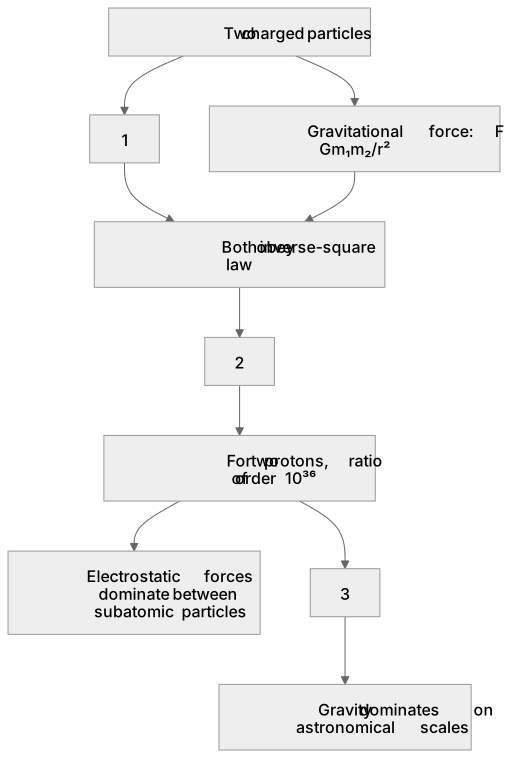
Some boxes have lost their names. Pick the right name for each number.
1Box 1
2Box 2
3Box 3
There is more to this lesson
The full lesson goes on to check your understanding and help you earn the marks. Create a free account to carry on, with your progress saved.
A week of Premium from your first lesson · Then the free plan continues · No card, no charge
Test your understanding of Coulomb's law (A-level only): Comparison of magnitude of gravitational and electrostatic forces between subatomic particles.
Active recall beats re-reading. Take an instant quiz now to test what you’ve learned and lock it into long-term memory.
A week of Premium from your first lesson · Then the free plan continues · No card, no charge