AQA · A-Level · Physics
Course version: 7408 · Version from Sept 2016
For a charged sphere, charge may be considered to be at the centre.
Full specification wording
Coulomb's law (A-level only): For a charged sphere, charge may be considered to be at the centre.
A uniformly charged conducting sphere behaves, for points outside it, as though all its charge were concentrated at its centre.
Checked against the AQA 7408 specification (opens in a new tab) on .
- Point 1 of 2
- 2 key terms
Study notes
From the checked teaching notes for this specification point.
The idea
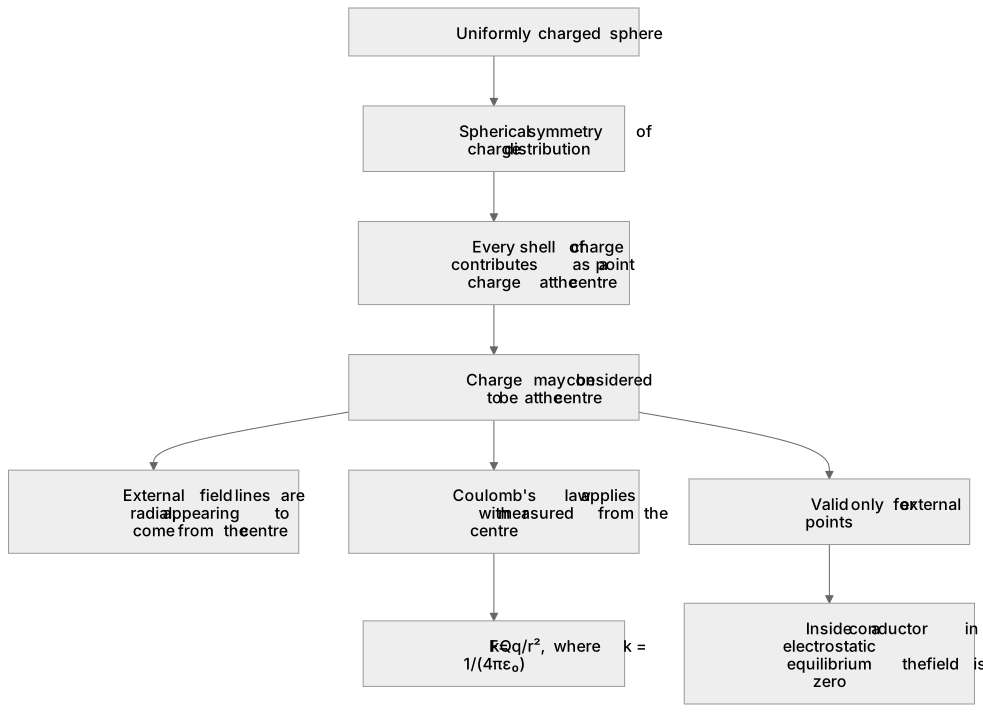
A uniformly charged conducting sphere behaves, for points outside it, as though all its charge were concentrated at its centre. This follows from the spherical symmetry of the charge distribution: every shell of charge contributes as a point charge at the centre, so the field outside is radial and Coulomb's law applies with r measured from the centre. For a point charge Q, the force on q is F = kQq/r², where k = 1/(4πε₀). The same result lets you treat a charged sphere as a point charge when finding force or field outside it. Inside a conductor in electrostatic equilibrium the field is zero, so the result is used only for external points.
What earns the marks
- For a uniformly charged sphere, external field lines are radial and appear to come from the centre.
- Coulomb's law may be applied with r measured from the centre of the sphere, not from its surface.
- The force between two charged spheres is F = kQ₁Q₂/r² when r is the centre-to-centre distance and the spheres do not overlap.
- The result depends on spherical symmetry and uniform charge distribution.
- Inside a conducting sphere in electrostatic equilibrium, the electric field is zero.
Common mistakes and how to put them right
Measuring r from the surface of the sphere instead of its centre.
Put it right by using the centre-to-centre distance.
Applying the point-charge result inside the sphere.
Put it right by noting that the field inside a conductor in equilibrium is zero.
Assuming the result holds for a non-uniformly charged or irregular object.
Put it right by restricting it to a uniformly charged sphere.
Exam tips
- Mark the centre of each sphere on a diagram and label r as the centre-to-centre distance.
- State that the sphere behaves as a point charge at its centre before substituting into F = kQ₁Q₂/r².
- Check whether the question asks for force or field, and use the appropriate equation.
- Keep charges in coulombs and distances in metres before calculating.
Try the lesson
The start of the Coulomb's law (A-level only): For a charged sphere, charge may be considered to be at the centre. lesson, made from checked teaching notes for this specification point.
Have a go first
When using Coulomb's law to find the force between two charged spheres, where may the charge on each sphere be considered to act?
Listen
A uniformly charged conducting sphere behaves, for points outside it, as though all its charge were concentrated at its centre. This follows from the spherical symmetry of the charge distribution: every shell of charge contributes as a point charge at the centre, so the field outside is radial and Coulomb's law applies with r measured from the centre. For a point charge Q, the force on q is F = kQq/r², where k = 1/(4πε₀). The same result lets you treat a charged sphere as a point charge when finding force or field outside it. Inside a conductor in electrostatic equilibrium the field is zero, so the result is used only for external points. A strong answer earns marks for these points. For a uniformly charged sphere, external field lines are radial and appear to come from the centre. Coulomb's law may be applied with r measured from the centre of the sphere, not from its surface. The force between two charged spheres is F = kQ₁Q₂/r² when r is the centre-to-centre distance and the spheres do not overlap. The result depends on spherical symmetry and uniform charge distribution. A common slip: Measuring r from the surface of the sphere instead of its centre. Instead, using the centre-to-centre distance. Exam tip: Mark the centre of each sphere on a diagram and label r as the centre-to-centre distance.
See it
Key words
Say what each word means before you turn the card.
Coulomb's law for point charges
Try answering aloud or in your head before turning the card.
Spherical symmetry and equivalent point charge
Try answering aloud or in your head before turning the card.
See every definition
- Coulomb's law for point charges
- For a point charge Q, the force on q is F = kQq/r², where k = 1/(4πε₀).
- Spherical symmetry and equivalent point charge
- For a uniformly charged sphere, charge may be considered to be at the centre, so it can be treated as a point charge for external points.
Label the diagram
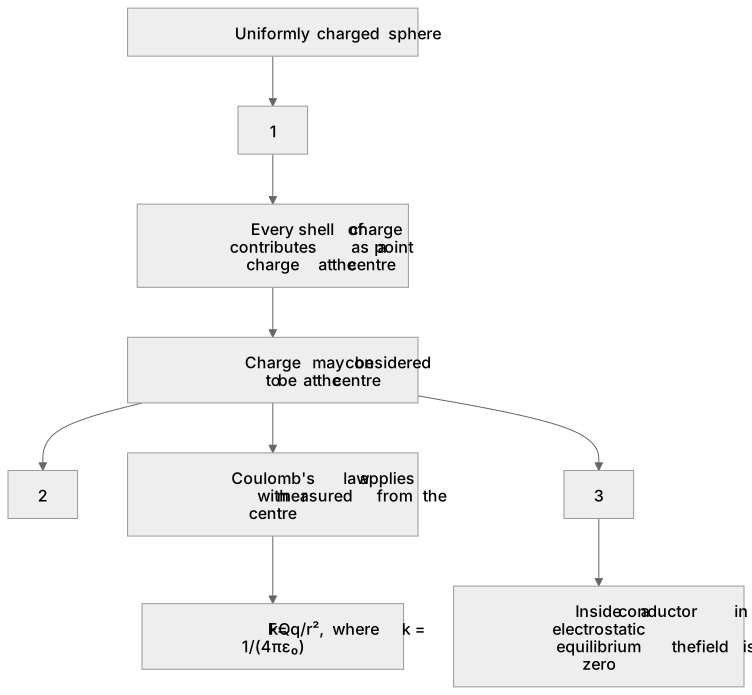
Some boxes have lost their names. Pick the right name for each number.
1Box 1
2Box 2
3Box 3
There is more to this lesson
The full lesson goes on to check your understanding and help you earn the marks. Create a free account to carry on, with your progress saved.
A week of Premium from your first lesson · Then the free plan continues · No card, no charge
Test your understanding of Coulomb's law (A-level only): For a charged sphere, charge may be considered to be at the centre.
Active recall beats re-reading. Take an instant quiz now to test what you’ve learned and lock it into long-term memory.
A week of Premium from your first lesson · Then the free plan continues · No card, no charge