AQA · A-Level · Physics
Course version: 7408 · Version from Sept 2016
Ohm’s law as a special case where I ∝ V under constant physical conditions.
Full specification wording
Current–voltage characteristics: Ohm’s law as a special case where I ∝ V under constant physical conditions.
Ohm’s law is not a universal rule for every component; it is the special case in which current is directly proportional to potential difference.
Checked against the AQA 7408 specification (opens in a new tab) on .
- Point 2 of 4
- 4 key terms
Study notes
From the checked teaching notes for this specification point.
The idea
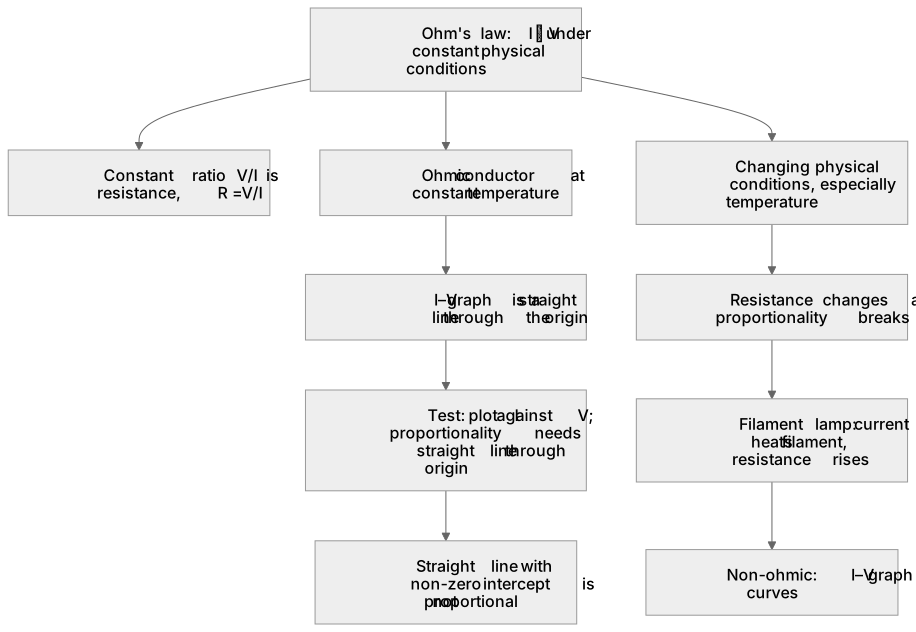
Ohm’s law is not a universal rule for every component; it is the special case in which current is directly proportional to potential difference. For a metallic conductor at constant temperature, doubling the p.d. doubles the current, so a graph of I against V is a straight line through the origin and the ratio V/I is constant. That constant ratio is resistance, R = V/I. The phrase ‘constant physical conditions’ is essential: heating a filament lamp raises its resistance, so its I–V graph curves and it is non-ohmic. To test the relationship, vary the supply, record paired ammeter and voltmeter readings, and plot I against V; proportionality is shown by a straight line through the origin, not merely by a positive gradient.
What earns the marks
- Ohm’s law applies only when current is directly proportional to potential difference, so I/V is constant.
- The constant of proportionality is 1/R, giving V = IR and R = V/I.
- An ohmic conductor at constant temperature gives a straight-line I–V graph passing through the origin.
- Changing physical conditions, especially temperature, changes resistance and breaks the proportionality.
- A filament lamp is non-ohmic because increasing current heats the filament and raises its resistance.
- Proportionality requires a straight line through the origin; a straight line with a non-zero intercept is not proportional.
Common mistakes and how to put them right
Treating Ohm’s law as true for all components.
Put it right by restricting it to ohmic conductors under constant physical conditions.
Reading a curved I–V graph as proportional because current still rises with p.d.
Put it right by checking that the ratio I/V stays constant.
Assuming a straight-line graph proves proportionality even when it does not pass through the origin.
Put it right by checking the origin intercept.
Exam tips
- State explicitly that temperature and other physical conditions must remain constant when quoting Ohm’s law.
- When describing a graph, quote the gradient or ratio rather than saying only that the line goes up.
- Link any non-ohmic behaviour to a named physical change, such as heating of the filament, rather than calling the component faulty.
Try the lesson
The start of the Current–voltage characteristics: Ohm’s law as a special case where I ∝ V under constant physical conditions. lesson, made from checked teaching notes for this specification point.
Have a go first
A resistor obeys Ohm's law. When the potential difference across it is doubled while its temperature stays constant, what happens to the current through it?
Listen
Ohm’s law is not a universal rule for every component; it is the special case in which current is directly proportional to potential difference. For a metallic conductor at constant temperature, doubling the p.d. doubles the current, so a graph of I against V is a straight line through the origin and the ratio V/I is constant. That constant ratio is resistance, R = V/I. The phrase ‘constant physical conditions’ is essential: heating a filament lamp raises its resistance, so its I–V graph curves and it is non-ohmic. To test the relationship, vary the supply, record paired ammeter and voltmeter readings, and plot I against V; proportionality is shown by a straight line through the origin, not merely by a positive gradient. A strong answer earns marks for these points. Ohm’s law applies only when current is directly proportional to potential difference, so I/V is constant. The constant of proportionality is 1/R, giving V = IR and R = V/I. An ohmic conductor at constant temperature gives a straight-line I–V graph passing through the origin. Changing physical conditions, especially temperature, changes resistance and breaks the proportionality. A common slip: Treating Ohm’s law as true for all components. Instead, restricting it to ohmic conductors under constant physical conditions. Exam tip: State explicitly that temperature and other physical conditions must remain constant when quoting Ohm’s law.
See it
Key words
Say what each word means before you turn the card.
Direct proportionality
Try answering aloud or in your head before turning the card.
Resistance as the ratio V/I
Try answering aloud or in your head before turning the card.
Constant physical conditions
Try answering aloud or in your head before turning the card.
Ohmic and non-ohmic conductors
Try answering aloud or in your head before turning the card.
See every definition
- Direct proportionality
- The special case in which current is directly proportional to potential difference, shown by a straight line through the origin.
- Resistance as the ratio V/I
- The constant ratio of potential difference to current, giving R = V/I.
- Constant physical conditions
- The requirement that conditions such as temperature stay unchanged for Ohm's law to apply.
- Ohmic and non-ohmic conductors
- An ohmic conductor at constant temperature gives a straight-line I–V graph through the origin, while a filament lamp is non-ohmic because heating raises its resistance.
Label the diagram
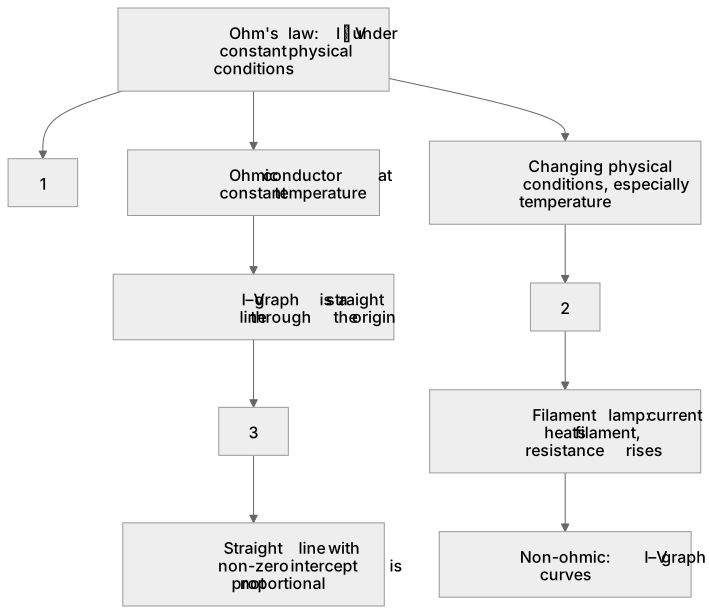
Some boxes have lost their names. Pick the right name for each number.
1Box 1
2Box 2
3Box 3
There is more to this lesson
The full lesson goes on to check your understanding and help you earn the marks. Create a free account to carry on, with your progress saved.
A week of Premium from your first lesson · Then the free plan continues · No card, no charge
Test your understanding of Current–voltage characteristics: Ohm’s law as a special case where I ∝ V under constant physical conditions.
Active recall beats re-reading. Take an instant quiz now to test what you’ve learned and lock it into long-term memory.
A week of Premium from your first lesson · Then the free plan continues · No card, no charge