AQA · A-Level · Physics
Course version: 7408 · Version from Sept 2016
Unless specifically stated in questions, ammeters and voltmeters should be…
Full specification wording
Current–voltage characteristics: Unless specifically stated in questions, ammeters and voltmeters should be treated as ideal (having zero and infinite resistance respectively).
Circuit calculations become simpler because ideal meters are assumed not to disturb the circuit.
Checked against the AQA 7408 specification (opens in a new tab) on .
- Point 3 of 4
- 4 key terms
Study notes
From the checked teaching notes for this specification point.
The idea
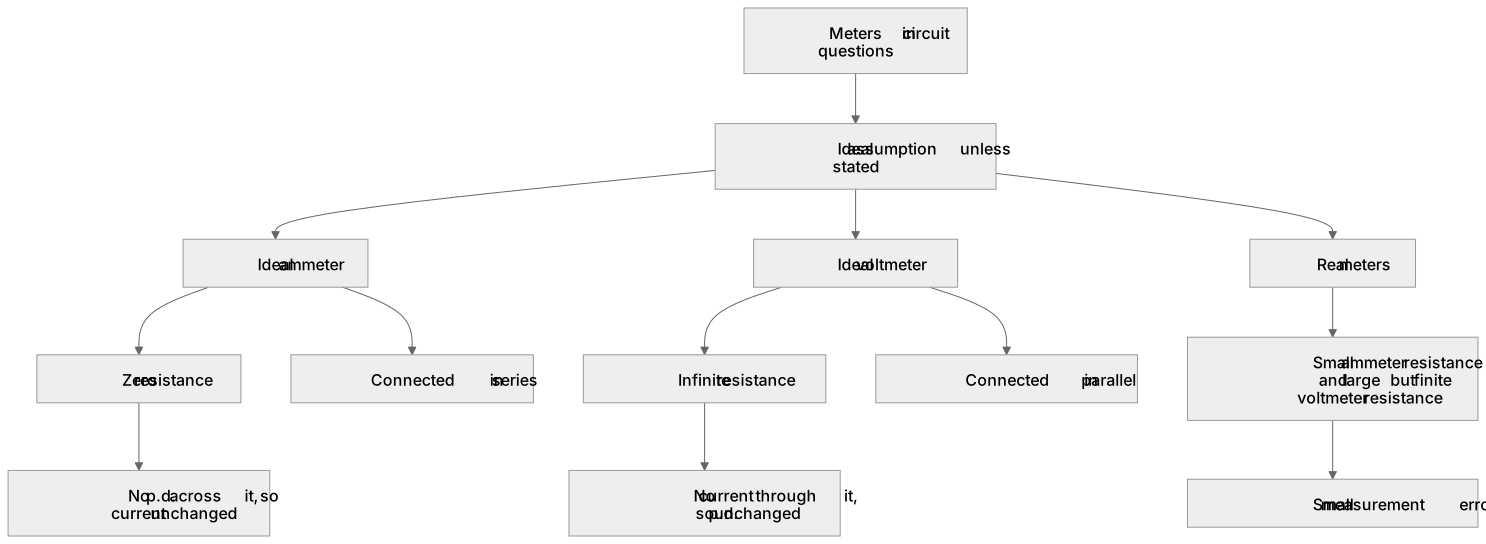
Circuit calculations become simpler because ideal meters are assumed not to disturb the circuit. An ideal ammeter is connected in series and has zero resistance, so it causes no potential difference across itself and does not reduce the current it measures. An ideal voltmeter is connected in parallel with the component and has infinite resistance, so it draws no current and does not alter the potential difference it measures. In reality, a moving-coil ammeter has a small resistance that slightly lowers the current, and a real voltmeter has a large but finite resistance that slightly lowers the measured p.d. Unless a question states otherwise, ignore these effects and treat the readings as the true values.
What earns the marks
- An ideal ammeter has zero resistance and is connected in series with the component.
- An ideal voltmeter has infinite resistance and is connected in parallel with the component.
- Zero resistance means no p.d. is dropped across an ideal ammeter, so it does not change the current.
- Infinite resistance means no current flows through an ideal voltmeter, so it does not change the p.d. across the component.
- Real meters have small but non-zero ammeter resistance and large but finite voltmeter resistance, which cause small measurement errors.
- Unless a question specifies non-ideal meters, use the ideal assumption in calculations and circuit analysis.
Common mistakes and how to put them right
Connecting a voltmeter in series or an ammeter in parallel.
Put it right by placing the voltmeter in parallel and the ammeter in series.
Assuming an ideal voltmeter carries a small current.
Put it right by treating its resistance as infinite so no current passes through it.
Including the ammeter’s resistance in series calculations when the question assumes ideal meters.
Put it right by using zero resistance unless told otherwise.
Exam tips
- Check meter positions before calculating: ammeter in series, voltmeter in parallel.
- If a question gives a meter resistance, treat the meter as a real component in the circuit rather than as ideal.
- Explain meter effects in terms of resistance changing current or potential difference, not merely as vague ‘errors’.
Try the lesson
The start of the Current–voltage characteristics: Unless specifically stated in questions, ammeters and voltmeters should be treated as ideal (having zero and infinite resistance respectively). lesson, made from checked teaching notes for this specification point.
Have a go first
In a circuit question where nothing is said about the meters, how should an ideal ammeter be treated?
Listen
Circuit calculations become simpler because ideal meters are assumed not to disturb the circuit. An ideal ammeter is connected in series and has zero resistance, so it causes no potential difference across itself and does not reduce the current it measures. An ideal voltmeter is connected in parallel with the component and has infinite resistance, so it draws no current and does not alter the potential difference it measures. In reality, a moving-coil ammeter has a small resistance that slightly lowers the current, and a real voltmeter has a large but finite resistance that slightly lowers the measured p.d. Unless a question states otherwise, ignore these effects and treat the readings as the true values. A strong answer earns marks for these points. An ideal ammeter has zero resistance and is connected in series with the component. An ideal voltmeter has infinite resistance and is connected in parallel with the component. Zero resistance means no p.d. is dropped across an ideal ammeter, so it does not change the current. Infinite resistance means no current flows through an ideal voltmeter, so it does not change the p.d. across the component. A common slip: Connecting a voltmeter in series or an ammeter in parallel. Instead, placing the voltmeter in parallel and the ammeter in series. Exam tip: Check meter positions before calculating: ammeter in series, voltmeter in parallel.
See it
Key words
Say what each word means before you turn the card.
Ideal ammeter
Try answering aloud or in your head before turning the card.
Ideal voltmeter
Try answering aloud or in your head before turning the card.
Real meters
Try answering aloud or in your head before turning the card.
Ideal assumption
Try answering aloud or in your head before turning the card.
See every definition
- Ideal ammeter
- Has zero resistance and is connected in series with the component, so no potential difference is dropped across it and it does not change the current.
- Ideal voltmeter
- Has infinite resistance and is connected in parallel with the component, so no current flows through it and it does not change the potential difference.
- Real meters
- Have small but non-zero ammeter resistance and large but finite voltmeter resistance, which cause small measurement errors.
- Ideal assumption
- Unless a question specifies non-ideal meters, treat the readings as the true values in calculations and circuit analysis.
Label the diagram
Some boxes have lost their names. Pick the right name for each number.
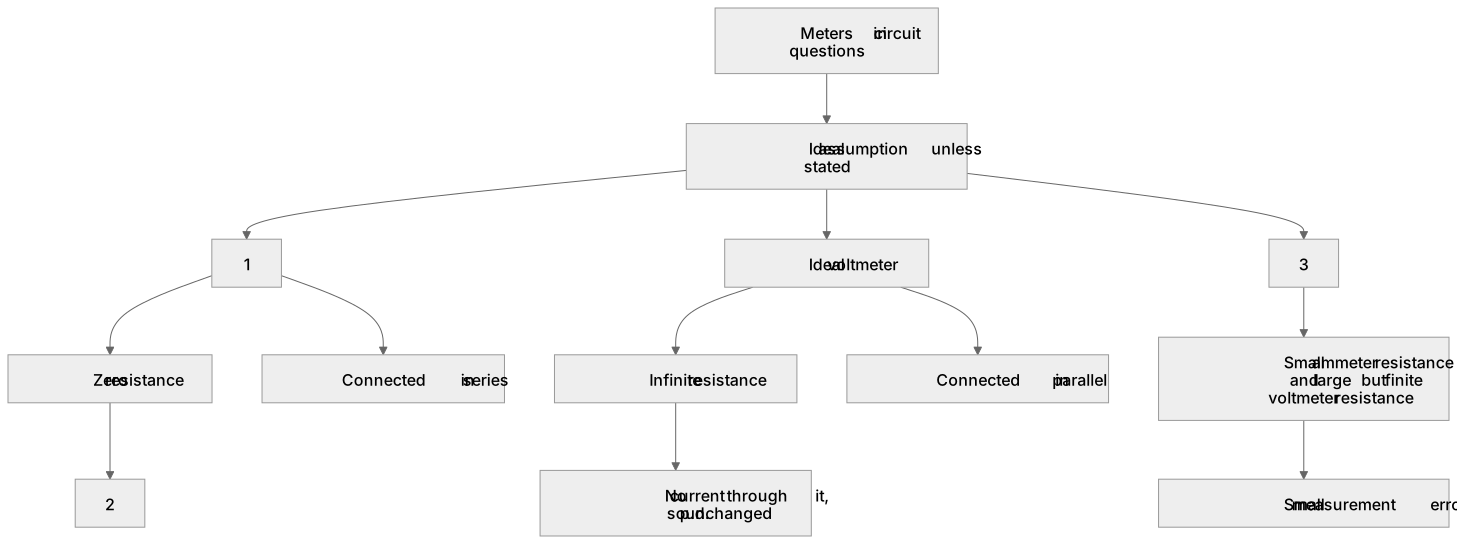
1Box 1
2Box 2
3Box 3
There is more to this lesson
The full lesson goes on to check your understanding and help you earn the marks. Create a free account to carry on, with your progress saved.
A week of Premium from your first lesson · Then the free plan continues · No card, no charge
Test your understanding of Current–voltage characteristics: Unless specifically stated in questions, ammeters and voltmeters should be treated as ideal (having zero and infinite resistance respectively).
Active recall beats re-reading. Take an instant quiz now to test what you’ve learned and lock it into long-term memory.
A week of Premium from your first lesson · Then the free plan continues · No card, no charge