AQA · A-Level · Physics
Course version: 7408 · Version from Sept 2016
Questions can be set where either I or V is on the horizontal axis of the…
Full specification wording
Current–voltage characteristics: Questions can be set where either I or V is on the horizontal axis of the characteristic graph.
A current–voltage characteristic shows how current through a component varies with potential difference.
Checked against the AQA 7408 specification (opens in a new tab) on .
- Point 4 of 4
- 4 key terms
Study notes
From the checked teaching notes for this specification point.
The idea
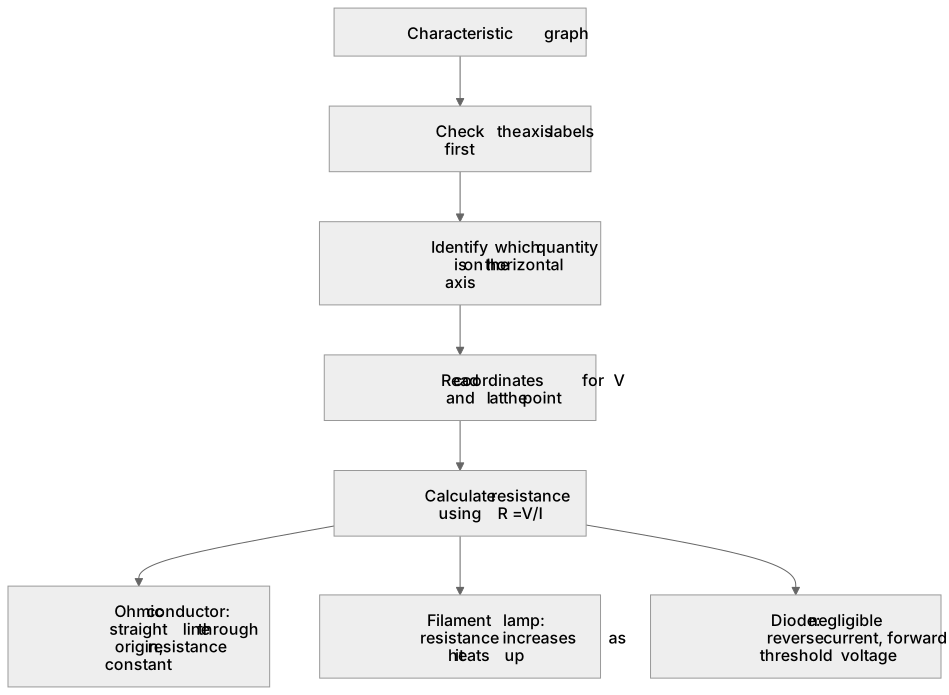
A current–voltage characteristic shows how current through a component varies with potential difference. Either quantity may be plotted on the horizontal axis, so you must read the labels carefully. Resistance at any specific point is always calculated using R = V/I, reading the coordinates directly from the graph, whether the line is curved or straight. The gradient only represents resistance (or conductance) for an ohmic conductor, where the graph is a straight line through the origin. A filament lamp curve shows resistance increasing as it heats up, while a diode conducts only above a forward threshold voltage. Always check the axes before extracting values for V and I.
What earns the marks
- Identifies which quantity is plotted on each axis before attempting any calculation from the characteristic graph.
- Calculates resistance at any given point on the graph by reading the coordinates and using the equation R = V/I.
- Recognises that for an ohmic conductor, the graph is a straight line through the origin, meaning resistance is constant and equals the inverse gradient of an I–V graph.
- Describes the diode characteristic as having negligible reverse current and a forward threshold voltage before conduction becomes significant.
- Explains the filament lamp curve in terms of increasing temperature raising the lattice vibration and so increasing resistance.
Common mistakes and how to put them right
Assuming the horizontal axis is always voltage.
Put it right: Read the axis labels first to correctly identify V and I values.
Calculating resistance of a non-ohmic component by taking the gradient of a tangent.
Put it right: Resistance at a point is always V/I using the coordinates, not the gradient.
Stating that a decreasing gradient on an I–V graph means resistance is decreasing.
Put it right: A decreasing gradient on an I–V graph (like a filament lamp) indicates that V/I is increasing, so resistance is increasing.
Exam tips
- Always read the coordinates for V and I at the specific point in question to calculate resistance using R = V/I.
- Pay close attention to the axis labels and units, especially checking for milliamperes (mA) which must be converted to amperes (A).
Try the lesson
The start of the Current–voltage characteristics: Questions can be set where either I or V is on the horizontal axis of the characteristic graph. lesson, made from checked teaching notes for this specification point.
Have a go first
A student plots a characteristic graph for a filament lamp with current I on the vertical axis and potential difference V on the horizontal axis. The graph is a curve with a decreasing gradient. If the student instead plots V on the vertical axis and I on the horizontal axis, what will be the shape of the resulting graph?
Listen
A current–voltage characteristic shows how current through a component varies with potential difference. Either quantity may be plotted on the horizontal axis, so you must read the labels carefully. Resistance at any specific point is always calculated using R = V/I, reading the coordinates directly from the graph, whether the line is curved or straight. The gradient only represents resistance (or conductance) for an ohmic conductor, where the graph is a straight line through the origin. A filament lamp curve shows resistance increasing as it heats up, while a diode conducts only above a forward threshold voltage. Always check the axes before extracting values for V and I. A strong answer earns marks for these points. Identifies which quantity is plotted on each axis before attempting any calculation from the characteristic graph. Calculates resistance at any given point on the graph by reading the coordinates and using the equation R = V/I. Recognises that for an ohmic conductor, the graph is a straight line through the origin, meaning resistance is constant and equals the inverse gradient of an I–V graph. Describes the diode characteristic as having negligible reverse current and a forward threshold voltage before conduction becomes significant. A common slip: Assuming the horizontal axis is always voltage. Instead, read the axis labels first to correctly identify V and I values. Exam tip: Always read the coordinates for V and I at the specific point in question to calculate resistance using R = V/I.
See it
Key words
Say what each word means before you turn the card.
Graph interpretation
Try answering aloud or in your head before turning the card.
Resistance calculation from coordinates
Try answering aloud or in your head before turning the card.
Ohmic and non-ohmic behaviour
Try answering aloud or in your head before turning the card.
Temperature dependence of resistance
Try answering aloud or in your head before turning the card.
See every definition
- Graph interpretation
- Reading the labels carefully to identify which quantity is plotted on each axis before extracting values for V and I.
- Resistance calculation from coordinates
- Reading the coordinates directly from the graph and using R = V/I, whether the line is curved or straight.
- Ohmic and non-ohmic behaviour
- For an ohmic conductor the graph is a straight line through the origin, while a filament lamp curve shows resistance increasing as it heats up.
- Temperature dependence of resistance
- Increasing temperature raises the lattice vibration and so increases resistance.
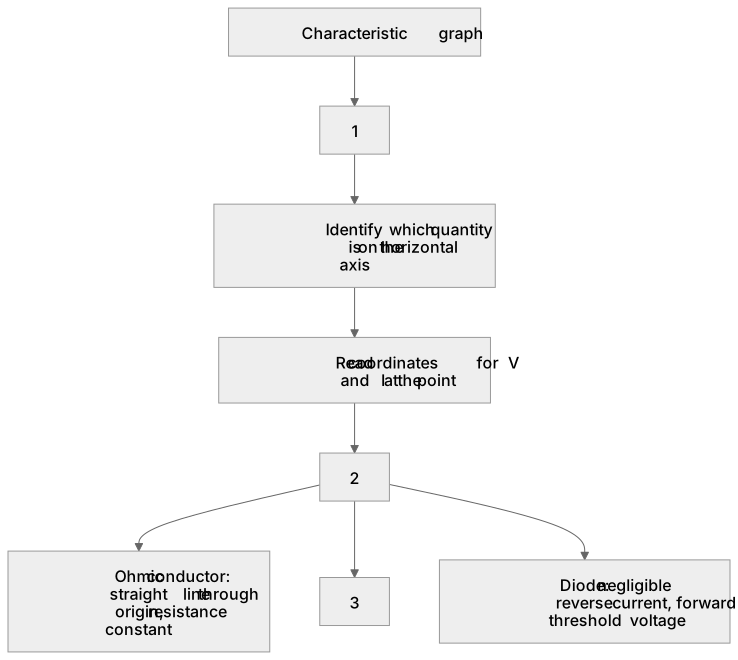
Label the diagram
Some boxes have lost their names. Pick the right name for each number.
1Box 1
2Box 2
3Box 3
There is more to this lesson
The full lesson goes on to check your understanding and help you earn the marks. Create a free account to carry on, with your progress saved.
A week of Premium from your first lesson · Then the free plan continues · No card, no charge
Test your understanding of Current–voltage characteristics: Questions can be set where either I or V is on the horizontal axis of the characteristic graph.
Active recall beats re-reading. Take an instant quiz now to test what you’ve learned and lock it into long-term memory.
A week of Premium from your first lesson · Then the free plan continues · No card, no charge