AQA · A-Level · Physics
Course version: 7408 · Version from Sept 2016
Appearance of the diffraction pattern from a single slit using…
Full specification wording
Diffraction: Appearance of the diffraction pattern from a single slit using monochromatic and white light.
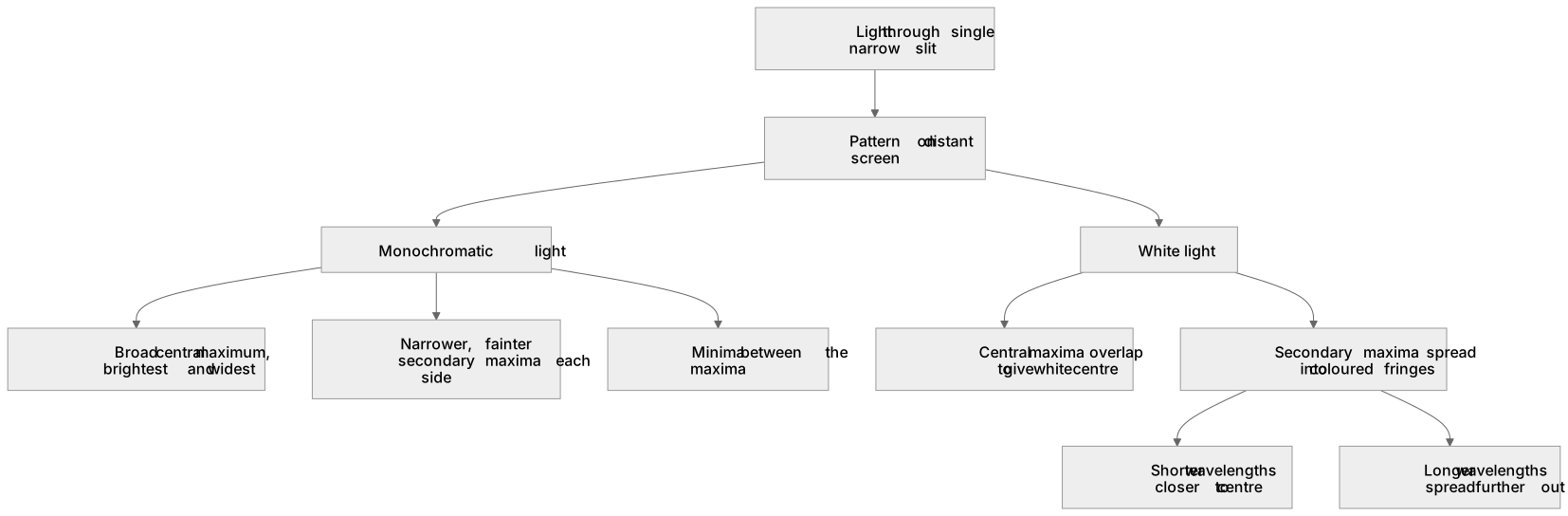
When monochromatic light passes through a single narrow slit, the pattern on a distant screen is a broad central maximum with narrower, fainter secondary maxima on each side, separated by minima.
Checked against the AQA 7408 specification (opens in a new tab) on .
- Point 1 of 5
- 4 key terms
Study notes
From the checked teaching notes for this specification point.
The idea
When monochromatic light passes through a single narrow slit, the pattern on a distant screen is a broad central maximum with narrower, fainter secondary maxima on each side, separated by minima. The central maximum is the brightest and widest feature. With white light, each wavelength produces its own pattern, so the central maxima overlap to give a white centre, while the secondary maxima spread into coloured fringes because shorter wavelengths have narrower patterns than longer wavelengths. A useful method is to shine a laser through an adjustable single slit and observe the pattern on a screen, then repeat with a white lamp. The pattern is evidence for diffraction and shows that light spreads when it passes through an aperture comparable in width to its wavelength.
What earns the marks
- Monochromatic light gives a central maximum that is much brighter and wider than the secondary maxima, with minima between the maxima.
- The intensity of the secondary maxima decreases as the order increases, so the pattern fades away from the centre.
- White light gives a white central maximum because all wavelengths overlap there.
- The secondary maxima from white light are coloured, with the shorter wavelengths closer to the centre and the longer wavelengths spread further out.
- The pattern is only clearly observed when the slit width is comparable to the wavelength of the light used.
Common mistakes and how to put them right
Thinking that the central maximum is narrower than the secondary maxima.
Put it right: The central maximum is the widest and brightest part of the pattern.
Believing that white light produces a white pattern throughout.
Put it right: Only the central maximum is white, while the secondary maxima are coloured.
Assuming that the pattern is the same for all slit widths.
Put it right: The pattern becomes narrower and less spread out as the slit width increases.
Exam tips
- Sketch the pattern with a wide central maximum and progressively fainter secondary maxima, labelling the central maximum clearly.
- For white light, state that the central maximum is white and that the secondary maxima are coloured, with blue nearer the centre than red.
- Use the phrase 'monochromatic light' correctly to mean light of a single wavelength or colour, and contrast it with white light in your answer.
Try the lesson
The start of the Diffraction: Appearance of the diffraction pattern from a single slit using monochromatic and white light. lesson, made from checked teaching notes for this specification point.
Have a go first
A single slit is illuminated with monochromatic red light. What is seen on a distant screen?
Listen
When monochromatic light passes through a single narrow slit, the pattern on a distant screen is a broad central maximum with narrower, fainter secondary maxima on each side, separated by minima. The central maximum is the brightest and widest feature. With white light, each wavelength produces its own pattern, so the central maxima overlap to give a white centre, while the secondary maxima spread into coloured fringes because shorter wavelengths have narrower patterns than longer wavelengths. A useful method is to shine a laser through an adjustable single slit and observe the pattern on a screen, then repeat with a white lamp. The pattern is evidence for diffraction and shows that light spreads when it passes through an aperture comparable in width to its wavelength. A strong answer earns marks for these points. Monochromatic light gives a central maximum that is much brighter and wider than the secondary maxima, with minima between the maxima. The intensity of the secondary maxima decreases as the order increases, so the pattern fades away from the centre. White light gives a white central maximum because all wavelengths overlap there. The secondary maxima from white light are coloured, with the shorter wavelengths closer to the centre and the longer wavelengths spread further out. A common slip: Thinking that the central maximum is narrower than the secondary maxima. Instead, the central maximum is the widest and brightest part of the pattern. Exam tip: Sketch the pattern with a wide central maximum and progressively fainter secondary maxima, labelling the central maximum clearly.
See it
Key words
Say what each word means before you turn the card.
Monochromatic light
Try answering aloud or in your head before turning the card.
White light
Try answering aloud or in your head before turning the card.
Central maximum
Try answering aloud or in your head before turning the card.
Secondary maxima
Try answering aloud or in your head before turning the card.
See every definition
- Monochromatic light
- Light of a single wavelength or colour, which through a single narrow slit gives a broad central maximum with narrower, fainter secondary maxima on each side.
- White light
- Light whose wavelengths each produce their own pattern, so the central maxima overlap to give a white centre while the secondary maxima spread into coloured fringes.
- Central maximum
- The brightest and widest feature of the pattern, with narrower, fainter secondary maxima on each side separated by minima.
- Secondary maxima
- Features on each side of the central maximum that are narrower and fainter, with intensity decreasing as the order increases so the pattern fades away from the centre.
Label the diagram
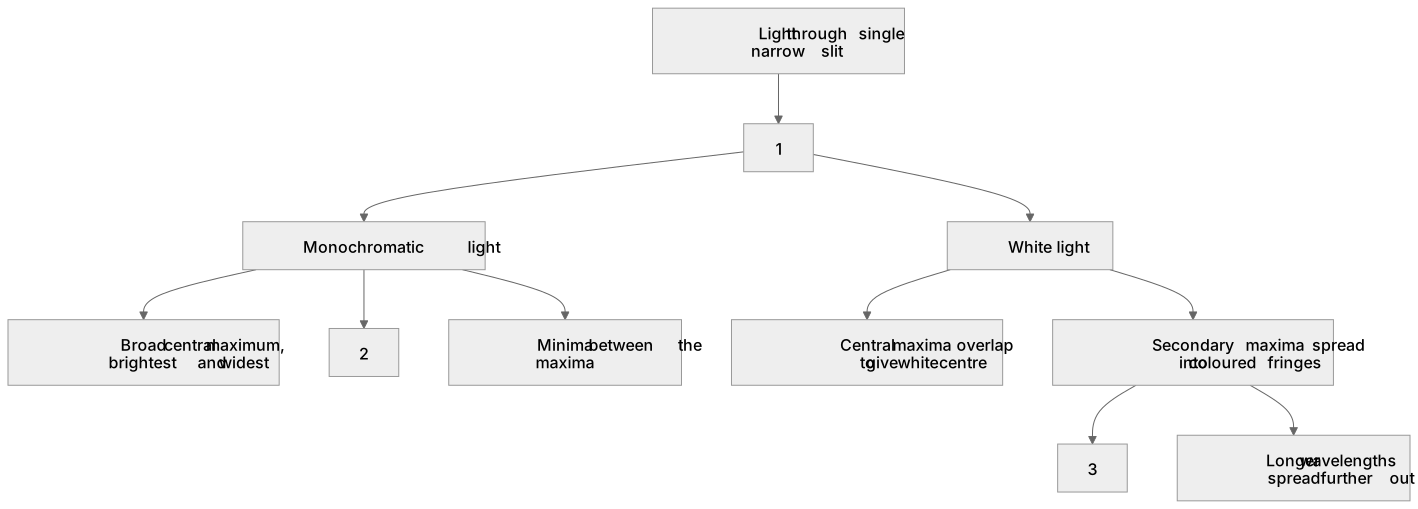
Some boxes have lost their names. Pick the right name for each number.
1Box 1
2Box 2
3Box 3
There is more to this lesson
The full lesson goes on to check your understanding and help you earn the marks. Create a free account to carry on, with your progress saved.
A week of Premium from your first lesson · Then the free plan continues · No card, no charge
Test your understanding of Diffraction: Appearance of the diffraction pattern from a single slit using monochromatic and white light.
Active recall beats re-reading. Take an instant quiz now to test what you’ve learned and lock it into long-term memory.
A week of Premium from your first lesson · Then the free plan continues · No card, no charge