AQA · A-Level · Physics
Course version: 7408 · Version from Sept 2016
Qualitative treatment of the variation of the width of the central…
Full specification wording
Diffraction: Qualitative treatment of the variation of the width of the central diffraction maximum with wavelength and slit width.
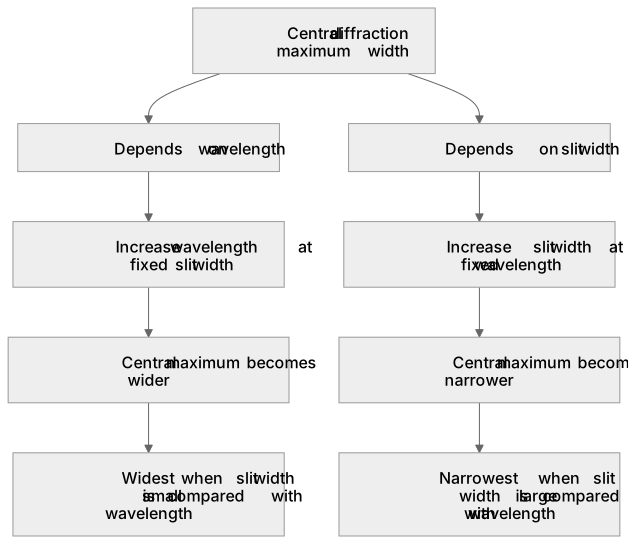
The width of the central diffraction maximum depends on both the wavelength of the light and the width of the slit.
Checked against the AQA 7408 specification (opens in a new tab) on .
- Point 2 of 5
- 4 key terms
Study notes
From the checked teaching notes for this specification point.
The idea
The width of the central diffraction maximum depends on both the wavelength of the light and the width of the slit. For a given slit width, increasing the wavelength makes the central maximum wider, so red light produces a broader central maximum than blue light. For a given wavelength, increasing the slit width makes the central maximum narrower, so a wider slit gives a tighter pattern. This is a qualitative relationship: the central maximum is widest when the wavelength is large compared with the slit width, and narrowest when the slit is wide compared with the wavelength. A practical way to see this is to shine a laser through a single slit and gradually narrow the slit; the central maximum spreads out as the slit becomes narrower.
What earns the marks
- For a fixed slit width, the central maximum becomes wider as the wavelength increases.
- For a fixed wavelength, the central maximum becomes narrower as the slit width increases.
- The central maximum is widest when the slit width is small compared with the wavelength.
- The central maximum is narrowest when the slit width is large compared with the wavelength.
- The relationship is qualitative: no calculation is required, but the direction of change must be stated correctly.
Common mistakes and how to put them right
Stating that increasing the slit width makes the central maximum wider.
Put it right: Increasing the slit width makes the central maximum narrower.
Stating that increasing the wavelength makes the central maximum narrower.
Put it right: Increasing the wavelength makes the central maximum wider.
Confusing the width of the central maximum with its brightness.
Put it right: Brightness and width are separate features, and the question asks about width.
Exam tips
- Use comparative language such as 'wider', 'narrower', 'increases' and 'decreases' to make the direction of change clear.
- Link the effect to the ratio of wavelength to slit width, for example by saying that a smaller slit width relative to the wavelength gives a wider central maximum.
- When comparing red and blue light through the same slit, state that red light gives a wider central maximum than blue light because red has a longer wavelength.
Try the lesson
The start of the Diffraction: Qualitative treatment of the variation of the width of the central diffraction maximum with wavelength and slit width. lesson, made from checked teaching notes for this specification point.
Have a go first
A single slit is made narrower while the wavelength of the light is kept the same. What happens to the width of the central diffraction maximum?
Listen
The width of the central diffraction maximum depends on both the wavelength of the light and the width of the slit. For a given slit width, increasing the wavelength makes the central maximum wider, so red light produces a broader central maximum than blue light. For a given wavelength, increasing the slit width makes the central maximum narrower, so a wider slit gives a tighter pattern. This is a qualitative relationship: the central maximum is widest when the wavelength is large compared with the slit width, and narrowest when the slit is wide compared with the wavelength. A practical way to see this is to shine a laser through a single slit and gradually narrow the slit; the central maximum spreads out as the slit becomes narrower. A strong answer earns marks for these points. For a fixed slit width, the central maximum becomes wider as the wavelength increases. For a fixed wavelength, the central maximum becomes narrower as the slit width increases. The central maximum is widest when the slit width is small compared with the wavelength. The central maximum is narrowest when the slit width is large compared with the wavelength. A common slip: Stating that increasing the slit width makes the central maximum wider. Instead, increasing the slit width makes the central maximum narrower. Exam tip: Use comparative language such as 'wider', 'narrower', 'increases' and 'decreases' to make the direction of change clear.
See it
Key words
Say what each word means before you turn the card.
Wavelength dependence of diffraction
Try answering aloud or in your head before turning the card.
Slit width and diffraction spreading
Try answering aloud or in your head before turning the card.
Qualitative reasoning in wave optics
Try answering aloud or in your head before turning the card.
Experimental control of diffraction variables
Try answering aloud or in your head before turning the card.
See every definition
- Wavelength dependence of diffraction
- For a given slit width, increasing the wavelength makes the central maximum wider, so red light produces a broader central maximum than blue light.
- Slit width and diffraction spreading
- For a given wavelength, increasing the slit width makes the central maximum narrower, so a wider slit gives a tighter pattern.
- Qualitative reasoning in wave optics
- The relationship is qualitative: no calculation is required, but the direction of change must be stated correctly.
- Experimental control of diffraction variables
- Shining a laser through a single slit and gradually narrowing the slit shows the central maximum spreading out as the slit becomes narrower.
Label the diagram
Some boxes have lost their names. Pick the right name for each number.
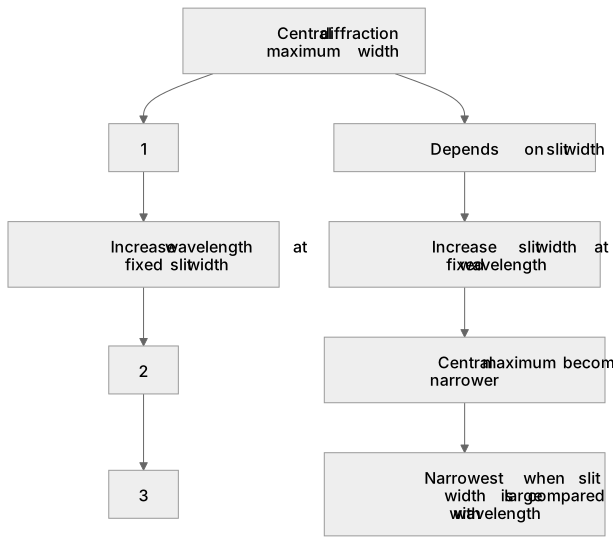
1Box 1
2Box 2
3Box 3
There is more to this lesson
The full lesson goes on to check your understanding and help you earn the marks. Create a free account to carry on, with your progress saved.
A week of Premium from your first lesson · Then the free plan continues · No card, no charge
Test your understanding of Diffraction: Qualitative treatment of the variation of the width of the central diffraction maximum with wavelength and slit width.
Active recall beats re-reading. Take an instant quiz now to test what you’ve learned and lock it into long-term memory.
A week of Premium from your first lesson · Then the free plan continues · No card, no charge