AQA · A-Level · Physics
Course version: 7408 · Version from Sept 2016
Diffraction: Applications of diffraction gratings.
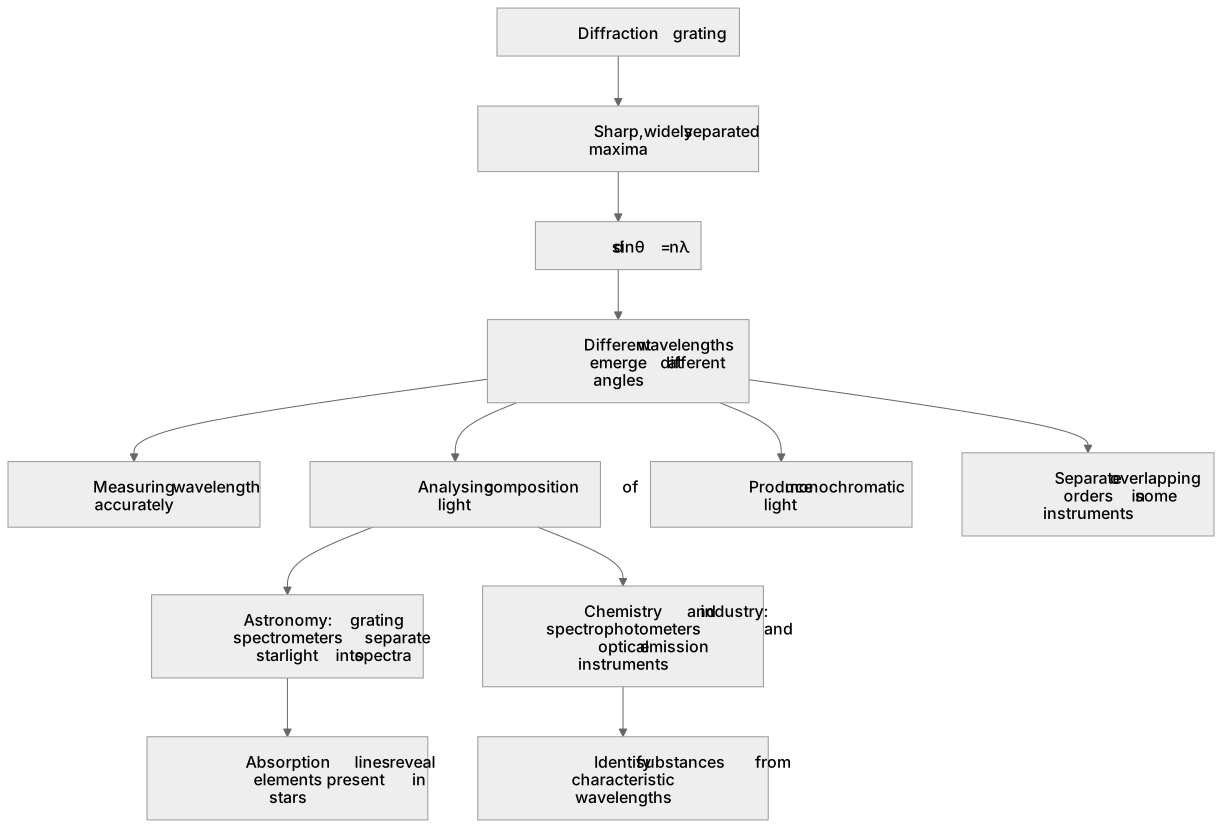
Diffraction gratings split light into sharp, widely separated maxima because many slits reinforce constructively at precise angles given by d sinθ = nλ.
Checked against the AQA 7408 specification (opens in a new tab) on .
- Point 5 of 5
- 4 key terms
Study notes
From the checked teaching notes for this specification point.
The idea
Diffraction gratings split light into sharp, widely separated maxima because many slits reinforce constructively at precise angles given by d sinθ = nλ. This makes them useful for measuring wavelength accurately and for analysing the composition of light. In astronomy, grating spectrometers separate starlight into spectra so that absorption lines reveal elements present in stars. In chemistry and industry, gratings are used in spectrophotometers and optical emission instruments to identify substances from their characteristic wavelengths. They also separate overlapping orders in some instruments and can be used to produce monochromatic light. The key idea is that the grating angle depends on wavelength, so different wavelengths emerge at different angles, enabling precise spectral analysis.
What earns the marks
- Explain that a diffraction grating produces sharp maxima at angles determined by d sinθ = nλ, allowing wavelength measurement.
- Describe how a grating separates light into its component wavelengths, producing a spectrum that can be analysed.
- Give a specific application such as spectroscopy in astronomy to identify elements in stars from absorption or emission lines.
- Explain the use of gratings in spectrophotometers or similar instruments to select or analyse particular wavelengths.
- Compare gratings with prisms, noting that gratings give more widely separated and more precisely measurable wavelengths.
- Use the equation to explain why a grating can resolve two close wavelengths when the order or number of slits is sufficient.
Common mistakes and how to put them right
Assuming a grating produces a continuous rainbow like a prism.
Put it right by stating that a grating gives discrete orders at specific angles for each wavelength.
Thinking that all wavelengths diffract by the same angle.
Put it right by using d sinθ = nλ to show that θ depends on λ.
Confusing the order number n with the number of slits.
Put it right by defining n as the order of the maximum and the number of slits as N.
Exam tips
- Link each application explicitly to the grating equation, for example by stating that different λ values give different θ values.
- Use precise terminology such as monochromatic, spectral line and order when describing applications.
- When comparing gratings with prisms, refer to the sharpness and angular separation of maxima rather than vague statements about accuracy.
Try the lesson
The start of the Diffraction: Applications of diffraction gratings. lesson, made from checked teaching notes for this specification point.
Have a go first
Which statement describes a practical use of a diffraction grating?
Listen
Diffraction gratings split light into sharp, widely separated maxima because many slits reinforce constructively at precise angles given by d sinθ = nλ. This makes them useful for measuring wavelength accurately and for analysing the composition of light. In astronomy, grating spectrometers separate starlight into spectra so that absorption lines reveal elements present in stars. In chemistry and industry, gratings are used in spectrophotometers and optical emission instruments to identify substances from their characteristic wavelengths. They also separate overlapping orders in some instruments and can be used to produce monochromatic light. The key idea is that the grating angle depends on wavelength, so different wavelengths emerge at different angles, enabling precise spectral analysis. A strong answer earns marks for these points. Explain that a diffraction grating produces sharp maxima at angles determined by d sinθ = nλ, allowing wavelength measurement. Describe how a grating separates light into its component wavelengths, producing a spectrum that can be analysed. Give a specific application such as spectroscopy in astronomy to identify elements in stars from absorption or emission lines. Explain the use of gratings in spectrophotometers or similar instruments to select or analyse particular wavelengths. A common slip: Assuming a grating produces a continuous rainbow like a prism. Instead, stating that a grating gives discrete orders at specific angles for each wavelength. Exam tip: Link each application explicitly to the grating equation, for example by stating that different λ values give different θ values.
See it
Key words
Say what each word means before you turn the card.
Spectroscopy and spectral analysis
Try answering aloud or in your head before turning the card.
Measurement of wavelength
Try answering aloud or in your head before turning the card.
Monochromatic light
Try answering aloud or in your head before turning the card.
Spectrum
Try answering aloud or in your head before turning the card.
See every definition
- Spectroscopy and spectral analysis
- Using a grating to separate light into a spectrum so that its component wavelengths can be analysed.
- Measurement of wavelength
- Using the grating equation d sinθ = nλ, since the angle depends on wavelength, to measure wavelength accurately.
- Monochromatic light
- Light of a single wavelength, which a diffraction grating can be used to produce.
- Spectrum
- The component wavelengths of light separated by a grating, which can then be analysed.
Label the diagram
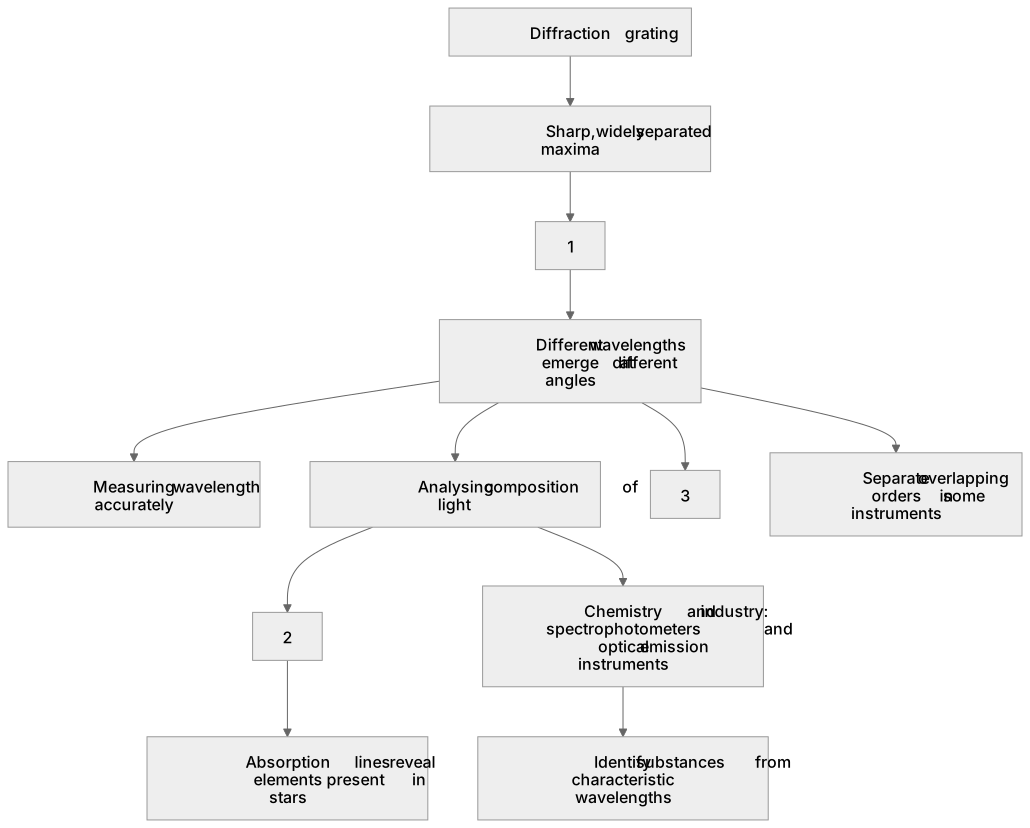
Some boxes have lost their names. Pick the right name for each number.
1Box 1
2Box 2
3Box 3
There is more to this lesson
The full lesson goes on to check your understanding and help you earn the marks. Create a free account to carry on, with your progress saved.
A week of Premium from your first lesson · Then the free plan continues · No card, no charge
Test your understanding of Diffraction: Applications of diffraction gratings.
Active recall beats re-reading. Take an instant quiz now to test what you’ve learned and lock it into long-term memory.
A week of Premium from your first lesson · Then the free plan continues · No card, no charge