AQA · A-Level · Physics
Course version: 7408 · Version from Sept 2016
Derivation of dsinθ = nλ Use of the spectrometer will not be tested.
Full specification wording
Diffraction: Derivation of dsinθ = nλ Use of the spectrometer will not be tested.
The grating equation d sinθ = nλ links the spacing d between adjacent slits, the diffraction angle θ and the wavelength λ for the nth order maximum.
Checked against the AQA 7408 specification (opens in a new tab) on .
- Point 4 of 5
- 4 key terms
Study notes
From the checked teaching notes for this specification point.
The idea
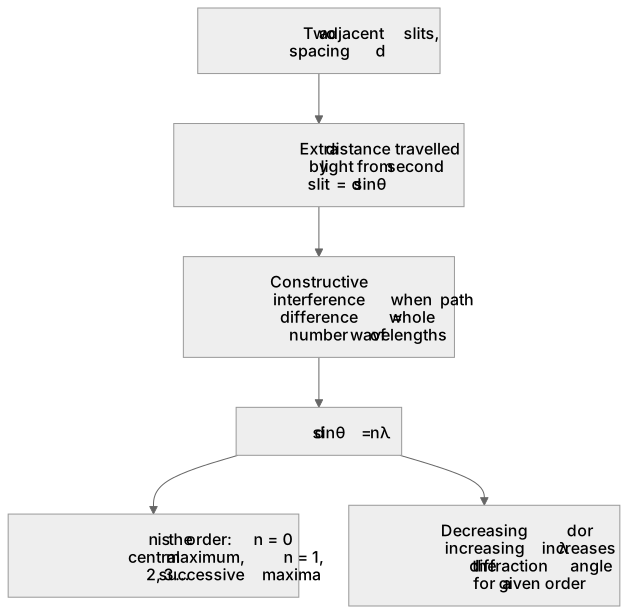
The grating equation d sinθ = nλ links the spacing d between adjacent slits, the diffraction angle θ and the wavelength λ for the nth order maximum. Derive it by considering two adjacent slits: the extra distance travelled by light from the second slit is d sinθ. For constructive interference this path difference must equal a whole number of wavelengths, nλ, giving d sinθ = nλ. The equation shows that larger λ or smaller d spreads the pattern more, and that n counts the order. Although you must be able to derive and use the equation, practical work with a spectrometer is not examined, so focus on the geometry, the meaning of each symbol and calculations involving d, θ, n and λ.
What earns the marks
- State that the path difference between light from two adjacent slits is d sinθ, where d is the slit spacing and θ is the angle from the straight-through direction.
- Explain that constructive interference occurs when the path difference equals a whole number of wavelengths, so d sinθ = nλ.
- Identify n as the order of the maximum, with n = 0 for the central maximum and n = 1, 2, 3 … for successive maxima.
- Use the equation to calculate d, θ, n or λ, converting angles to radians where required and using sinθ correctly.
- Recognise that the derivation applies to any pair of adjacent slits and that all such pairs reinforce at the same angle.
- Explain how the equation predicts that decreasing d or increasing λ increases the diffraction angle for a given order.
Common mistakes and how to put them right
Using the angle from the grating surface instead of the angle from the normal.
Put it right by measuring θ between the diffracted ray and the straight-through direction.
Treating d as the number of lines per metre rather than the slit spacing.
Put it right by using d = 1 / N, where N is the number of lines per metre.
Forgetting that n must be an integer for a maximum.
Put it right by checking that the calculated order is a whole number and rejecting non-integer values.
Exam tips
- Sketch two adjacent slits and mark the path difference d sinθ before writing the equation; this makes the derivation clear and earns method credit.
- When calculating, keep d and λ in the same unit, usually metres, and give the angle to an appropriate number of significant figures.
- If asked to derive the equation, state the condition for constructive interference explicitly rather than just quoting d sinθ = nλ.
Try the lesson
The start of the Diffraction: Derivation of dsinθ = nλ Use of the spectrometer will not be tested. lesson, made from checked teaching notes for this specification point.
Have a go first
In the grating equation d sinθ = nλ, what does the symbol d represent?
Listen
The grating equation d sinθ = nλ links the spacing d between adjacent slits, the diffraction angle θ and the wavelength λ for the nth order maximum. Derive it by considering two adjacent slits: the extra distance travelled by light from the second slit is d sinθ. For constructive interference this path difference must equal a whole number of wavelengths, nλ, giving d sinθ = nλ. The equation shows that larger λ or smaller d spreads the pattern more, and that n counts the order. Although you must be able to derive and use the equation, practical work with a spectrometer is not examined, so focus on the geometry, the meaning of each symbol and calculations involving d, θ, n and λ. A strong answer earns marks for these points. State that the path difference between light from two adjacent slits is d sinθ, where d is the slit spacing and θ is the angle from the straight-through direction. Explain that constructive interference occurs when the path difference equals a whole number of wavelengths, so d sinθ = nλ. Identify n as the order of the maximum, with n = 0 for the central maximum and n = 1, 2, 3 … for successive maxima. Use the equation to calculate d, θ, n or λ, converting angles to radians where required and using sinθ correctly. A common slip: Using the angle from the grating surface instead of the angle from the normal. Instead, measuring θ between the diffracted ray and the straight-through direction. Exam tip: Sketch two adjacent slits and mark the path difference d sinθ before writing the equation; this makes the derivation clear and earns method credit.
See it
Key words
Say what each word means before you turn the card.
Path difference
Try answering aloud or in your head before turning the card.
Constructive interference
Try answering aloud or in your head before turning the card.
Order of the maximum
Try answering aloud or in your head before turning the card.
Slit spacing
Try answering aloud or in your head before turning the card.
See every definition
- Path difference
- The extra distance travelled by light from the second slit compared with the first of two adjacent slits, equal to d sinθ.
- Constructive interference
- Occurs when the path difference between light from two adjacent slits equals a whole number of wavelengths, nλ.
- Order of the maximum
- The value n, with n = 0 for the central maximum and n = 1, 2, 3 … for successive maxima.
- Slit spacing
- The spacing d between adjacent slits, which with the diffraction angle θ and wavelength λ gives the grating equation.
Label the diagram
Some boxes have lost their names. Pick the right name for each number.
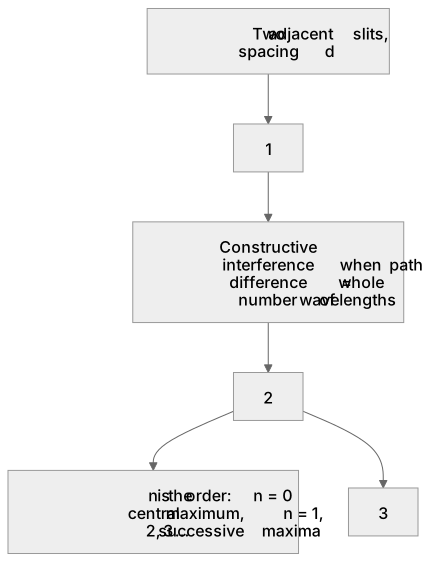
1Box 1
2Box 2
3Box 3
There is more to this lesson
The full lesson goes on to check your understanding and help you earn the marks. Create a free account to carry on, with your progress saved.
A week of Premium from your first lesson · Then the free plan continues · No card, no charge
Test your understanding of Diffraction: Derivation of dsinθ = nλ Use of the spectrometer will not be tested.
Active recall beats re-reading. Take an instant quiz now to test what you’ve learned and lock it into long-term memory.
A week of Premium from your first lesson · Then the free plan continues · No card, no charge