AQA · A-Level · Physics
Course version: 7408 · Version from Sept 2016
No work done moving charge along an equipotential surface.
Full specification wording
Electric potential (A-level only): No work done moving charge along an equipotential surface.
An equipotential surface is a surface on which the electric potential is constant.
Checked against the AQA 7408 specification (opens in a new tab) on .
- Point 3 of 3
- 3 key terms
Study notes
From the checked teaching notes for this specification point.
The idea
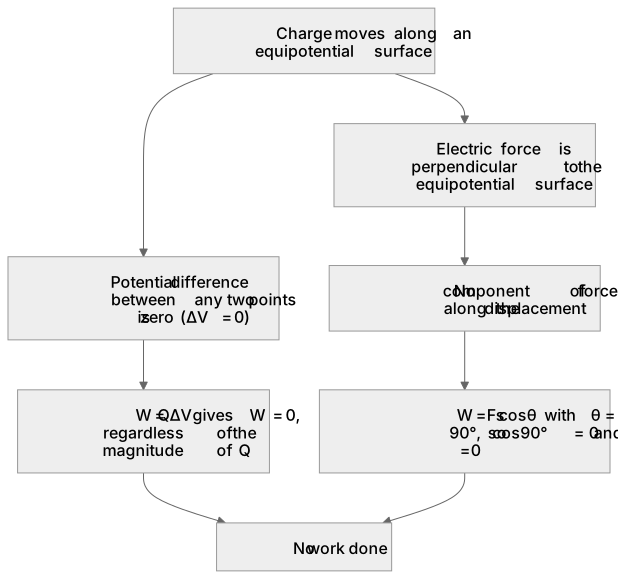
An equipotential surface is a surface on which the electric potential is constant. Since potential difference ΔV between any two points on the surface is zero, the work done W = QΔV is also zero. This is because the electric force is always perpendicular to the equipotential surface, so the component of force along the direction of motion is zero. For example, moving a charge around a circular equipotential centred on a point charge requires no work, even though the charge experiences a force. This principle is used in understanding conductors in electrostatic equilibrium, where the surface is an equipotential, and in the design of particle accelerators where particles move along equipotentials without energy change.
What earns the marks
- State that on an equipotential surface, the potential difference between any two points is zero (ΔV = 0).
- Apply W = QΔV to show that if ΔV = 0, then W = 0, regardless of the magnitude of Q.
- Explain that the electric force is perpendicular to the equipotential surface, so the force has no component along the displacement.
- Relate this to the definition of work done: W = Fs cosθ, where θ = 90°, so cos90° = 0 and W = 0.
- Give a practical example, such as a charge moving on a spherical equipotential around a point charge, or a charge moving along the surface of a charged conductor.
Common mistakes and how to put them right
Assuming that because a force acts on the charge, work must be done.
Put it right: Work depends on the component of force along the displacement; perpendicular forces do no work.
Thinking that moving along an equipotential changes the potential energy of the charge.
Put it right: Potential energy depends on potential, which is constant, so it does not change.
Confusing equipotential surfaces with electric field lines.
Put it right: Equipotentials are perpendicular to field lines and represent constant potential, while field lines show the direction of force on a positive charge.
Exam tips
- When asked why no work is done, explicitly state that ΔV = 0 and that the electric force is perpendicular to the displacement.
- Use the equation W = QΔV to justify the zero work done, and mention that Q is not zero but ΔV is zero.
- If a diagram is given, identify the equipotential surface and show that the path lies along it, then explain the perpendicularity of force and motion.
Try the lesson
The start of the Electric potential (A-level only): No work done moving charge along an equipotential surface. lesson, made from checked teaching notes for this specification point.
Have a go first
A charge is moved from one point to another on the same equipotential surface. What is the work done in moving the charge?
Listen
An equipotential surface is a surface on which the electric potential is constant. Since potential difference ΔV between any two points on the surface is zero, the work done W = QΔV is also zero. This is because the electric force is always perpendicular to the equipotential surface, so the component of force along the direction of motion is zero. For example, moving a charge around a circular equipotential centred on a point charge requires no work, even though the charge experiences a force. This principle is used in understanding conductors in electrostatic equilibrium, where the surface is an equipotential, and in the design of particle accelerators where particles move along equipotentials without energy change. A strong answer earns marks for these points. State that on an equipotential surface, the potential difference between any two points is zero (ΔV = 0). Apply W = QΔV to show that if ΔV = 0, then W = 0, regardless of the magnitude of Q. Explain that the electric force is perpendicular to the equipotential surface, so the force has no component along the displacement. Relate this to the definition of work done: W = Fs cosθ, where θ = 90°, so cos90° = 0 and W = 0. A common slip: Assuming that because a force acts on the charge, work must be done. Instead, work depends on the component of force along the displacement; perpendicular forces do no work. Exam tip: When asked why no work is done, explicitly state that ΔV = 0 and that the electric force is perpendicular to the displacement.
See it
Key words
Say what each word means before you turn the card.
Equipotential surfaces
Try answering aloud or in your head before turning the card.
Work done in electric fields
Try answering aloud or in your head before turning the card.
Perpendicularity of force and displacement
Try answering aloud or in your head before turning the card.
See every definition
- Equipotential surfaces
- A surface on which the electric potential is constant, so the potential difference between any two points on it is zero.
- Work done in electric fields
- Given by W = QΔV, so it is zero when ΔV is zero, regardless of the magnitude of Q.
- Perpendicularity of force and displacement
- The electric force is always perpendicular to the equipotential surface, so the force has no component along the displacement.
Label the diagram
Some boxes have lost their names. Pick the right name for each number.
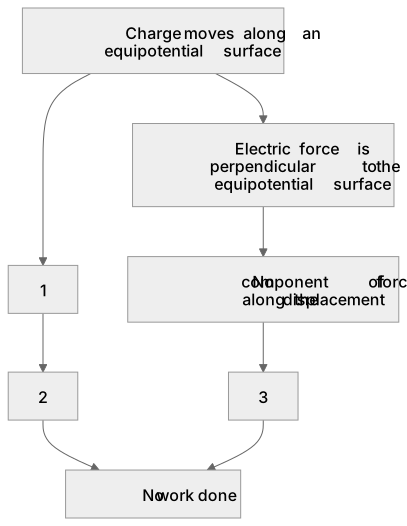
1Box 1
2Box 2
3Box 3
There is more to this lesson
The full lesson goes on to check your understanding and help you earn the marks. Create a free account to carry on, with your progress saved.
A week of Premium from your first lesson · Then the free plan continues · No card, no charge
Test your understanding of Electric potential (A-level only): No work done moving charge along an equipotential surface.
Active recall beats re-reading. Take an instant quiz now to test what you’ve learned and lock it into long-term memory.
A week of Premium from your first lesson · Then the free plan continues · No card, no charge