AQA · A-Level · Physics
Course version: 7408 · Version from Sept 2016
Hertz’s discovery of radio waves including measurements of the speed of…
Full specification wording
Electromagnetic waves (A-level only): Hertz’s discovery of radio waves including measurements of the speed of radio waves.
Hertz generated and detected radio waves using a spark-gap transmitter and a resonant loop receiver.
Checked against the AQA 7408 specification (opens in a new tab) on .
- Point 2 of 3
- 4 key terms
Study notes
From the checked teaching notes for this specification point.
The idea
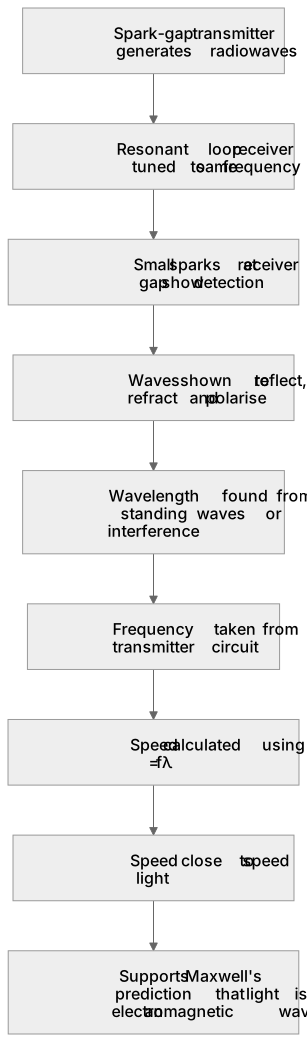
Hertz generated and detected radio waves using a spark-gap transmitter and a resonant loop receiver. A high-voltage spark across a gap produced oscillating charges, radiating electromagnetic waves. When the receiver loop was tuned to the same frequency, small sparks appeared across its gap, demonstrating reception. Hertz showed the waves could be reflected, refracted and polarised, confirming their electromagnetic nature. He measured their speed by relating wavelength to frequency: he determined wavelength from standing-wave patterns or interference and frequency from the transmitter circuit, then used v = fλ. His results agreed with the speed of light, supporting Maxwell’s prediction that light is an electromagnetic wave.
What earns the marks
- Hertz used a spark-gap transmitter to generate radio waves and a resonant loop receiver to detect them.
- Detection relied on tuning the receiver to the transmitter frequency so that resonance produced detectable sparks.
- Hertz demonstrated reflection, refraction and polarisation of radio waves, supporting their electromagnetic wave nature.
- He measured wavelength using standing waves or interference and frequency from the transmitter, then calculated speed using v = fλ.
- The measured speed was close to the speed of light, providing evidence that light is an electromagnetic wave.
- Hertz’s work confirmed Maxwell’s theoretical prediction of electromagnetic waves.
Common mistakes and how to put them right
Thinking Hertz discovered radio waves by accident without measurement.
Put it right by stating he deliberately generated, detected and measured their speed.
Confusing the roles of transmitter and receiver.
Put it right by stating the spark-gap transmitter radiates and the loop receiver detects via resonance.
Using c = fλ with the measured frequency and wavelength without recognising that the result is compared with the speed of light.
Put it right by stating the comparison supports Maxwell’s theory.
Exam tips
- Describe the apparatus clearly: spark gap, induction coil, loop with small gap, and how sparks indicate detection.
- Explain how wavelength was found from the distance between nodes or interference fringes, and frequency from the oscillator circuit.
- Link the measured speed to the speed of light to explain the significance for Maxwell’s theory.
Try the lesson
The start of the Electromagnetic waves (A-level only): Hertz’s discovery of radio waves including measurements of the speed of radio waves. lesson, made from checked teaching notes for this specification point.
Have a go first
In Hertz’s experiments with radio waves, what did he use to detect the radio waves produced by his spark gap?
Listen
Hertz generated and detected radio waves using a spark-gap transmitter and a resonant loop receiver. A high-voltage spark across a gap produced oscillating charges, radiating electromagnetic waves. When the receiver loop was tuned to the same frequency, small sparks appeared across its gap, demonstrating reception. Hertz showed the waves could be reflected, refracted and polarised, confirming their electromagnetic nature. He measured their speed by relating wavelength to frequency: he determined wavelength from standing-wave patterns or interference and frequency from the transmitter circuit, then used v = fλ. His results agreed with the speed of light, supporting Maxwell’s prediction that light is an electromagnetic wave. A strong answer earns marks for these points. Hertz used a spark-gap transmitter to generate radio waves and a resonant loop receiver to detect them. Detection relied on tuning the receiver to the transmitter frequency so that resonance produced detectable sparks. Hertz demonstrated reflection, refraction and polarisation of radio waves, supporting their electromagnetic wave nature. He measured wavelength using standing waves or interference and frequency from the transmitter, then calculated speed using v = fλ. A common slip: Thinking Hertz discovered radio waves by accident without measurement. Instead, stating he deliberately generated, detected and measured their speed. Exam tip: Describe the apparatus clearly: spark gap, induction coil, loop with small gap, and how sparks indicate detection.
See it
Key words
Say what each word means before you turn the card.
Experimental generation and detection of radio waves
Try answering aloud or in your head before turning the card.
Resonance in receiver circuits
Try answering aloud or in your head before turning the card.
Measurement of speed using v = fλ
Try answering aloud or in your head before turning the card.
Evidence for Maxwell’s electromagnetic theory of light
Try answering aloud or in your head before turning the card.
See every definition
- Experimental generation and detection of radio waves
- A high-voltage spark across a gap produced oscillating charges that radiated electromagnetic waves, and a resonant loop receiver tuned to the same frequency showed small sparks across its gap.
- Resonance in receiver circuits
- Detection relied on tuning the receiver to the transmitter frequency so that resonance produced detectable sparks.
- Measurement of speed using v = fλ
- Wavelength was determined from standing-wave patterns or interference and frequency from the transmitter circuit, then speed was calculated using v = fλ.
- Evidence for Maxwell’s electromagnetic theory of light
- The measured speed agreed with the speed of light, supporting Maxwell’s prediction that light is an electromagnetic wave.
Label the diagram
Some boxes have lost their names. Pick the right name for each number.
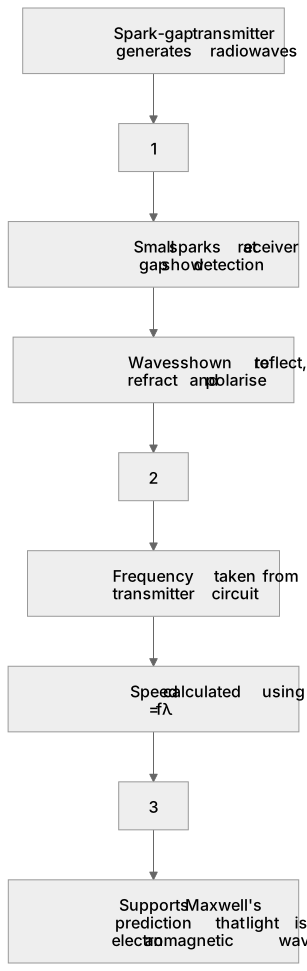
1Box 1
2Box 2
3Box 3
There is more to this lesson
The full lesson goes on to check your understanding and help you earn the marks. Create a free account to carry on, with your progress saved.
A week of Premium from your first lesson · Then the free plan continues · No card, no charge
Test your understanding of Electromagnetic waves (A-level only): Hertz’s discovery of radio waves including measurements of the speed of radio waves.
Active recall beats re-reading. Take an instant quiz now to test what you’ve learned and lock it into long-term memory.
A week of Premium from your first lesson · Then the free plan continues · No card, no charge