AQA · A-Level · Physics
Course version: 7408 · Version from Sept 2016
Electromagnetic waves (A-level only): Nature of electromagnetic waves.
Electromagnetic waves are transverse oscillations of electric and magnetic fields that propagate through a vacuum at the speed of light, c = 3.00 × 10⁸ m s⁻¹.
Checked against the AQA 7408 specification (opens in a new tab) on .
- Point 1 of 3
- 4 key terms
Study notes
From the checked teaching notes for this specification point.
The idea
Electromagnetic waves are transverse oscillations of electric and magnetic fields that propagate through a vacuum at the speed of light, c = 3.00 × 10⁸ m s⁻¹. They need no medium, carry energy and momentum, and can be polarised. The electric field E, magnetic field B and direction of propagation are mutually perpendicular. All regions of the electromagnetic spectrum, from radio waves to gamma rays, share this nature; they differ in frequency and wavelength, related by c = fλ. For example, a 100 MHz radio wave has λ = c/f = 3.00 m. Maxwell predicted such waves; their speed in a vacuum is invariant. In a medium, speed is lower and v = fλ still applies, with frequency unchanged at a boundary.
What earns the marks
- Electromagnetic waves are transverse waves with oscillating electric and magnetic fields perpendicular to each other and to the direction of energy transfer.
- The wave equation c = fλ relates speed, frequency and wavelength for electromagnetic waves in a vacuum.
- Electromagnetic waves carry energy and momentum and can be polarised because they are transverse.
- The electromagnetic spectrum is continuous and ordered by frequency or wavelength, with radio waves at low frequency and gamma rays at high frequency.
- When electromagnetic waves pass from one medium to another, frequency remains constant while speed and wavelength change.
Common mistakes and how to put them right
Treating electromagnetic waves as longitudinal.
Put it right by stating they are transverse and can be polarised.
Believing electromagnetic waves require a medium.
Put it right by stating they travel through a vacuum at c.
Using c = fλ with c for a medium.
Put it right by using v = fλ for the medium and c = fλ only in a vacuum.
Assuming frequency changes on refraction.
Put it right by stating frequency is set by the source and remains constant.
Exam tips
- Sketch the three mutually perpendicular directions for E, B and propagation to make the transverse nature clear.
- When using c = fλ, convert frequencies from MHz or GHz to Hz and wavelengths from nm to m before calculating.
- If asked to compare regions of the spectrum, quote typical frequencies or wavelengths and link them to a named application.
Try the lesson
The start of the Electromagnetic waves (A-level only): Nature of electromagnetic waves. lesson, made from checked teaching notes for this specification point.
Have a go first
Which statement describes the nature of all electromagnetic waves travelling through a vacuum?
Listen
Electromagnetic waves are transverse oscillations of electric and magnetic fields that propagate through a vacuum at the speed of light, c = 3.00 × 10⁸ m s⁻¹. They need no medium, carry energy and momentum, and can be polarised. The electric field E, magnetic field B and direction of propagation are mutually perpendicular. All regions of the electromagnetic spectrum, from radio waves to gamma rays, share this nature; they differ in frequency and wavelength, related by c = fλ. For example, a 100 MHz radio wave has λ = c/f = 3.00 m. Maxwell predicted such waves; their speed in a vacuum is invariant. In a medium, speed is lower and v = fλ still applies, with frequency unchanged at a boundary. A strong answer earns marks for these points. Electromagnetic waves are transverse waves with oscillating electric and magnetic fields perpendicular to each other and to the direction of energy transfer. The wave equation c = fλ relates speed, frequency and wavelength for electromagnetic waves in a vacuum. Electromagnetic waves carry energy and momentum and can be polarised because they are transverse. The electromagnetic spectrum is continuous and ordered by frequency or wavelength, with radio waves at low frequency and gamma rays at high frequency. A common slip: Treating electromagnetic waves as longitudinal. Instead, stating they are transverse and can be polarised. Exam tip: Sketch the three mutually perpendicular directions for E, B and propagation to make the transverse nature clear.
See it
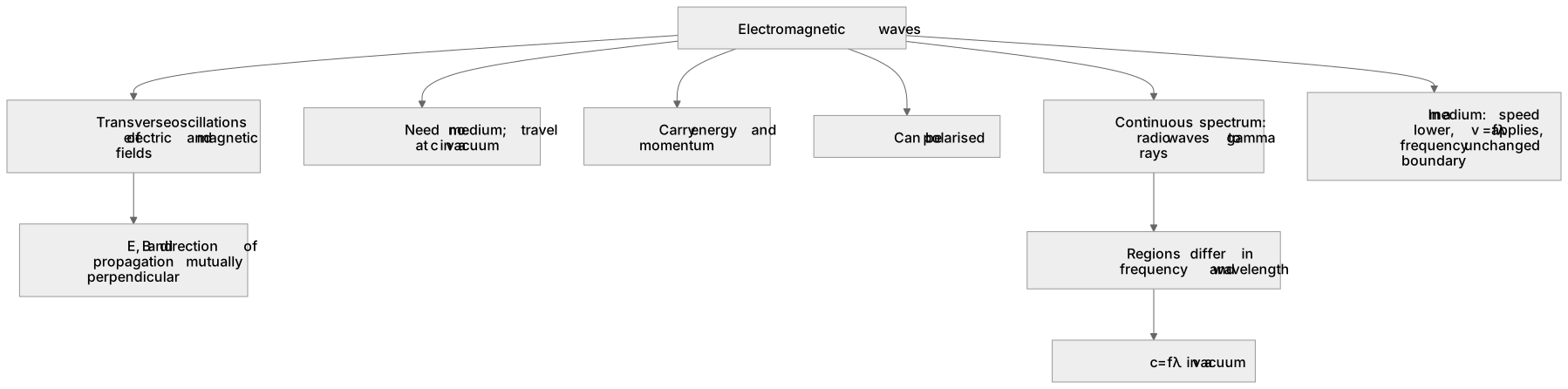
Key words
Say what each word means before you turn the card.
Electromagnetic waves
Try answering aloud or in your head before turning the card.
Wave equation
Try answering aloud or in your head before turning the card.
Electromagnetic spectrum
Try answering aloud or in your head before turning the card.
Polarisation
Try answering aloud or in your head before turning the card.
See every definition
- Electromagnetic waves
- Transverse oscillations of electric and magnetic fields that propagate through a vacuum at the speed of light and can be polarised.
- Wave equation
- c = fλ relates speed, frequency and wavelength for electromagnetic waves in a vacuum.
- Electromagnetic spectrum
- A continuous range ordered by frequency or wavelength, with radio waves at low frequency and gamma rays at high frequency.
- Polarisation
- A property electromagnetic waves can show because they are transverse.
Label the diagram
Some boxes have lost their names. Pick the right name for each number.
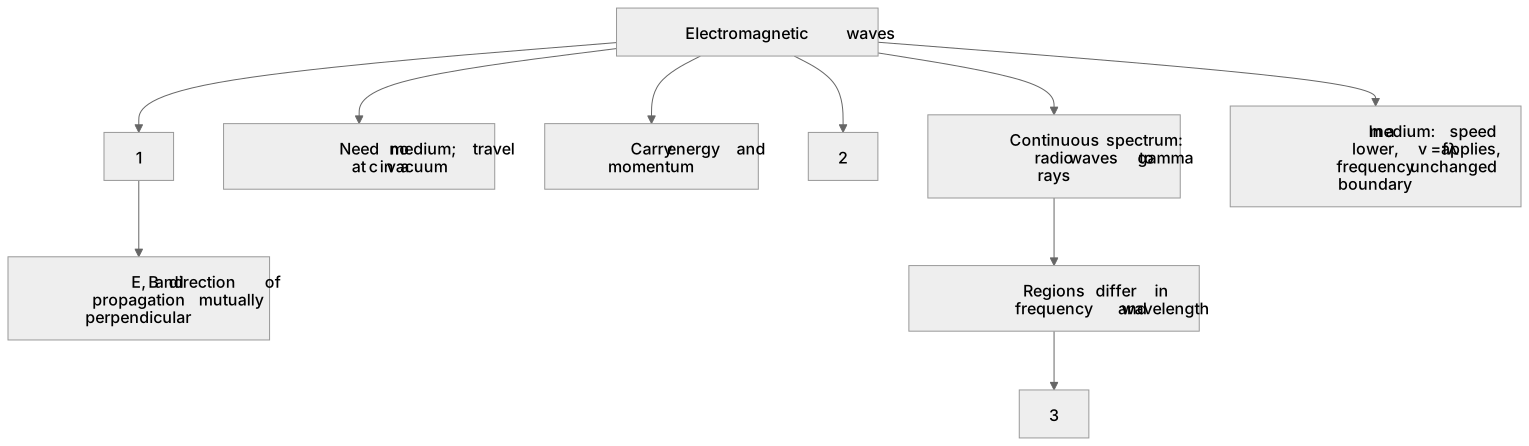
1Box 1
2Box 2
3Box 3
There is more to this lesson
The full lesson goes on to check your understanding and help you earn the marks. Create a free account to carry on, with your progress saved.
A week of Premium from your first lesson · Then the free plan continues · No card, no charge
Test your understanding of Electromagnetic waves (A-level only): Nature of electromagnetic waves.
Active recall beats re-reading. Take an instant quiz now to test what you’ve learned and lock it into long-term memory.
A week of Premium from your first lesson · Then the free plan continues · No card, no charge