AQA · A-Level · Physics
Course version: 7408 · Version from Sept 2016
Estimation of approximate values of physical quantities.
Full specification wording
Estimation of physical quantities: Estimation of approximate values of physical quantities.
Estimation means producing a sensible order-of-magnitude value for a quantity without precise measurement, by combining known benchmarks with simple reasoning.
Checked against the AQA 7408 specification (opens in a new tab) on .
- Point 2 of 2
- 4 key terms
Study notes
From the checked teaching notes for this specification point.
The idea
Estimation means producing a sensible order-of-magnitude value for a quantity without precise measurement, by combining known benchmarks with simple reasoning. You build a chain: identify the quantity, recall or construct a familiar reference, then scale it. For example, estimate the mass of air in a room by taking air density as about 1 kg m⁻³ and the room volume as 5 m × 4 m × 3 m = 60 m³, giving roughly 60 kg. For a speed, estimate a distance and a time separately, then divide. For an atomic-scale quantity, use the size of an atom, about 1 × 10⁻¹⁰ m, and scale. Always state assumptions, keep units consistent, and round to one significant figure. The skill is assessed through questions that reward a defensible method, correct unit handling and a plausible power of ten, not a memorised exact value.
What earns the marks
- Identifies the target quantity and the physical relationship linking it to measurable or familiar quantities, for example density = mass ÷ volume or speed = distance ÷ time.
- Selects a reasonable reference value, such as adult mass about 70 kg, walking speed about 1.5 m s⁻¹, air density about 1 kg m⁻³ or atomic diameter about 1 × 10⁻¹⁰ m.
- Carries out the arithmetic with consistent SI units, converting centimetres to metres or grams to kilograms before substituting.
- Rounds the final answer to one significant figure and expresses it as an order of magnitude, for example about 10² kg or about 10⁶ m.
- States the assumptions made, such as treating a person as a cylinder of water or a room as a rectangular box, and comments on whether the estimate is likely to be too high or too low.
Common mistakes and how to put them right
Mixing units, for example substituting a length in centimetres into a formula that requires metres.
Put it right: Convert every quantity to SI base units before calculating.
Treating the estimate as a precise answer and quoting many significant figures.
Put it right: Round to one significant figure and present the result as an approximate order of magnitude.
Forgetting to state assumptions, so the method cannot be followed.
Put it right: Write each assumed value and its source, such as taking the density of water as 1000 kg m⁻³.
Exam tips
- Write the estimate as a short chain of reasoning: quantity, relationship, assumed values, substitution, rounded result with unit.
- Choose round benchmark values that are easy to calculate with, since the power of ten matters more than the exact digits.
- Check the final unit by carrying units through the calculation, and reject any answer whose unit does not match the quantity asked for.
Try the lesson
The start of the Estimation of physical quantities: Estimation of approximate values of physical quantities. lesson, made from checked teaching notes for this specification point.
Have a go first
Which of the following is the most reasonable estimate for the mass of a typical adult human?
Listen
Estimation means producing a sensible order-of-magnitude value for a quantity without precise measurement, by combining known benchmarks with simple reasoning. You build a chain: identify the quantity, recall or construct a familiar reference, then scale it. For example, estimate the mass of air in a room by taking air density as about 1 kg m⁻³ and the room volume as 5 m × 4 m × 3 m = 60 m³, giving roughly 60 kg. For a speed, estimate a distance and a time separately, then divide. For an atomic-scale quantity, use the size of an atom, about 1 × 10⁻¹⁰ m, and scale. Always state assumptions, keep units consistent, and round to one significant figure. The skill is assessed through questions that reward a defensible method, correct unit handling and a plausible power of ten, not a memorised exact value. A strong answer earns marks for these points. Identifies the target quantity and the physical relationship linking it to measurable or familiar quantities, for example density = mass ÷ volume or speed = distance ÷ time. Selects a reasonable reference value, such as adult mass about 70 kg, walking speed about 1.5 m s⁻¹, air density about 1 kg m⁻³ or atomic diameter about 1 × 10⁻¹⁰ m. Carries out the arithmetic with consistent SI units, converting centimetres to metres or grams to kilograms before substituting. Rounds the final answer to one significant figure and expresses it as an order of magnitude, for example about 10² kg or about 10⁶ m. A common slip: Mixing units, for example substituting a length in centimetres into a formula that requires metres. Instead, convert every quantity to SI base units before calculating. Exam tip: Write the estimate as a short chain of reasoning: quantity, relationship, assumed values, substitution, rounded result with unit.
See it
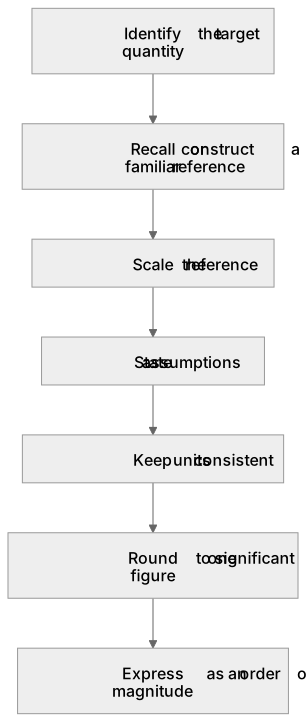
Put it in order
Put these steps in the order they happen.
- 1. Express as an order of magnitude
- 2. Round to one significant figure
- 3. Scale the reference
- 4. Keep units consistent
- 5. Identify the target quantity
- 6. Recall or construct a familiar reference
- 7. State assumptions
Key words
Say what each word means before you turn the card.
Order-of-magnitude reasoning
Try answering aloud or in your head before turning the card.
Use of familiar physical benchmarks
Try answering aloud or in your head before turning the card.
Dimensional consistency and unit conversion
Try answering aloud or in your head before turning the card.
Communication of assumptions and uncertainty
Try answering aloud or in your head before turning the card.
See every definition
- Order-of-magnitude reasoning
- Producing a sensible approximate value for a quantity by combining known benchmarks with simple reasoning, then rounding to one significant figure and expressing it as a power of ten.
- Use of familiar physical benchmarks
- Recalling or constructing a familiar reference value, such as adult mass about 70 kg or air density about 1 kg m⁻³, and scaling it to the quantity being estimated.
- Dimensional consistency and unit conversion
- Keeping units consistent by converting every quantity to SI base units, such as centimetres to metres or grams to kilograms, before substituting into the calculation.
- Communication of assumptions and uncertainty
- Stating the assumptions made, such as treating a room as a rectangular box, and commenting on whether the estimate is likely to be too high or too low.
Label the diagram
Some boxes have lost their names. Pick the right name for each number.
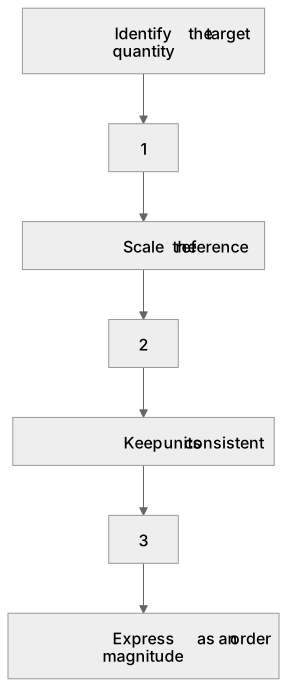
1Box 1
2Box 2
3Box 3
There is more to this lesson
The full lesson goes on to check your understanding and help you earn the marks. Create a free account to carry on, with your progress saved.
A week of Premium from your first lesson · Then the free plan continues · No card, no charge
Test your understanding of Estimation of physical quantities: Estimation of approximate values of physical quantities.
Active recall beats re-reading. Take an instant quiz now to test what you’ve learned and lock it into long-term memory.
A week of Premium from your first lesson · Then the free plan continues · No card, no charge