AQA · A-Level · Physics
Course version: 7408 · Version from Sept 2016
Estimation of physical quantities: Orders of magnitude.
An order of magnitude compares sizes using powers of ten.
Checked against the AQA 7408 specification (opens in a new tab) on .
- Point 1 of 2
- 3 key terms
Study notes
From the checked teaching notes for this specification point.
The idea
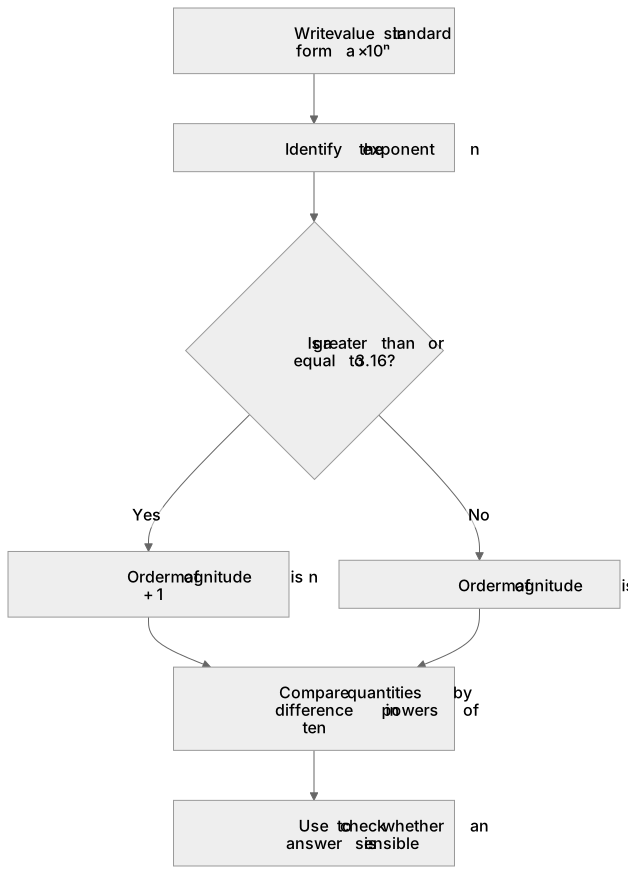
An order of magnitude compares sizes using powers of ten. Two quantities differ by one order of magnitude if one is about ten times the other. In physics, you often estimate a quantity to the nearest power of ten. For example, the diameter of an atom is about 10⁻¹⁰ m and a nucleus is 10⁻¹⁵ m, so the atom is five orders of magnitude larger. To find an order of magnitude, write the value in standard form a × 10ⁿ. If a is greater than or equal to 3.16 (the square root of 10), the order of magnitude is n + 1; otherwise, it is n. This skill helps you check whether an answer is sensible and compare very different scales.
What earns the marks
- Define order of magnitude as a scale based on powers of ten.
- Express a quantity in standard form a × 10ⁿ and identify the exponent n.
- State that the order of magnitude is n + 1 if a is greater than or equal to 3.16 (or 5), and n otherwise.
- Compare two quantities by finding the difference in their powers of ten.
- Use orders of magnitude to make rough estimates of physical quantities.
Common mistakes and how to put them right
Confusing order of magnitude with the coefficient in standard form.
Put it right: The order of magnitude is the nearest power of ten.
Forgetting to round up the exponent when the coefficient is large.
Put it right: If a ≥ 3.16 in a × 10ⁿ, the order of magnitude is n + 1.
Forgetting that orders of magnitude use base ten, not base two or base e.
Put it right: Each order of magnitude corresponds to a factor of ten.
Exam tips
- When estimating, round each input to the nearest power of ten before combining them.
- Remember to check the coefficient in standard form; if it is 3.16 or larger, round the order of magnitude up to the next power of ten.
Try the lesson
The start of the Estimation of physical quantities: Orders of magnitude. lesson, made from checked teaching notes for this specification point.
Have a go first
The diameter of a typical atom is about 1 × 10⁻¹⁰ m. Which value is the closest order of magnitude for this diameter?
Listen
An order of magnitude compares sizes using powers of ten. Two quantities differ by one order of magnitude if one is about ten times the other. In physics, you often estimate a quantity to the nearest power of ten. For example, the diameter of an atom is about 10⁻¹⁰ m and a nucleus is 10⁻¹⁵ m, so the atom is five orders of magnitude larger. To find an order of magnitude, write the value in standard form a × 10ⁿ. If a is greater than or equal to 3.16 (the square root of 10), the order of magnitude is n + 1; otherwise, it is n. This skill helps you check whether an answer is sensible and compare very different scales. A strong answer earns marks for these points. Define order of magnitude as a scale based on powers of ten. Express a quantity in standard form a × 10ⁿ and identify the exponent n. State that the order of magnitude is n + 1 if a is greater than or equal to 3.16 (or 5), and n otherwise. Compare two quantities by finding the difference in their powers of ten. A common slip: Confusing order of magnitude with the coefficient in standard form. Instead, the order of magnitude is the nearest power of ten. Exam tip: When estimating, round each input to the nearest power of ten before combining them.
See it
Key words
Say what each word means before you turn the card.
Order of magnitude
Try answering aloud or in your head before turning the card.
Standard form
Try answering aloud or in your head before turning the card.
Estimation
Try answering aloud or in your head before turning the card.
See every definition
- Order of magnitude
- A scale based on powers of ten, where two quantities differ by one order of magnitude if one is about ten times the other.
- Standard form
- A value written as a × 10ⁿ, from which the exponent n is identified to find the order of magnitude.
- Estimation
- Using orders of magnitude to make rough estimates of physical quantities and to check whether an answer is sensible.
Label the diagram
Some boxes have lost their names. Pick the right name for each number.
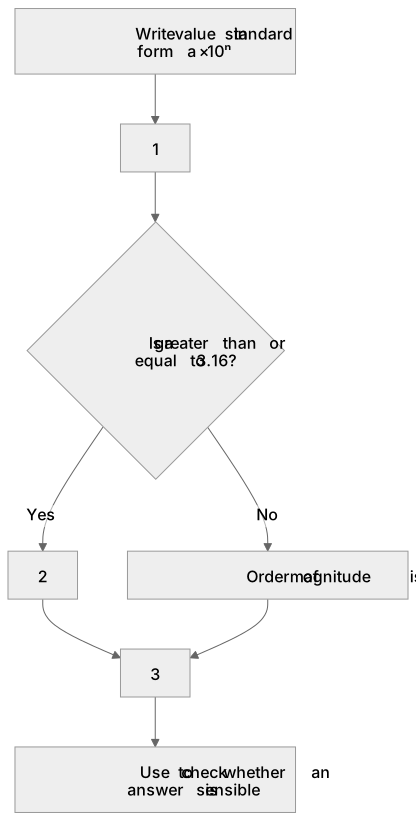
1Box 1
2Box 2
3Box 3
There is more to this lesson
The full lesson goes on to check your understanding and help you earn the marks. Create a free account to carry on, with your progress saved.
A week of Premium from your first lesson · Then the free plan continues · No card, no charge
Test your understanding of Estimation of physical quantities: Orders of magnitude.
Active recall beats re-reading. Take an instant quiz now to test what you’ve learned and lock it into long-term memory.
A week of Premium from your first lesson · Then the free plan continues · No card, no charge