AQA · A-Level · Physics
Course version: 7408 · Version from Sept 2016
Understanding of definition of gravitational potential, including zero…
Full specification wording
Gravitational potential (A-level only): Understanding of definition of gravitational potential, including zero value at infinity.
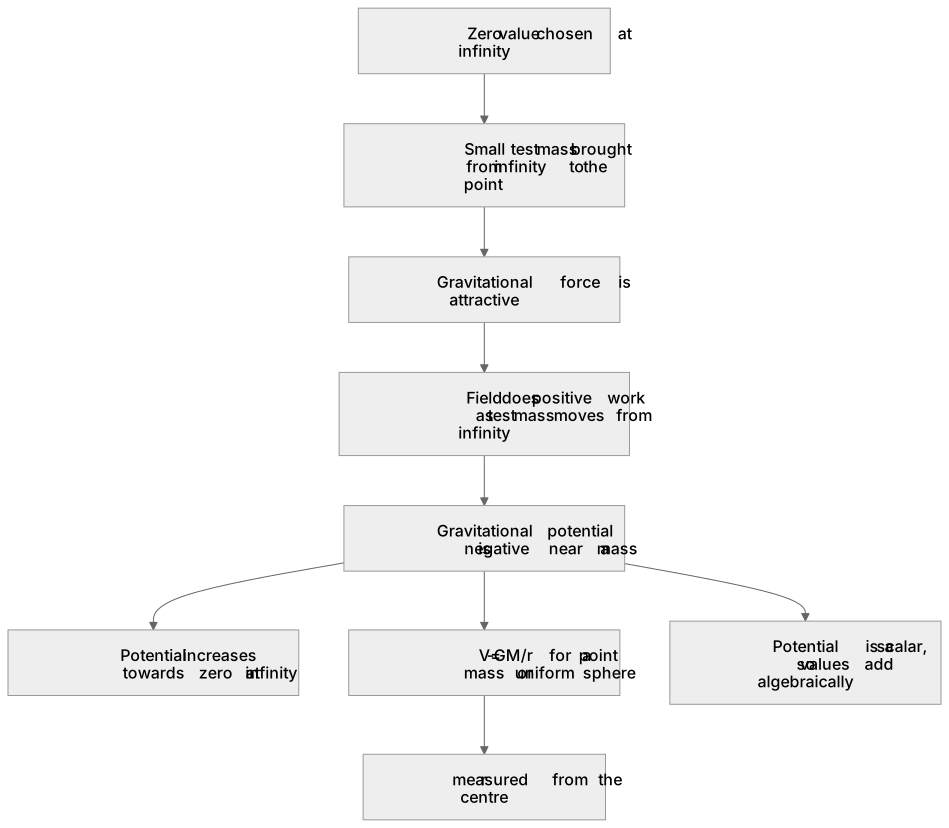
Gravitational potential, V, at a point is the work done per unit mass in bringing a small test mass from infinity to that point.
Checked against the AQA 7408 specification (opens in a new tab) on .
- Point 1 of 5
- 4 key terms
Study notes
From the checked teaching notes for this specification point.
The idea
Gravitational potential, V, at a point is the work done per unit mass in bringing a small test mass from infinity to that point. Because the gravitational force is attractive, the work done by the field is positive when moving from infinity, so the potential is negative near a mass and increases towards zero at infinity. The defining equation is V = -GM/r for a point mass or uniform sphere, where G is the gravitational constant, M is the mass producing the field, and r is the distance from the centre. The zero value is chosen at infinity, where the field strength is zero. For example, at the surface of the Earth, using M = 5.97 × 10²⁴ kg and r = 6.37 × 10⁶ m gives V ≈ -6.25 × 10⁷ J kg⁻¹. Potential is a scalar, so values add algebraically.
What earns the marks
- Defines gravitational potential as work done per unit mass in moving a small test mass from infinity to the point.
- States that the zero of gravitational potential is at infinity.
- Explains that gravitational potential is negative near a mass because the gravitational force is attractive and the field does positive work as the test mass moves from infinity.
- Uses V = -GM/r correctly for a point mass or uniform sphere, with r measured from the centre.
- Recognises that gravitational potential is a scalar quantity and that potentials from multiple masses add algebraically.
- Calculates potential at a point using given values of G, M and r, including correct substitution and units J kg⁻¹.
Common mistakes and how to put them right
Treating gravitational potential as a vector and attempting to resolve it into components.
Put it right: Treat it as a scalar and add values algebraically.
Omitting the negative sign in V = -GM/r.
Put it right: Include the negative sign because the potential is negative near a mass when zero is at infinity.
Confusing gravitational potential with gravitational field strength.
Put it right: Remember that potential is work done per unit mass (J kg⁻¹) while field strength is force per unit mass (N kg⁻¹).
Exam tips
- When defining gravitational potential, always include the phrase 'work done per unit mass' and specify the path from infinity.
- In calculations, write the equation V = -GM/r, substitute values with units, and give the answer in J kg⁻¹ with an appropriate number of significant figures.
- If a question asks about the zero of potential, state clearly that it is at infinity and explain that this choice makes the potential negative near a mass.
Try the lesson
The start of the Gravitational potential (A-level only): Understanding of definition of gravitational potential, including zero value at infinity. lesson, made from checked teaching notes for this specification point.
Have a go first
Which statement defines the gravitational potential at a point in a gravitational field?
Listen
Gravitational potential, V, at a point is the work done per unit mass in bringing a small test mass from infinity to that point. Because the gravitational force is attractive, the work done by the field is positive when moving from infinity, so the potential is negative near a mass and increases towards zero at infinity. The defining equation is V = -GM/r for a point mass or uniform sphere, where G is the gravitational constant, M is the mass producing the field, and r is the distance from the centre. The zero value is chosen at infinity, where the field strength is zero. For example, at the surface of the Earth, using M = 5.97 × 10²⁴ kg and r = 6.37 × 10⁶ m gives V ≈ -6.25 × 10⁷ J kg⁻¹. Potential is a scalar, so values add algebraically. A strong answer earns marks for these points. Defines gravitational potential as work done per unit mass in moving a small test mass from infinity to the point. States that the zero of gravitational potential is at infinity. Explains that gravitational potential is negative near a mass because the gravitational force is attractive and the field does positive work as the test mass moves from infinity. Uses V = -GM/r correctly for a point mass or uniform sphere, with r measured from the centre. A common slip: Treating gravitational potential as a vector and attempting to resolve it into components. Instead, treat it as a scalar and add values algebraically. Exam tip: When defining gravitational potential, always include the phrase 'work done per unit mass' and specify the path from infinity.
See it
Key words
Say what each word means before you turn the card.
Gravitational potential
Try answering aloud or in your head before turning the card.
Zero value at infinity
Try answering aloud or in your head before turning the card.
Negative potential near a mass
Try answering aloud or in your head before turning the card.
Scalar nature of potential
Try answering aloud or in your head before turning the card.
See every definition
- Gravitational potential
- The work done per unit mass in bringing a small test mass from infinity to that point.
- Zero value at infinity
- The zero value is chosen at infinity, where the field strength is zero.
- Negative potential near a mass
- Because the gravitational force is attractive, the work done by the field is positive when moving from infinity, so the potential is negative near a mass.
- Scalar nature of potential
- Potential is a scalar, so values add algebraically.
Label the diagram
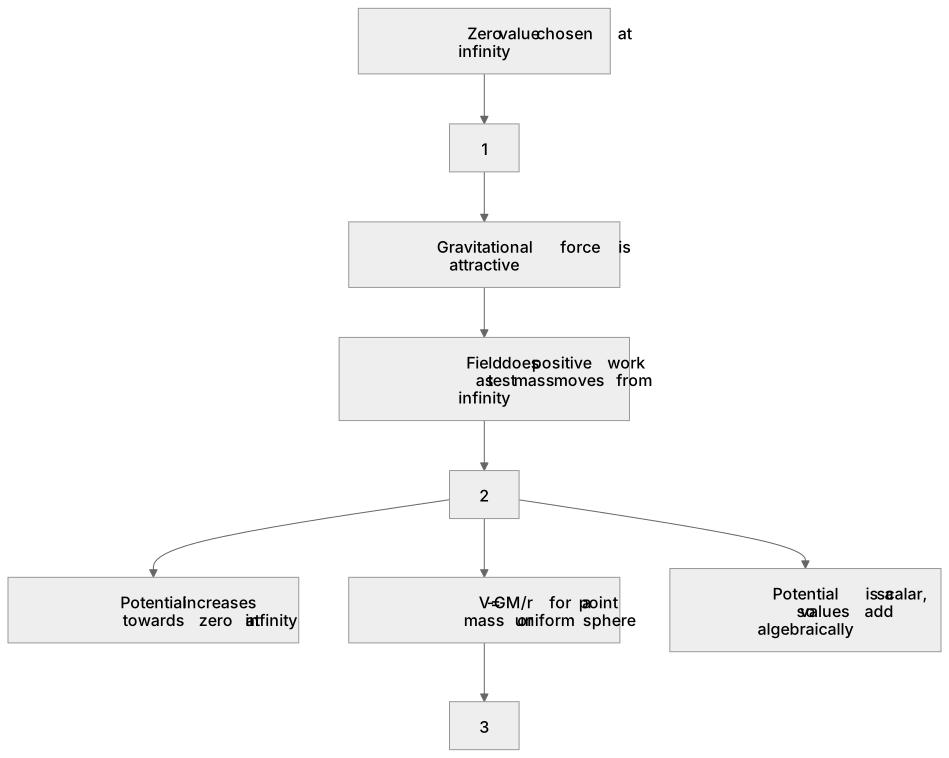
Some boxes have lost their names. Pick the right name for each number.
1Box 1
2Box 2
3Box 3
There is more to this lesson
The full lesson goes on to check your understanding and help you earn the marks. Create a free account to carry on, with your progress saved.
A week of Premium from your first lesson · Then the free plan continues · No card, no charge
Test your understanding of Gravitational potential (A-level only): Understanding of definition of gravitational potential, including zero value at infinity.
Active recall beats re-reading. Take an instant quiz now to test what you’ve learned and lock it into long-term memory.
A week of Premium from your first lesson · Then the free plan continues · No card, no charge