AQA · A-Level · Physics
Course version: 7408 · Version from Sept 2016
Understanding of gravitational potential difference.
Full specification wording
Gravitational potential (A-level only): Understanding of gravitational potential difference.
Gravitational potential difference, ΔV, between two points is the difference in gravitational potential between them, equal to the work done per unit mass in moving a small test mass between the…
Checked against the AQA 7408 specification (opens in a new tab) on .
- Point 2 of 5
- 4 key terms
Study notes
From the checked teaching notes for this specification point.
The idea
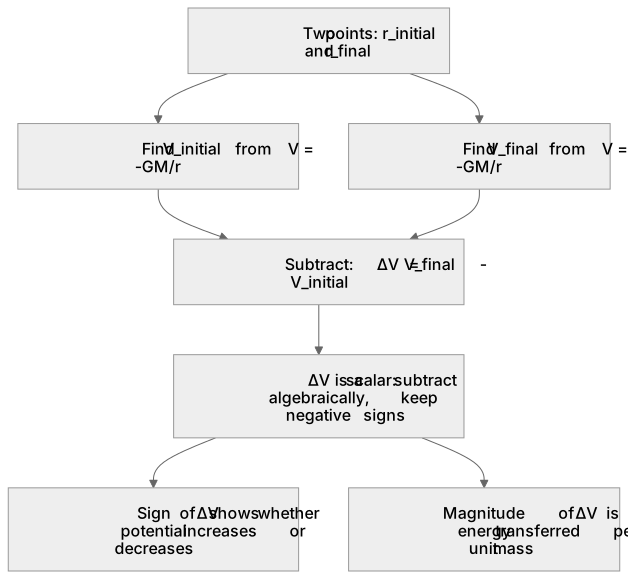
Gravitational potential difference, ΔV, between two points is the difference in gravitational potential between them, equal to the work done per unit mass in moving a small test mass between the two points. It is calculated as ΔV = V_final - V_initial, where each V is found from V = -GM/r. Because potential is a scalar, the difference is simply the algebraic subtraction of the two potential values. For example, moving from r = 2R to r = R near a planet gives ΔV = (-GM/R) - (-GM/2R) = -GM/2R, which is negative, meaning the potential decreases as the test mass moves closer. The magnitude of ΔV is the energy transferred per unit mass, and the sign indicates the direction of potential change. This concept is essential for understanding changes in potential energy and orbital motion.
What earns the marks
- Defines gravitational potential difference as the difference in gravitational potential between two points.
- Calculates potential difference using ΔV = V_final - V_initial, with each V obtained from V = -GM/r.
- Interprets the sign of ΔV in terms of whether potential increases or decreases between the two points.
- Relates gravitational potential difference to the work done per unit mass in moving between the two points.
- Applies the concept to problems involving changes in distance from a mass, such as moving between two orbital radii.
- Uses the scalar nature of potential to add or subtract potentials algebraically without vector resolution.
Common mistakes and how to put them right
Subtracting potentials in the wrong order, giving the wrong sign for ΔV.
Put it right: Use ΔV = V_final - V_initial consistently.
Treating potential difference as a vector quantity.
Put it right: Treat it as a scalar and subtract algebraically.
Forgetting that potential is negative, leading to sign errors when subtracting.
Put it right: Keep the negative signs in the calculation and simplify carefully.
Exam tips
- When calculating potential difference, show the two potential values clearly before subtracting, and state the sign of the result.
- If asked for the work done per unit mass, remember it is equal to the negative of the potential difference, or simply the magnitude of ΔV depending on context.
- Use consistent units throughout, and express potential difference in J kg⁻¹.
Try the lesson
The start of the Gravitational potential (A-level only): Understanding of gravitational potential difference. lesson, made from checked teaching notes for this specification point.
Have a go first
Which quantity is equal to the gravitational potential difference between two points in a gravitational field?
Listen
Gravitational potential difference, ΔV, between two points is the difference in gravitational potential between them, equal to the work done per unit mass in moving a small test mass between the two points. It is calculated as ΔV = V_final - V_initial, where each V is found from V = -GM/r. Because potential is a scalar, the difference is simply the algebraic subtraction of the two potential values. For example, moving from r = 2R to r = R near a planet gives ΔV = (-GM/R) - (-GM/2R) = -GM/2R, which is negative, meaning the potential decreases as the test mass moves closer. The magnitude of ΔV is the energy transferred per unit mass, and the sign indicates the direction of potential change. This concept is essential for understanding changes in potential energy and orbital motion. A strong answer earns marks for these points. Defines gravitational potential difference as the difference in gravitational potential between two points. Calculates potential difference using ΔV = V_final - V_initial, with each V obtained from V = -GM/r. Interprets the sign of ΔV in terms of whether potential increases or decreases between the two points. Relates gravitational potential difference to the work done per unit mass in moving between the two points. A common slip: Subtracting potentials in the wrong order, giving the wrong sign for ΔV. Instead, use ΔV = V_final - V_initial consistently. Exam tip: When calculating potential difference, show the two potential values clearly before subtracting, and state the sign of the result.
See it
Key words
Say what each word means before you turn the card.
Gravitational potential difference
Try answering aloud or in your head before turning the card.
Work done per unit mass
Try answering aloud or in your head before turning the card.
Algebraic subtraction of scalars
Try answering aloud or in your head before turning the card.
Sign and direction of potential change
Try answering aloud or in your head before turning the card.
See every definition
- Gravitational potential difference
- The difference in gravitational potential between two points, equal to the work done per unit mass in moving a small test mass between them.
- Work done per unit mass
- The energy transferred per unit mass in moving a small test mass between two points, given by the magnitude of the potential difference.
- Algebraic subtraction of scalars
- Because potential is a scalar, the difference is found by simply subtracting the two potential values algebraically.
- Sign and direction of potential change
- The sign of the potential difference indicates the direction of potential change between the two points.
Label the diagram
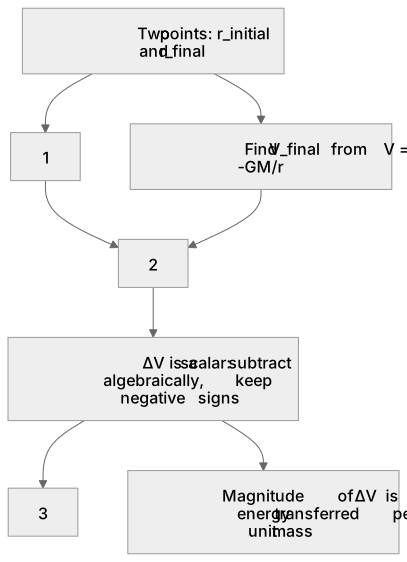
Some boxes have lost their names. Pick the right name for each number.
1Box 1
2Box 2
3Box 3
There is more to this lesson
The full lesson goes on to check your understanding and help you earn the marks. Create a free account to carry on, with your progress saved.
A week of Premium from your first lesson · Then the free plan continues · No card, no charge
Test your understanding of Gravitational potential (A-level only): Understanding of gravitational potential difference.
Active recall beats re-reading. Take an instant quiz now to test what you’ve learned and lock it into long-term memory.
A week of Premium from your first lesson · Then the free plan continues · No card, no charge