AQA · A-Level · Physics
Course version: 7408 · Version from Sept 2016
Questions will be limited to consideration of image resolution,…
Full specification wording
Imaging comparisons (A-level only): Questions will be limited to consideration of image resolution, convenience and safety issues.
This statement defines the scope of comparison questions across imaging techniques such as X-ray, ultrasound, CT, PET and MRI.
Checked against the AQA 7408 specification (opens in a new tab) on .
- Point 2 of 2
- 4 key terms
Study notes
From the checked teaching notes for this specification point.
The idea
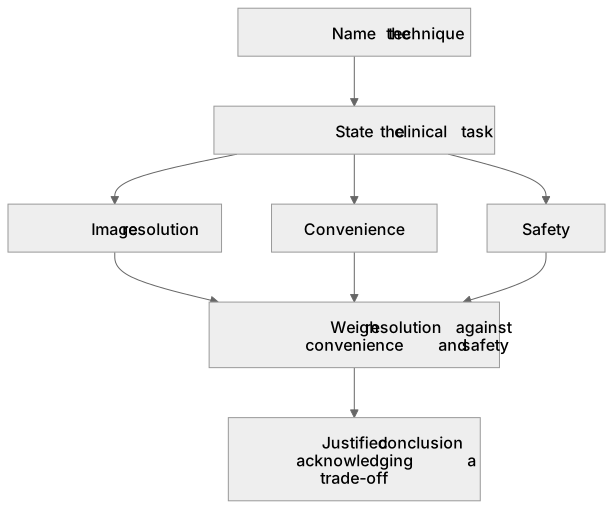
This statement defines the scope of comparison questions across imaging techniques such as X-ray, ultrasound, CT, PET and MRI. You are not expected to compare every physical principle in detail; instead, you judge techniques by three practical criteria. Image resolution concerns how small a separation of features can be distinguished, so a technique producing sharp, high-contrast images of fine structure scores well. Convenience covers patient experience and clinical practicality: scan duration, need for stillness, portability, invasiveness and availability. Safety covers ionising radiation dose, heating or cavitation risks, contrast agent reactions and any need to avoid certain patients. A useful method is to name the technique, state the clinical task, then weigh resolution against convenience and safety to justify a choice.
What earns the marks
- Identifies image resolution as the ability to distinguish small, closely spaced features in the resulting image, linking it to the imaging wavelength or reconstruction method where relevant.
- Discusses convenience in terms of scan duration, patient comfort, need to remain still, portability, availability and whether the procedure is invasive.
- Discusses safety in terms of ionising radiation dose, heating or cavitation effects, contrast agent risks and suitability for particular patients such as pregnant women.
- Compares two or more techniques by weighing resolution against convenience and safety for a stated clinical situation rather than listing techniques separately.
- Reaches a justified conclusion that identifies the most suitable technique for the context and acknowledges a trade-off, for example lower resolution but no ionising radiation.
Common mistakes and how to put them right
Treating resolution as brightness or image size rather than the ability to distinguish fine detail.
Put it right by defining resolution as the smallest separable feature and linking it to the imaging method.
Listing advantages and disadvantages of each technique without comparing them.
Put it right: Explicitly weighing the criteria against each other for the clinical task given.
Assuming all radiation-based techniques carry equal risk regardless of dose.
Put it right by distinguishing dose levels and noting that some techniques avoid ionising radiation altogether.
Exam tips
- Read the clinical context carefully and let it drive your judgement, because the best technique depends on the patient and the diagnostic question.
- Use comparative connectives such as whereas and however to show you are weighing criteria rather than describing techniques in isolation.
- State a clear overall recommendation and support it with at least one resolution point, one convenience point and one safety point.
Try the lesson
The start of the Imaging comparisons (A-level only): Questions will be limited to consideration of image resolution, convenience and safety issues. lesson, made from checked teaching notes for this specification point.
Have a go first
A hospital needs to compare two imaging techniques for examining a patient's knee. Which of the following is a safety issue that should be considered when making this comparison?
Listen
This statement defines the scope of comparison questions across imaging techniques such as X-ray, ultrasound, CT, PET and MRI. You are not expected to compare every physical principle in detail; instead, you judge techniques by three practical criteria. Image resolution concerns how small a separation of features can be distinguished, so a technique producing sharp, high-contrast images of fine structure scores well. Convenience covers patient experience and clinical practicality: scan duration, need for stillness, portability, invasiveness and availability. Safety covers ionising radiation dose, heating or cavitation risks, contrast agent reactions and any need to avoid certain patients. A useful method is to name the technique, state the clinical task, then weigh resolution against convenience and safety to justify a choice. A strong answer earns marks for these points. Identifies image resolution as the ability to distinguish small, closely spaced features in the resulting image, linking it to the imaging wavelength or reconstruction method where relevant. Discusses convenience in terms of scan duration, patient comfort, need to remain still, portability, availability and whether the procedure is invasive. Discusses safety in terms of ionising radiation dose, heating or cavitation effects, contrast agent risks and suitability for particular patients such as pregnant women. Compares two or more techniques by weighing resolution against convenience and safety for a stated clinical situation rather than listing techniques separately. A common slip: Treating resolution as brightness or image size rather than the ability to distinguish fine detail. Instead, defining resolution as the smallest separable feature and linking it to the imaging method. Exam tip: Read the clinical context carefully and let it drive your judgement, because the best technique depends on the patient and the diagnostic question.
See it
Key words
Say what each word means before you turn the card.
Image resolution
Try answering aloud or in your head before turning the card.
Convenience
Try answering aloud or in your head before turning the card.
Safety
Try answering aloud or in your head before turning the card.
Justified comparison
Try answering aloud or in your head before turning the card.
See every definition
- Image resolution
- How small a separation of features can be distinguished, so a technique producing sharp, high-contrast images of fine structure scores well.
- Convenience
- Patient experience and clinical practicality, covering scan duration, need for stillness, portability, invasiveness and availability.
- Safety
- Ionising radiation dose, heating or cavitation risks, contrast agent reactions and any need to avoid certain patients.
- Justified comparison
- Naming the technique, stating the clinical task, then weighing resolution against convenience and safety to justify a choice.
Label the diagram
Some boxes have lost their names. Pick the right name for each number.
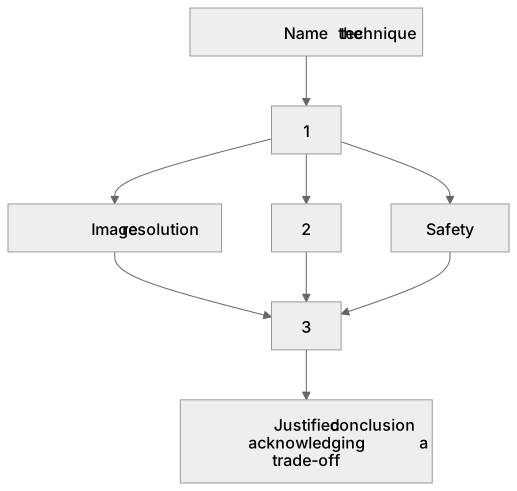
1Box 1
2Box 2
3Box 3
There is more to this lesson
The full lesson goes on to check your understanding and help you earn the marks. Create a free account to carry on, with your progress saved.
A week of Premium from your first lesson · Then the free plan continues · No card, no charge
Test your understanding of Imaging comparisons (A-level only): Questions will be limited to consideration of image resolution, convenience and safety issues.
Active recall beats re-reading. Take an instant quiz now to test what you’ve learned and lock it into long-term memory.
A week of Premium from your first lesson · Then the free plan continues · No card, no charge