AQA · A-Level · Physics
Course version: 7408 · Version from Sept 2016
The Molybdenum-Technetium generator, its basic use and importance.
Full specification wording
Imaging techniques (A-level only): The Molybdenum-Technetium generator, its basic use and importance.
A Molybdenum-Technetium generator supplies technetium-99m close to the patient.
Checked against the AQA 7408 specification (opens in a new tab) on .
- Point 2 of 2
- 3 key terms
Study notes
From the checked teaching notes for this specification point.
The idea
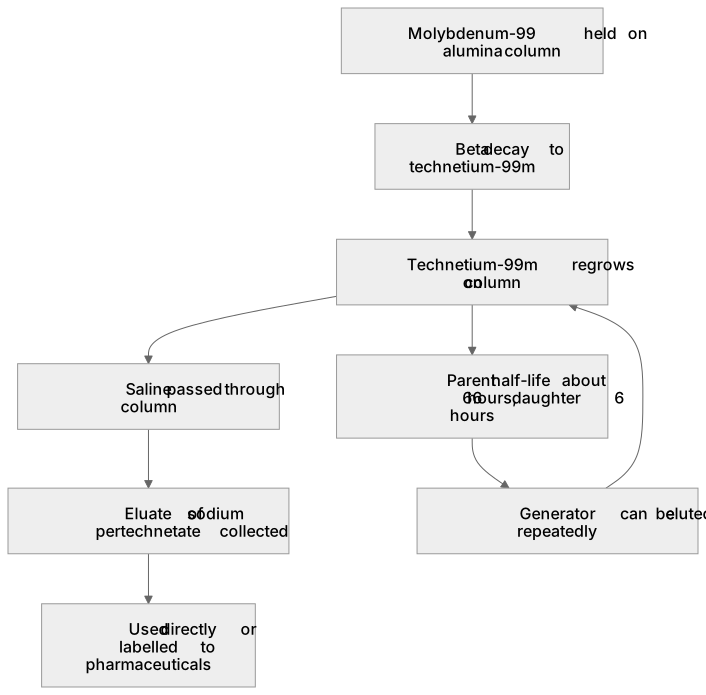
A Molybdenum-Technetium generator supplies technetium-99m close to the patient. Molybdenum-99, with a half-life of about 66 hours, is held on an alumina column and decays by beta emission to technetium-99m, which is eluted as sodium pertechnetate with saline. Because the parent half-life is much longer than the 6-hour daughter half-life, the generator can be milked repeatedly as technetium-99m regrows. This matters because technetium-99m emits a suitable gamma photon, is short-lived enough to limit dose, and can be labelled to many pharmaceuticals. The generator therefore gives hospitals a reliable, on-site source of a versatile tracer without needing a reactor for each scan.
What earns the marks
- Molybdenum-99 is adsorbed on an alumina column and decays by beta emission to technetium-99m, which is the daughter used for imaging.
- Technetium-99m is removed by passing saline through the column, producing an eluate of sodium pertechnetate that can be used directly or labelled.
- The parent half-life of about 66 hours is much longer than the 6-hour daughter half-life, so the daughter regrows and the generator can be eluted repeatedly.
- The generator provides a convenient on-site supply of a short-lived gamma emitter, reducing the need to transport a rapidly decaying isotope from a distant reactor.
- Technetium-99m has suitable gamma energy and can be attached to a range of pharmaceuticals, which makes the generator important for many different imaging investigations.
- The elution process is assessed by describing the separation of parent and daughter and explaining why the daughter, not the parent, is used for the scan.
Common mistakes and how to put them right
Confusing parent and daughter.
Put it right: State which isotope remains on the column and which is collected.
Thinking the generator creates technetium-99m continuously without limit.
Put it right: Explain that elution is repeated after a suitable ingrowth period.
Assuming the eluate is pure technetium metal.
Put it right: Describe the chemical form collected.
Exam tips
- Name both isotopes and state their half-lives when explaining why repeated elution works.
- Describe the column, the saline eluent and the collected pertechnetate in a clear sequence.
- Link the generator's importance to patient care by mentioning on-site supply and the short half-life of the imaging isotope.
Try the lesson
The start of the Imaging techniques (A-level only): The Molybdenum-Technetium generator, its basic use and importance. lesson, made from checked teaching notes for this specification point.
Have a go first
What is the main purpose of a Molybdenum-Technetium generator in a hospital?
Listen
A Molybdenum-Technetium generator supplies technetium-99m close to the patient. Molybdenum-99, with a half-life of about 66 hours, is held on an alumina column and decays by beta emission to technetium-99m, which is eluted as sodium pertechnetate with saline. Because the parent half-life is much longer than the 6-hour daughter half-life, the generator can be milked repeatedly as technetium-99m regrows. This matters because technetium-99m emits a suitable gamma photon, is short-lived enough to limit dose, and can be labelled to many pharmaceuticals. The generator therefore gives hospitals a reliable, on-site source of a versatile tracer without needing a reactor for each scan. A strong answer earns marks for these points. Molybdenum-99 is adsorbed on an alumina column and decays by beta emission to technetium-99m, which is the daughter used for imaging. Technetium-99m is removed by passing saline through the column, producing an eluate of sodium pertechnetate that can be used directly or labelled. The parent half-life of about 66 hours is much longer than the 6-hour daughter half-life, so the daughter regrows and the generator can be eluted repeatedly. The generator provides a convenient on-site supply of a short-lived gamma emitter, reducing the need to transport a rapidly decaying isotope from a distant reactor. A common slip: Confusing parent and daughter: molybdenum-99 is the longer-lived parent and technetium-99m is the eluted daughter. Instead, state which isotope remains on the column and which is collected. Exam tip: Name both isotopes and state their half-lives when explaining why repeated elution works.
See it
Key words
Say what each word means before you turn the card.
Repeated elution and regrowth
Try answering aloud or in your head before turning the card.
On-site supply of short-lived tracers
Try answering aloud or in your head before turning the card.
Chemical form and labelling
Try answering aloud or in your head before turning the card.
See every definition
- Repeated elution and regrowth
- Because the parent half-life is much longer than the 6-hour daughter half-life, the generator can be milked repeatedly as technetium-99m regrows.
- On-site supply of short-lived tracers
- The generator gives hospitals a reliable, on-site source of a versatile tracer without needing a reactor for each scan.
- Chemical form and labelling
- Technetium-99m is eluted as sodium pertechnetate with saline and can be labelled to many pharmaceuticals.
Label the diagram
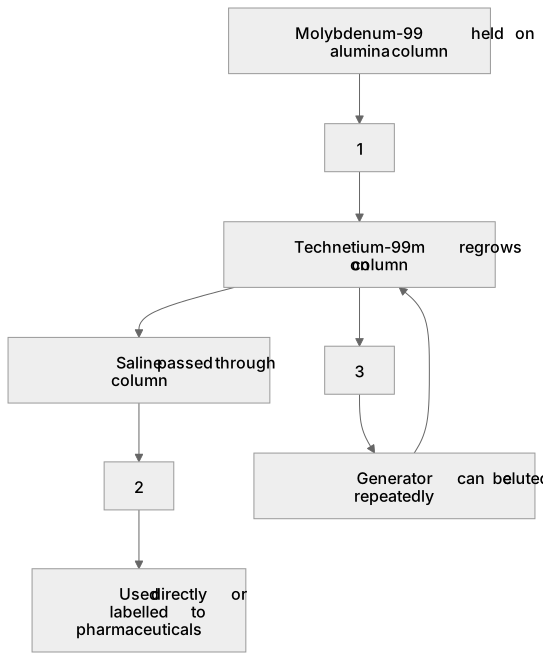
Some boxes have lost their names. Pick the right name for each number.
1Box 1
2Box 2
3Box 3
There is more to this lesson
The full lesson goes on to check your understanding and help you earn the marks. Create a free account to carry on, with your progress saved.
A week of Premium from your first lesson · Then the free plan continues · No card, no charge
Test your understanding of Imaging techniques (A-level only): The Molybdenum-Technetium generator, its basic use and importance.
Active recall beats re-reading. Take an instant quiz now to test what you’ve learned and lock it into long-term memory.
A week of Premium from your first lesson · Then the free plan continues · No card, no charge