AQA · A-Level · Physics
Course version: 7408 · Version from Sept 2016
Interference: Path difference. Coherence.
Interference depends on how waves combine after travelling different distances.
Checked against the AQA 7408 specification (opens in a new tab) on .
- Point 1 of 7
- 4 key terms
Study notes
From the checked teaching notes for this specification point.
The idea
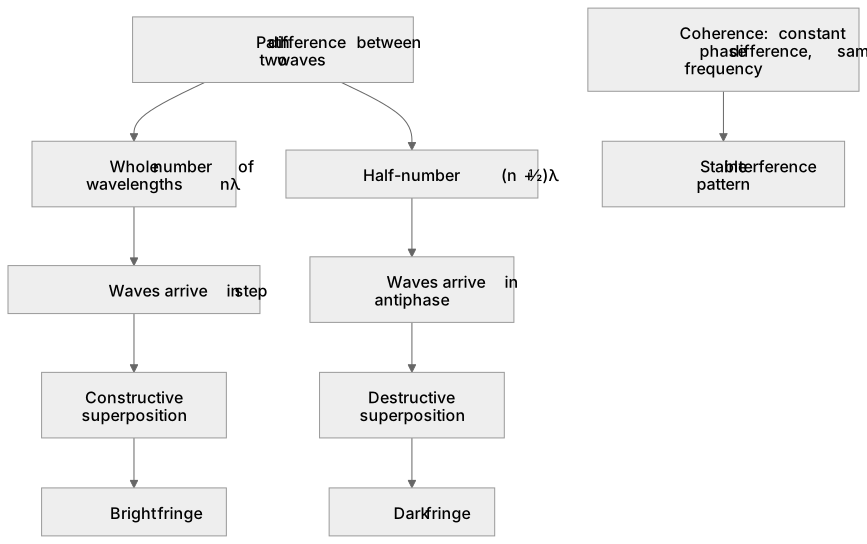
Interference depends on how waves combine after travelling different distances. Path difference is the extra distance one wave travels compared with another from the same source to a point; it determines whether they arrive in step or out of step. Coherence means waves have a constant phase difference and, in practice, the same frequency. Two coherent sources produce a stable pattern: path difference of a whole number of wavelengths gives constructive superposition and bright fringes, while a half-number gives destructive superposition and dark fringes. For example, if one path is 2.5λ longer, the waves arrive in antiphase and cancel. Lasers provide coherent light; separate lamps do not, so their patterns shift too quickly to observe.
What earns the marks
- Define path difference as the difference in distance travelled by two waves from their sources to the same point.
- State that constructive interference occurs when path difference is nλ, where n is an integer, giving a bright fringe or maximum.
- State that destructive interference occurs when path difference is (n + ½)λ, giving a dark fringe or minimum.
- Define coherence as a constant phase difference between waves, which for sustained interference requires the same frequency.
- Explain that a laser produces coherent, monochromatic light, so a stable interference pattern can be observed.
- Apply the path-difference conditions to a two-source arrangement, such as Young's double-slit experiment, to predict fringe positions.
Common mistakes and how to put them right
Treating path difference as the distance between the two sources rather than the difference in path lengths to a point.
Put it right by measuring each source-to-point distance and subtracting.
Believing any two waves of the same wavelength are automatically coherent.
Put it right by requiring a constant phase difference, which usually means a common source or a laser.
Using the condition for maxima for minima.
Put it right by associating whole-number multiples of wavelength with maxima and half-number multiples with minima.
Exam tips
- Sketch two waves from sources to a point and label the extra distance as the path difference before substituting values.
- When asked why a pattern is not observed with two lamps, link the answer to rapidly changing phase difference rather than to brightness alone.
- Check whether the question asks for a condition or a calculation; for calculations, convert all lengths to metres and keep wavelengths in metres.
Try the lesson
The start of the Interference: Path difference. Coherence. lesson, made from checked teaching notes for this specification point.
Have a go first
Two loudspeakers emit sound waves of the same frequency and are connected to the same signal generator. A student stands where the path difference from the two speakers is 1.5 wavelengths. What is observed at that point?
Listen
Interference depends on how waves combine after travelling different distances. Path difference is the extra distance one wave travels compared with another from the same source to a point; it determines whether they arrive in step or out of step. Coherence means waves have a constant phase difference and, in practice, the same frequency. Two coherent sources produce a stable pattern: path difference of a whole number of wavelengths gives constructive superposition and bright fringes, while a half-number gives destructive superposition and dark fringes. For example, if one path is 2.5λ longer, the waves arrive in antiphase and cancel. Lasers provide coherent light; separate lamps do not, so their patterns shift too quickly to observe. A strong answer earns marks for these points. Define path difference as the difference in distance travelled by two waves from their sources to the same point. State that constructive interference occurs when path difference is nλ, where n is an integer, giving a bright fringe or maximum. State that destructive interference occurs when path difference is (n + ½)λ, giving a dark fringe or minimum. Define coherence as a constant phase difference between waves, which for sustained interference requires the same frequency. A common slip: Treating path difference as the distance between the two sources rather than the difference in path lengths to a point. Instead, measuring each source-to-point distance and subtracting. Exam tip: Sketch two waves from sources to a point and label the extra distance as the path difference before substituting values.
See it
Key words
Say what each word means before you turn the card.
Path difference
Try answering aloud or in your head before turning the card.
Coherence
Try answering aloud or in your head before turning the card.
Constructive superposition
Try answering aloud or in your head before turning the card.
Destructive superposition
Try answering aloud or in your head before turning the card.
See every definition
- Path difference
- The extra distance one wave travels compared with another from the same source to a point, determining whether they arrive in step or out of step.
- Coherence
- Waves have a constant phase difference and, in practice, the same frequency.
- Constructive superposition
- A path difference of a whole number of wavelengths gives this, producing bright fringes.
- Destructive superposition
- A path difference of a half-number of wavelengths gives this, producing dark fringes.
Label the diagram
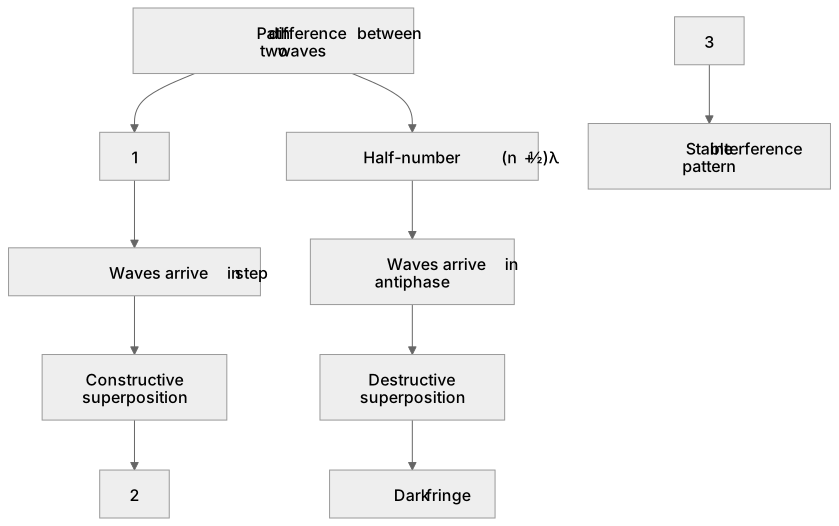
Some boxes have lost their names. Pick the right name for each number.
1Box 1
2Box 2
3Box 3
There is more to this lesson
The full lesson goes on to check your understanding and help you earn the marks. Create a free account to carry on, with your progress saved.
A week of Premium from your first lesson · Then the free plan continues · No card, no charge
Test your understanding of Interference: Path difference. Coherence.
Active recall beats re-reading. Take an instant quiz now to test what you’ve learned and lock it into long-term memory.
A week of Premium from your first lesson · Then the free plan continues · No card, no charge