AQA · A-Level · Physics
Course version: 7408 · Version from Sept 2016
Interference and diffraction using a laser as a source of monochromatic…
Full specification wording
Interference: Interference and diffraction using a laser as a source of monochromatic light.
A laser emits monochromatic, coherent light, so it is ideal for demonstrating both interference and diffraction.
Checked against the AQA 7408 specification (opens in a new tab) on .
- Point 2 of 7
- 4 key terms
Study notes
From the checked teaching notes for this specification point.
The idea
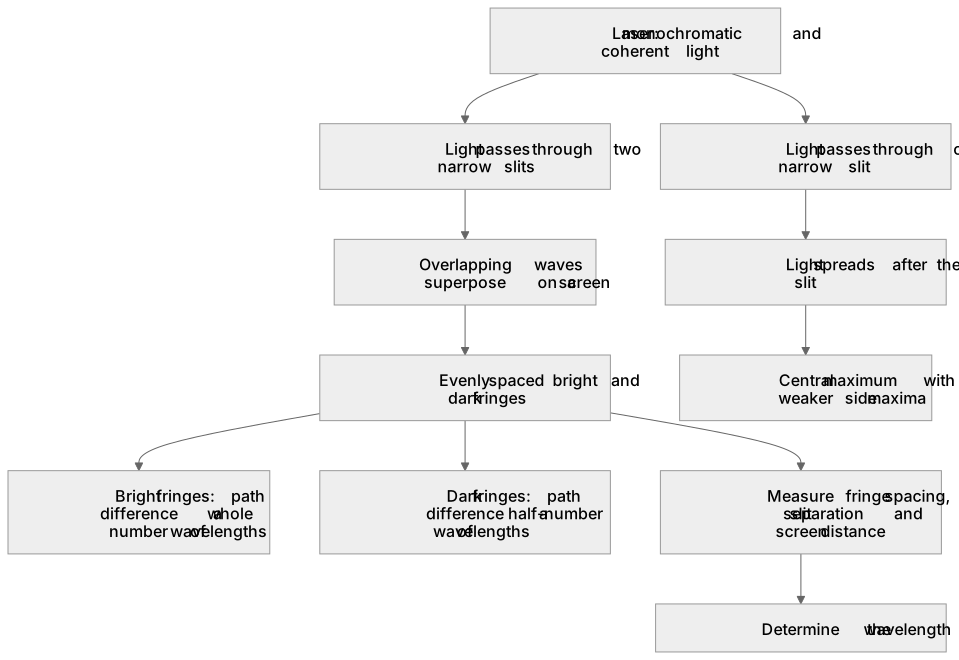
A laser emits monochromatic, coherent light, so it is ideal for demonstrating both interference and diffraction. In a double-slit experiment, light from the laser passes through two narrow slits and the overlapping waves superpose on a screen, producing evenly spaced bright and dark fringes. The fringe spacing depends on wavelength, slit separation and slit-to-screen distance. In single-slit diffraction, light spreads after passing through one narrow slit, forming a central maximum with weaker side maxima. Because the laser light is monochromatic, each fringe corresponds to a specific path difference, and because it is coherent, the pattern remains stable. Measurements of fringe spacing, slit separation and screen distance allow the wavelength to be determined.
What earns the marks
- Describe how laser light passes through two slits and superposes to form a pattern of bright and dark fringes on a screen.
- Explain that the laser provides monochromatic light of a single wavelength and coherent light with a constant phase difference.
- Use the relationship between fringe spacing, wavelength, slit separation and distance from slits to screen to calculate wavelength or another quantity.
- Describe single-slit diffraction as spreading of light with a central maximum and subsidiary maxima of lower intensity.
- Explain that bright fringes occur where path difference is a whole number of wavelengths and dark fringes where it is a half-number of wavelengths.
- Describe a practical measurement: measuring across several fringe spacings and dividing to reduce uncertainty in the fringe spacing.
Common mistakes and how to put them right
Using the distance from one slit to the screen instead of the perpendicular distance from the slits to the screen.
Put it right by measuring the perpendicular distance.
Measuring only one fringe spacing, which gives a large percentage uncertainty.
Put it right by measuring across many fringes and dividing by the number of spacings.
Confusing the roles of the two slits in interference with the single slit in diffraction.
Put it right by linking two slits to an interference pattern and one narrow slit to a diffraction pattern.
Exam tips
- State clearly that the laser is both monochromatic and coherent, as each property supports a stable, measurable pattern.
- When calculating wavelength, rearrange the fringe-spacing equation before substituting values, and include the unit metre throughout.
- For practical questions, describe measuring across multiple fringes and dividing, and mention repeating the measurement to improve reliability.
Try the lesson
The start of the Interference: Interference and diffraction using a laser as a source of monochromatic light. lesson, made from checked teaching notes for this specification point.
Have a go first
A laser is used to illuminate a double slit in a demonstration of interference. Why is a laser suitable for this demonstration?
Listen
A laser emits monochromatic, coherent light, so it is ideal for demonstrating both interference and diffraction. In a double-slit experiment, light from the laser passes through two narrow slits and the overlapping waves superpose on a screen, producing evenly spaced bright and dark fringes. The fringe spacing depends on wavelength, slit separation and slit-to-screen distance. In single-slit diffraction, light spreads after passing through one narrow slit, forming a central maximum with weaker side maxima. Because the laser light is monochromatic, each fringe corresponds to a specific path difference, and because it is coherent, the pattern remains stable. Measurements of fringe spacing, slit separation and screen distance allow the wavelength to be determined. A strong answer earns marks for these points. Describe how laser light passes through two slits and superposes to form a pattern of bright and dark fringes on a screen. Explain that the laser provides monochromatic light of a single wavelength and coherent light with a constant phase difference. Use the relationship between fringe spacing, wavelength, slit separation and distance from slits to screen to calculate wavelength or another quantity. Describe single-slit diffraction as spreading of light with a central maximum and subsidiary maxima of lower intensity. A common slip: Using the distance from one slit to the screen instead of the perpendicular distance from the slits to the screen. Instead, measuring the perpendicular distance. Exam tip: State clearly that the laser is both monochromatic and coherent, as each property supports a stable, measurable pattern.
See it
Key words
Say what each word means before you turn the card.
Coherent monochromatic sources
Try answering aloud or in your head before turning the card.
Double-slit interference
Try answering aloud or in your head before turning the card.
Single-slit diffraction
Try answering aloud or in your head before turning the card.
Experimental measurement and uncertainty
Try answering aloud or in your head before turning the card.
See every definition
- Coherent monochromatic sources
- A laser emits monochromatic light of a single wavelength and coherent light with a constant phase difference, so the pattern remains stable.
- Double-slit interference
- Light from the laser passes through two narrow slits and the overlapping waves superpose on a screen, producing evenly spaced bright and dark fringes.
- Single-slit diffraction
- Light spreads after passing through one narrow slit, forming a central maximum with weaker side maxima.
- Experimental measurement and uncertainty
- Measuring across several fringe spacings and dividing reduces uncertainty in the fringe spacing.
Label the diagram
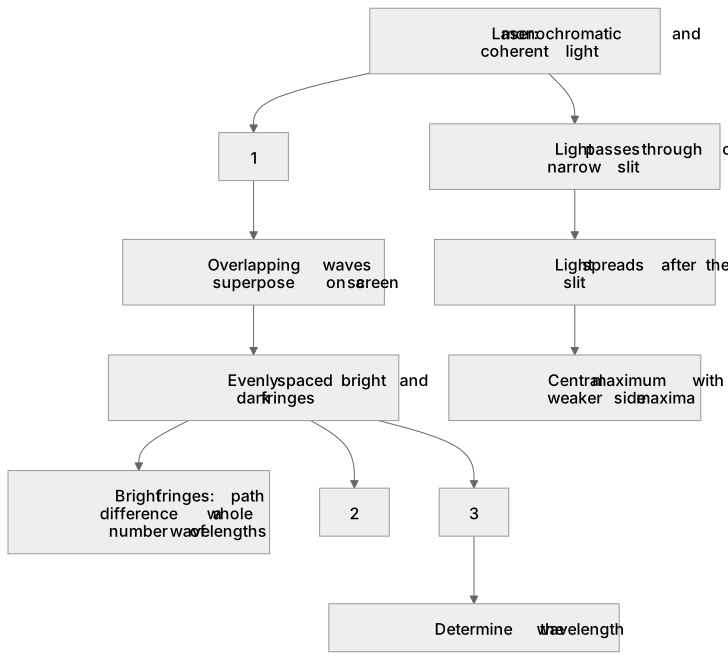
Some boxes have lost their names. Pick the right name for each number.
1Box 1
2Box 2
3Box 3
There is more to this lesson
The full lesson goes on to check your understanding and help you earn the marks. Create a free account to carry on, with your progress saved.
A week of Premium from your first lesson · Then the free plan continues · No card, no charge
Test your understanding of Interference: Interference and diffraction using a laser as a source of monochromatic light.
Active recall beats re-reading. Take an instant quiz now to test what you’ve learned and lock it into long-term memory.
A week of Premium from your first lesson · Then the free plan continues · No card, no charge