AQA · A-Level · Physics
Course version: 7408 · Version from Sept 2016
Young’s double-slit experiment: the use of two coherent sources or the use…
Full specification wording
Interference: Young’s double-slit experiment: the use of two coherent sources or the use of a single source with double slits to produce an interference pattern.
Young’s double-slit experiment demonstrates interference of light.
Checked against the AQA 7408 specification (opens in a new tab) on .
- Point 3 of 7
- 4 key terms
Study notes
From the checked teaching notes for this specification point.
The idea
Young’s double-slit experiment demonstrates interference of light. Two sources are coherent when they emit waves of the same frequency with a constant phase difference, so their superposition is stable in time. This can be achieved by illuminating two narrow slits with one source, because both slits then receive light from the same wavefronts. The slits act as two coherent sources. Where path differences are whole numbers of wavelengths, constructive interference produces bright fringes; where path differences are odd numbers of half-wavelengths, destructive interference produces dark fringes. A laser gives a convenient coherent source, while a single lamp with a double slit avoids the difficulty of keeping two separate lamps coherent. The pattern is observed on a screen as equally spaced bright and dark fringes.
What earns the marks
- States that coherent sources have the same frequency and a constant phase difference.
- Explains that a single source illuminating two slits produces two coherent sources because both slits are supplied by the same wavefronts.
- Describes constructive interference as occurring when the path difference is a whole number of wavelengths, giving a bright fringe.
- Describes destructive interference as occurring when the path difference is an odd number of half-wavelengths, giving a dark fringe.
- Uses the double-slit arrangement with a screen to observe an interference pattern of equally spaced bright and dark fringes.
- Distinguishes the double-slit method from using two independent sources, which would not remain coherent unless synchronised.
Common mistakes and how to put them right
Thinking that any two lamps of the same colour are automatically coherent.
Put it right: Coherence requires a constant phase difference, which independent lamps do not maintain.
Confusing the roles of the single source and the double slits.
Put it right: The single source provides the initial wavefronts, and the two slits create the two coherent sources.
Stating that bright fringes arise from waves that are in phase at the screen without linking this to a whole-number path difference.
Put it right: Bright fringes require a path difference of a whole number of wavelengths.
Exam tips
- Define coherence precisely before describing the experiment, because many marks depend on the same frequency and constant phase difference.
- When describing the pattern, refer to bright and dark fringes rather than vague bands of light and shade.
- Link each observed fringe to the path difference condition, using whole wavelengths for bright fringes and odd half-wavelengths for dark fringes.
Try the lesson
The start of the Interference: Young’s double-slit experiment: the use of two coherent sources or the use of a single source with double slits to produce an interference pattern. lesson, made from checked teaching notes for this specification point.
Have a go first
In Young’s double-slit experiment, why must the two sources of light be coherent?
Listen
Young’s double-slit experiment demonstrates interference of light. Two sources are coherent when they emit waves of the same frequency with a constant phase difference, so their superposition is stable in time. This can be achieved by illuminating two narrow slits with one source, because both slits then receive light from the same wavefronts. The slits act as two coherent sources. Where path differences are whole numbers of wavelengths, constructive interference produces bright fringes; where path differences are odd numbers of half-wavelengths, destructive interference produces dark fringes. A laser gives a convenient coherent source, while a single lamp with a double slit avoids the difficulty of keeping two separate lamps coherent. The pattern is observed on a screen as equally spaced bright and dark fringes. A strong answer earns marks for these points. States that coherent sources have the same frequency and a constant phase difference. Explains that a single source illuminating two slits produces two coherent sources because both slits are supplied by the same wavefronts. Describes constructive interference as occurring when the path difference is a whole number of wavelengths, giving a bright fringe. Describes destructive interference as occurring when the path difference is an odd number of half-wavelengths, giving a dark fringe. A common slip: Thinking that any two lamps of the same colour are automatically coherent. Instead, coherence requires a constant phase difference, which independent lamps do not maintain. Exam tip: Define coherence precisely before describing the experiment, because many marks depend on the same frequency and constant phase difference.
See it
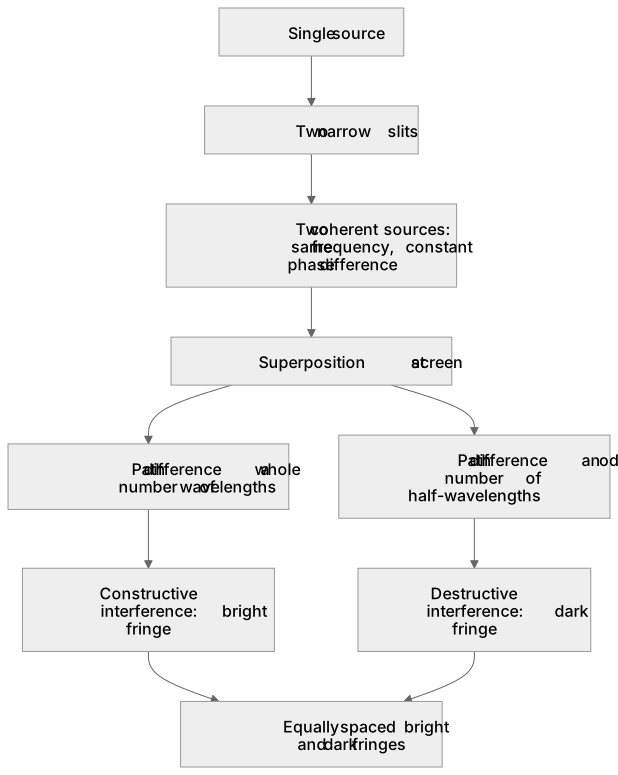
Key words
Say what each word means before you turn the card.
Coherent sources
Try answering aloud or in your head before turning the card.
Constructive interference
Try answering aloud or in your head before turning the card.
Destructive interference
Try answering aloud or in your head before turning the card.
Double-slit arrangement
Try answering aloud or in your head before turning the card.
See every definition
- Coherent sources
- Sources that emit waves of the same frequency with a constant phase difference, so their superposition is stable in time.
- Constructive interference
- Occurs where path differences are whole numbers of wavelengths, producing bright fringes.
- Destructive interference
- Occurs where path differences are odd numbers of half-wavelengths, producing dark fringes.
- Double-slit arrangement
- Uses two coherent sources, or a single source with double slits, to produce an interference pattern observed on a screen as equally spaced bright and dark fringes.
Label the diagram
Some boxes have lost their names. Pick the right name for each number.
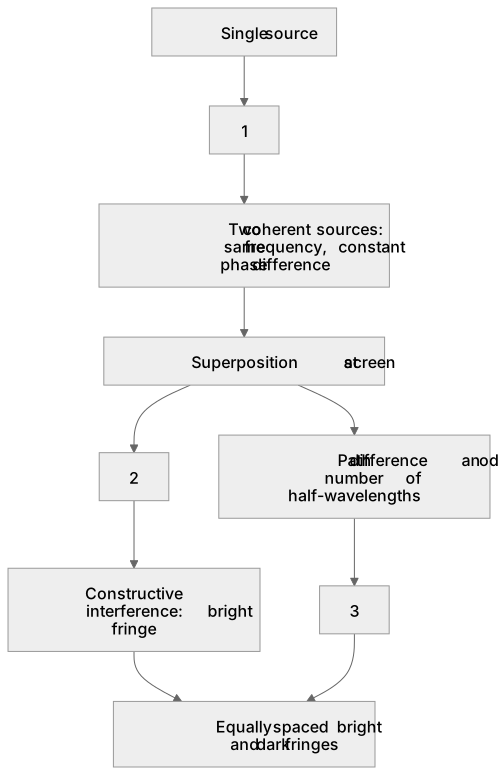
1Box 1
2Box 2
3Box 3
There is more to this lesson
The full lesson goes on to check your understanding and help you earn the marks. Create a free account to carry on, with your progress saved.
A week of Premium from your first lesson · Then the free plan continues · No card, no charge
Test your understanding of Interference: Young’s double-slit experiment: the use of two coherent sources or the use of a single source with double slits to produce an interference pattern.
Active recall beats re-reading. Take an instant quiz now to test what you’ve learned and lock it into long-term memory.
A week of Premium from your first lesson · Then the free plan continues · No card, no charge