AQA · A-Level · Physics
Course version: 7408 · Version from Sept 2016
Magnetic flux density (A-level only): Fleming’s left hand rule.
Fleming’s left hand rule predicts the direction of the force on a current-carrying conductor in a magnetic field.
Checked against the AQA 7408 specification (opens in a new tab) on .
- Point 2 of 4
Study notes
From the checked teaching notes for this specification point.
The idea
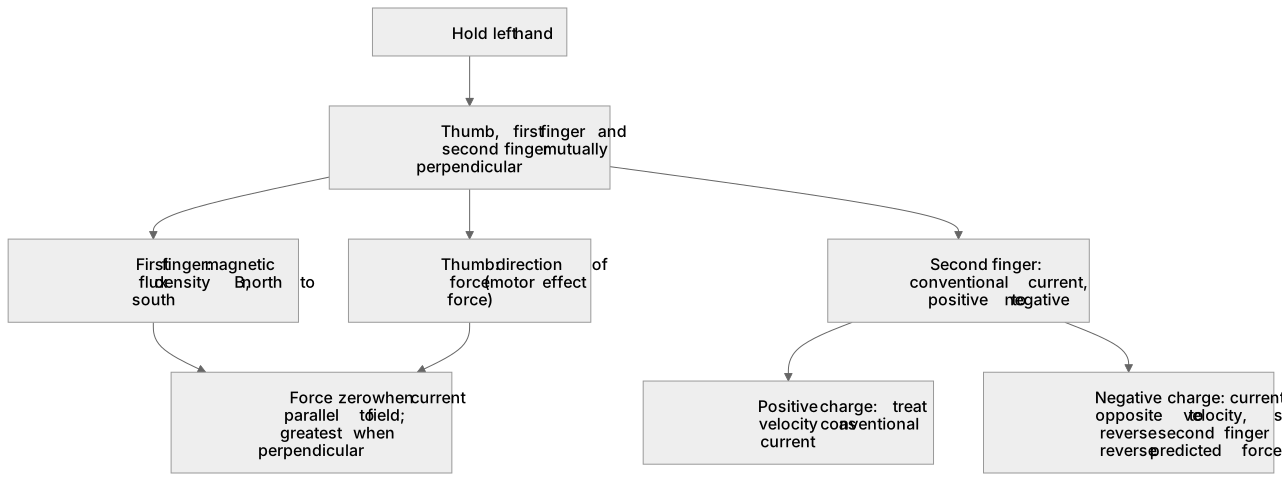
Fleming’s left hand rule predicts the direction of the force on a current-carrying conductor in a magnetic field. Hold the left hand with the thumb, first finger and second finger mutually perpendicular. The first finger points along the magnetic flux density B from north to south. The second finger points in the conventional current direction, from positive to negative. The thumb then gives the direction of the force, also called the motor effect force. For a positive charge moving in a field, treat the velocity as conventional current. For a negative charge such as an electron, the current is opposite to the velocity, so reverse the second finger or reverse the predicted force. The rule applies when the current and field are not parallel; the force is greatest when they are perpendicular. Use it with F = BIl sin θ to link direction and magnitude.
What earns the marks
- States that the first finger represents the magnetic flux density B, directed from north to south.
- States that the second finger represents conventional current, from positive to negative.
- States that the thumb represents the direction of the force on the conductor.
- Describes the three digits as mutually perpendicular when the hand is held correctly.
- Applies the rule to a moving positive charge by taking the current direction as the velocity direction.
- Applies the rule to a moving negative charge by reversing the current direction relative to the velocity, or by reversing the force direction.
- Recognises that the force is zero when the current is parallel to the magnetic field and maximum when perpendicular.
Common mistakes and how to put them right
Using the right hand instead of the left hand.
Put it right: The right-hand rule gives the direction for a generator effect, so use the left hand for the motor effect force.
Pointing the second finger along electron flow rather than conventional current.
Put it right: Conventional current is opposite to electron flow, so reverse the finger for negative charge carriers.
Treating the first finger as the force and the thumb as the field.
Put it right: The first finger is the field and the thumb is the force, so swap them to obtain the correct prediction.
Exam tips
- Sketch the left hand with labelled fingers beside your working so the examiner can see the direction reasoning clearly.
- When a question gives an electron beam, state explicitly that conventional current is opposite to the electron velocity before applying the rule.
- Check whether the field and current are perpendicular; if they are parallel, state that the force is zero rather than forcing a direction.
Try the lesson
The start of the Magnetic flux density (A-level only): Fleming’s left hand rule. lesson, made from checked teaching notes for this specification point.
Have a go first
In Fleming’s left hand rule, which finger represents the direction of the magnetic field?
Listen
Fleming’s left hand rule predicts the direction of the force on a current-carrying conductor in a magnetic field. Hold the left hand with the thumb, first finger and second finger mutually perpendicular. The first finger points along the magnetic flux density B from north to south. The second finger points in the conventional current direction, from positive to negative. The thumb then gives the direction of the force, also called the motor effect force. For a positive charge moving in a field, treat the velocity as conventional current. For a negative charge such as an electron, the current is opposite to the velocity, so reverse the second finger or reverse the predicted force. The rule applies when the current and field are not parallel; the force is greatest when they are perpendicular. Use it with F = BIl sin θ to link direction and magnitude. A strong answer earns marks for these points. States that the first finger represents the magnetic flux density B, directed from north to south. States that the second finger represents conventional current, from positive to negative. States that the thumb represents the direction of the force on the conductor. Describes the three digits as mutually perpendicular when the hand is held correctly. Exam tip: Sketch the left hand with labelled fingers beside your working so the examiner can see the direction reasoning clearly.
See it
Label the diagram
Some boxes have lost their names. Pick the right name for each number.
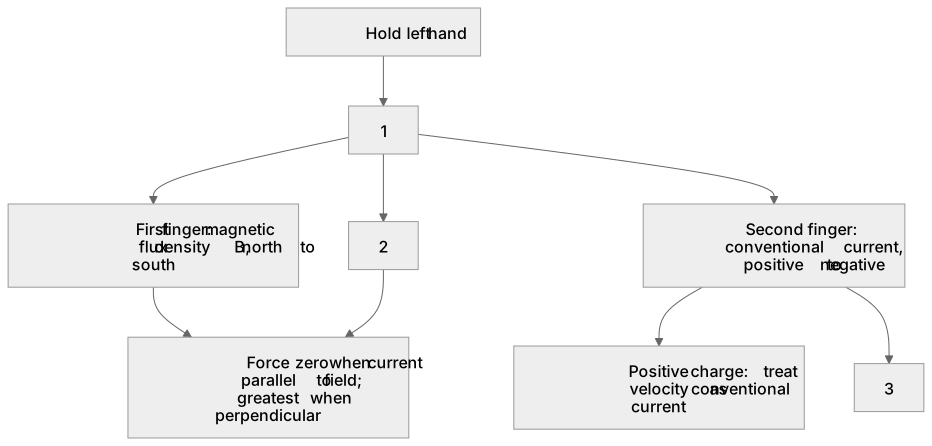
1Box 1
2Box 2
3Box 3
There is more to this lesson
The full lesson goes on to check your understanding and help you earn the marks. Create a free account to carry on, with your progress saved.
A week of Premium from your first lesson · Then the free plan continues · No card, no charge
Test your understanding of Magnetic flux density (A-level only): Fleming’s left hand rule.
Active recall beats re-reading. Take an instant quiz now to test what you’ve learned and lock it into long-term memory.
A week of Premium from your first lesson · Then the free plan continues · No card, no charge