AQA · A-Level · Physics
Course version: 7408 · Version from Sept 2016
Force on a current-carrying wire in a magnetic field: F = BIl when field…
Full specification wording
Magnetic flux density (A-level only): Force on a current-carrying wire in a magnetic field: F = BIl when field is perpendicular to current.
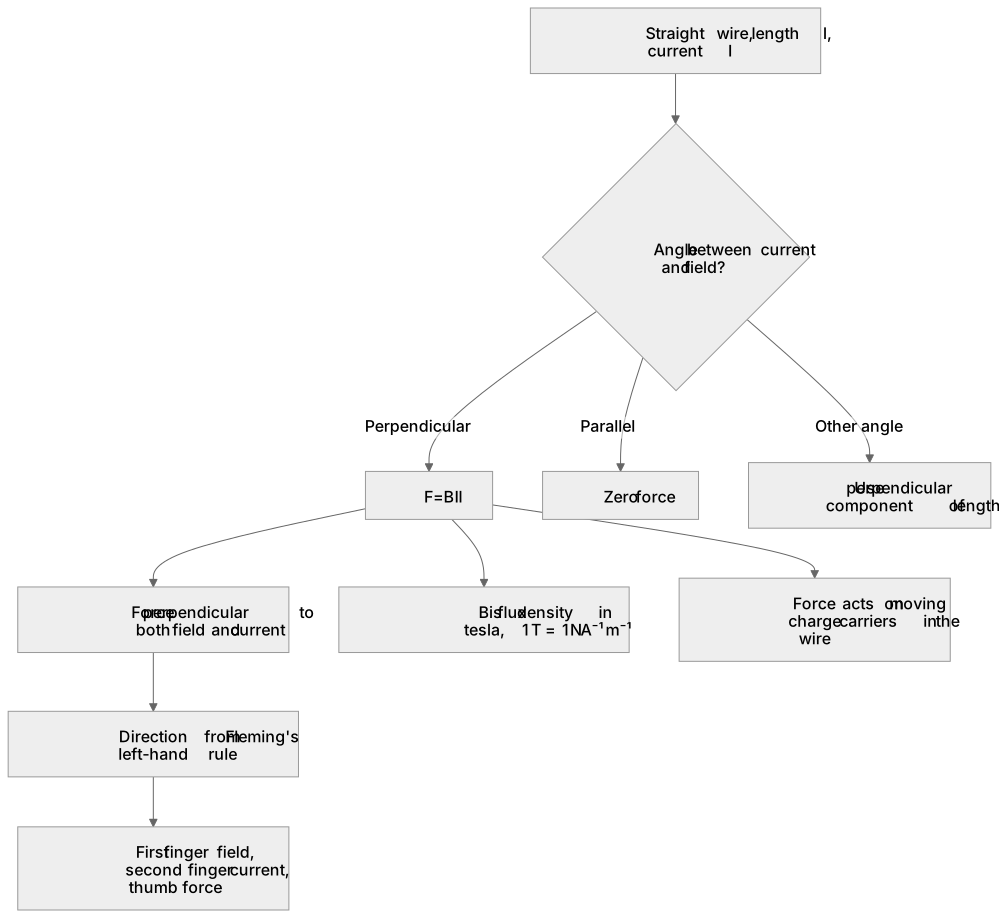
A straight wire of length l carrying current I at right angles to a uniform magnetic field of flux density B experiences a force F = BIl.
Checked against the AQA 7408 specification (opens in a new tab) on .
- Point 1 of 4
- 4 key terms
Study notes
From the checked teaching notes for this specification point.
The idea
A straight wire of length l carrying current I at right angles to a uniform magnetic field of flux density B experiences a force F = BIl. The force is perpendicular to both the field and the current, so Fleming's left-hand rule gives its direction: first finger field, second finger current, thumb motion or force. Flux density B is measured in tesla, where 1 T = 1 N A⁻¹ m⁻¹. Use the component of length perpendicular to the field if the wire is not at 90°, and note that a wire parallel to the field experiences no force. The equation applies to a uniform field and a straight conductor, and the force acts on the moving charge carriers within the wire.
What earns the marks
- States F = BIl and applies it only when the current is perpendicular to the magnetic field.
- Identifies B as magnetic flux density in tesla, with 1 T = 1 N A⁻¹ m⁻¹.
- Uses Fleming's left-hand rule to determine the direction of the force, which is perpendicular to both field and current.
- Recognises that a wire parallel to the field experiences zero force, and uses the perpendicular component of length for other angles.
- Rearranges the equation to find B, I or l and substitutes consistent SI units.
- Explains that the force arises from the magnetic force on the moving charge carriers in the wire.
Common mistakes and how to put them right
Using the full length of a wire that is not perpendicular to the field.
Put it right by using the component of length perpendicular to the field, l sin θ.
Applying F = BIl when the wire is parallel to the field, which gives zero force.
Put it right by checking the angle between current and field first.
Confusing the direction of force with the direction of current or field.
Put it right by applying Fleming's left-hand rule with the first two fingers mutually perpendicular.
Exam tips
- Sketch the field, current and force directions with arrows before substituting numbers.
- Convert length to metres and current to amperes, and quote the force in newtons with a sensible number of significant figures.
- If the wire is at an angle, state clearly that you are using the perpendicular component of length.
Try the lesson
The start of the Magnetic flux density (A-level only): Force on a current-carrying wire in a magnetic field: F = BIl when field is perpendicular to current. lesson, made from checked teaching notes for this specification point.
Have a go first
A straight wire of length 0.25 m carries a current of 4.0 A at right angles to a uniform magnetic field of flux density 0.30 T. Calculate the force on the wire.
Listen
A straight wire of length l carrying current I at right angles to a uniform magnetic field of flux density B experiences a force F = BIl. The force is perpendicular to both the field and the current, so Fleming's left-hand rule gives its direction: first finger field, second finger current, thumb motion or force. Flux density B is measured in tesla, where 1 T = 1 N A⁻¹ m⁻¹. Use the component of length perpendicular to the field if the wire is not at 90°, and note that a wire parallel to the field experiences no force. The equation applies to a uniform field and a straight conductor, and the force acts on the moving charge carriers within the wire. A strong answer earns marks for these points. States F = BIl and applies it only when the current is perpendicular to the magnetic field. Identifies B as magnetic flux density in tesla, with 1 T = 1 N A⁻¹ m⁻¹. Uses Fleming's left-hand rule to determine the direction of the force, which is perpendicular to both field and current. Recognises that a wire parallel to the field experiences zero force, and uses the perpendicular component of length for other angles. A common slip: Using the full length of a wire that is not perpendicular to the field. Instead, using the component of length perpendicular to the field, l sin θ. Exam tip: Sketch the field, current and force directions with arrows before substituting numbers.
See it
Key words
Say what each word means before you turn the card.
Magnetic flux density
Try answering aloud or in your head before turning the card.
Fleming's left-hand rule
Try answering aloud or in your head before turning the card.
Force on a current-carrying wire
Try answering aloud or in your head before turning the card.
Wire parallel to the field
Try answering aloud or in your head before turning the card.
See every definition
- Magnetic flux density
- Measured in tesla, where 1 T = 1 N A⁻¹ m⁻¹, and denoted by B in the equation F = BIl.
- Fleming's left-hand rule
- Gives the direction of the force: first finger field, second finger current, thumb motion or force.
- Force on a current-carrying wire
- F = BIl when the field is perpendicular to the current, and the force is perpendicular to both the field and the current.
- Wire parallel to the field
- Experiences no force, and for other angles the component of length perpendicular to the field is used.
There is more to this lesson
The full lesson goes on to check your understanding and help you earn the marks. Create a free account to carry on, with your progress saved.
A week of Premium from your first lesson · Then the free plan continues · No card, no charge
Test your understanding of Magnetic flux density (A-level only): Force on a current-carrying wire in a magnetic field: F = BIl when field is perpendicular to current.
Active recall beats re-reading. Take an instant quiz now to test what you’ve learned and lock it into long-term memory.
A week of Premium from your first lesson · Then the free plan continues · No card, no charge