AQA · A-Level · Physics
Course version: 7408 · Version from Sept 2016
Mass and energy (A-level only): Atomic mass unit, u.
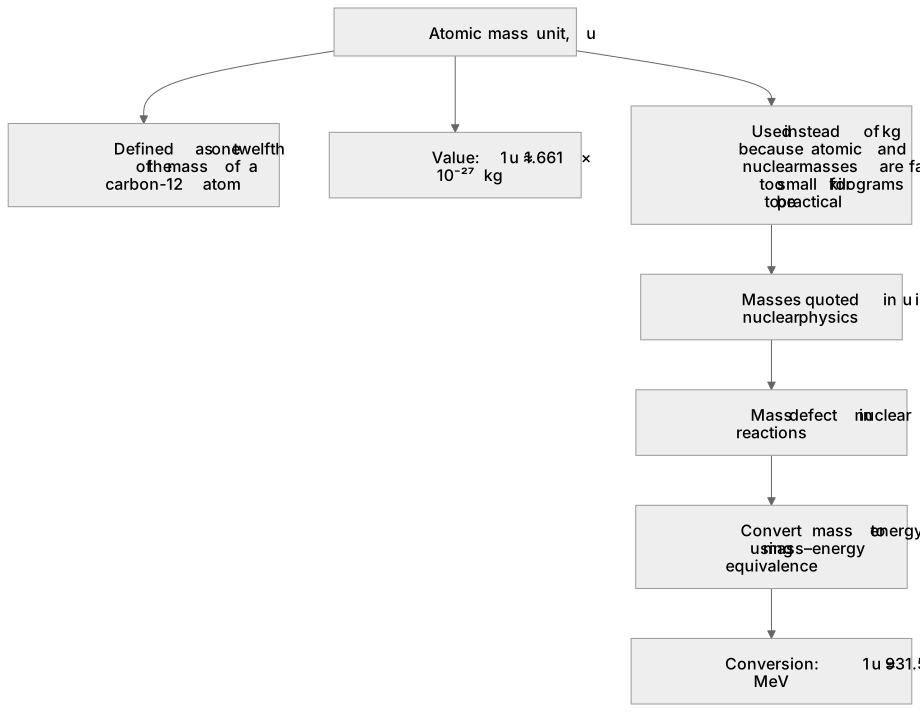
The atomic mass unit, u, is a non-SI unit of mass defined as one twelfth of the mass of a carbon-12 atom in its nuclear and electronic ground state.
Checked against the AQA 7408 specification (opens in a new tab) on .
- Point 1 of 8
- 4 key terms
Study notes
From the checked teaching notes for this specification point.
The idea
The atomic mass unit, u, is a non-SI unit of mass defined as one twelfth of the mass of a carbon-12 atom in its nuclear and electronic ground state. It provides a convenient scale for atomic and nuclear masses because these are far too small for kilograms to be practical. One u is approximately 1.661 × 10⁻²⁷ kg. In nuclear physics, masses are often quoted in u, and mass differences in nuclear reactions are converted to energy using Einstein’s mass–energy equivalence.
For example: The mass defect of a helium-4 nucleus is about 0.0304 u, which corresponds to a binding energy of roughly 28.3 MeV.
What earns the marks
- State that the atomic mass unit is defined as one twelfth of the mass of a carbon-12 atom.
- Recall that 1 u ≈ 1.661 × 10⁻²⁷ kg.
- Use u as a unit of mass in nuclear calculations, such as mass defect.
- Convert mass in u to energy using the equivalence 1 u = 931.5 MeV.
- Explain why u is used instead of kg for atomic and nuclear masses.
Common mistakes and how to put them right
Confusing the atomic mass unit with the relative atomic mass.
Put it right: u is a unit of mass, while relative atomic mass is a dimensionless ratio.
Using 1 u = 1.66 × 10⁻²⁷ kg without recognising it is an approximation.
Put it right: Use the more precise value 1.661 × 10⁻²⁷ kg when needed.
Forgetting to convert mass from u to kg before using SI equations.
Put it right: Either convert to kg or use the energy equivalent 1 u = 931.5 MeV directly.
Exam tips
- Learn the definition of u precisely, including the carbon-12 reference.
- In calculations, keep track of units and convert to kg if the equation requires SI units.
- Use the conversion 1 u = 931.5 MeV to simplify energy calculations in nuclear reactions.
Try the lesson
The start of the Mass and energy (A-level only): Atomic mass unit, u. lesson, made from checked teaching notes for this specification point.
Have a go first
Which statement defines the atomic mass unit, u?
Listen
The atomic mass unit, u, is a non-SI unit of mass defined as one twelfth of the mass of a carbon-12 atom in its nuclear and electronic ground state. It provides a convenient scale for atomic and nuclear masses because these are far too small for kilograms to be practical. One u is approximately 1.661 × 10⁻²⁷ kg. In nuclear physics, masses are often quoted in u, and mass differences in nuclear reactions are converted to energy using Einstein’s mass–energy equivalence. For example, the mass defect of a helium-4 nucleus is about 0.0304 u, which corresponds to a binding energy of roughly 28.3 MeV. A strong answer earns marks for these points. State that the atomic mass unit is defined as one twelfth of the mass of a carbon-12 atom. Recall that 1 u ≈ 1.661 × 10⁻²⁷ kg. Use u as a unit of mass in nuclear calculations, such as mass defect. Convert mass in u to energy using the equivalence 1 u = 931.5 MeV. A common slip: Confusing the atomic mass unit with the relative atomic mass. Instead, u is a unit of mass, while relative atomic mass is a dimensionless ratio. Exam tip: Learn the definition of u precisely, including the carbon-12 reference.
See it
Key words
Say what each word means before you turn the card.
Atomic mass unit
Try answering aloud or in your head before turning the card.
Mass defect
Try answering aloud or in your head before turning the card.
Mass–energy equivalence
Try answering aloud or in your head before turning the card.
Binding energy
Try answering aloud or in your head before turning the card.
See every definition
- Atomic mass unit
- A non-SI unit of mass defined as one twelfth of the mass of a carbon-12 atom in its nuclear and electronic ground state.
- Mass defect
- A difference in mass in nuclear reactions that is converted to energy using Einstein's mass–energy equivalence.
- Mass–energy equivalence
- Einstein's principle that mass and energy are equivalent, enabling conversion between u and MeV.
- Binding energy
- The energy corresponding to the mass defect of a nucleus, such as roughly 28.3 MeV for helium-4.
Label the diagram
Some boxes have lost their names. Pick the right name for each number.
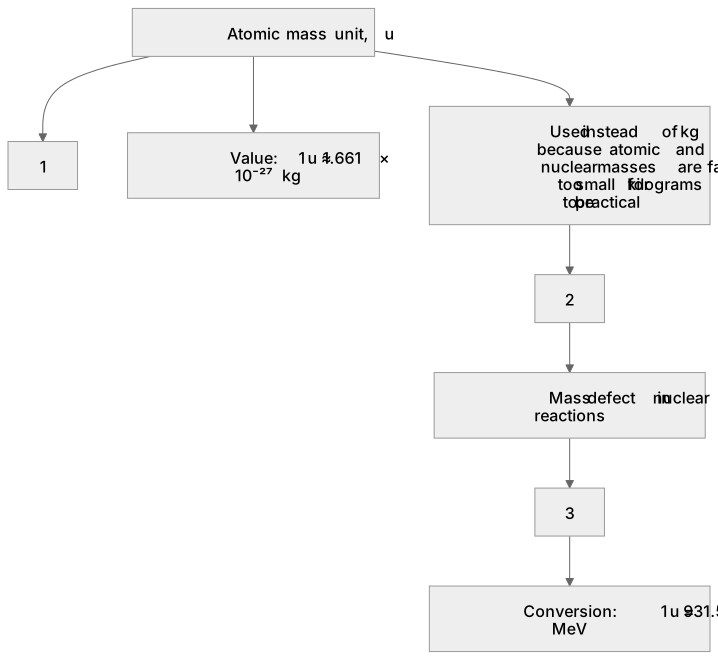
1Box 1
2Box 2
3Box 3
There is more to this lesson
The full lesson goes on to check your understanding and help you earn the marks. Create a free account to carry on, with your progress saved.
A week of Premium from your first lesson · Then the free plan continues · No card, no charge
Test your understanding of Mass and energy (A-level only): Atomic mass unit, u.
Active recall beats re-reading. Take an instant quiz now to test what you’ve learned and lock it into long-term memory.
A week of Premium from your first lesson · Then the free plan continues · No card, no charge