AQA · A-Level · Physics
Course version: 7408 · Version from Sept 2016
Moments: Centre of mass.
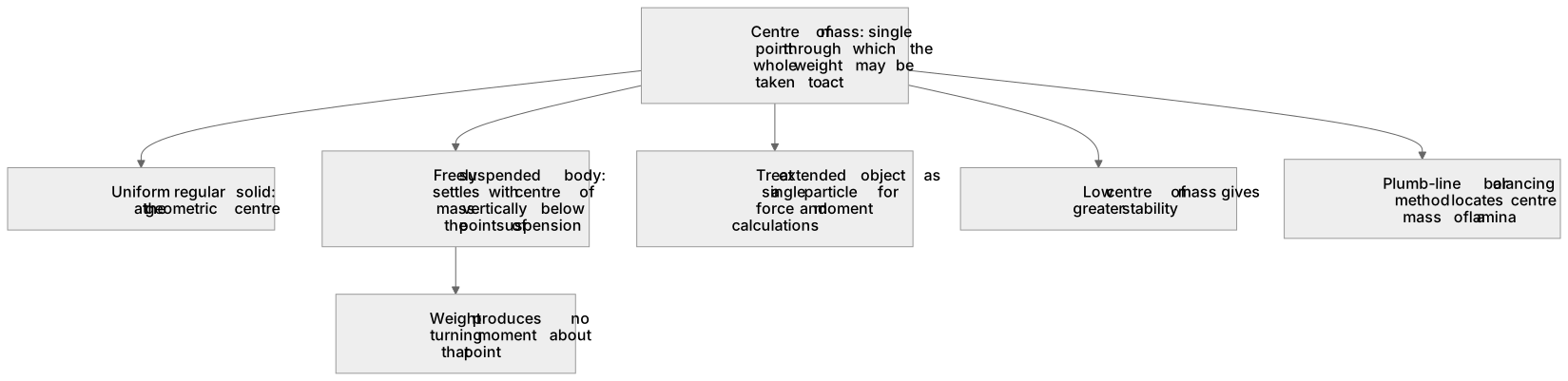
The centre of mass of a body is the single point through which the whole weight of the body may be taken to act.
Checked against the AQA 7408 specification (opens in a new tab) on .
- Point 6 of 7
Study notes
From the checked teaching notes for this specification point.
The idea
The centre of mass of a body is the single point through which the whole weight of the body may be taken to act. For a uniform regular solid it lies at the geometric centre, so a metre ruler balances at its 50 cm mark and a cube balances above the centre of its base. When a body is freely suspended it settles with its centre of mass directly below the point of suspension, because the weight then produces no turning moment about that point. This idea lets you treat an extended object as a single particle for force and moment calculations, and it explains why a low centre of mass gives greater stability.
What earns the marks
- State that the centre of mass is the point at which the entire weight of the body may be considered to act.
- Explain that a freely suspended body comes to rest with its centre of mass vertically below the point of suspension.
- Use the centre of mass as the point of application of the weight when taking moments about a pivot.
- Recognise that for a uniform regular solid the centre of mass coincides with the geometric centre.
- Describe a plumb-line or balancing method for locating the centre of mass of a lamina experimentally.
Common mistakes and how to put them right
Treating the centre of mass as a point where gravity is absent or where no weight acts.
Put it right by stating that the whole weight acts through that point.
Assuming every object's centre of mass lies inside the material.
Put it right by noting that a hollow ring or a horseshoe has its centre of mass in the empty space.
Placing the weight at the nearest edge or at the pivot when taking moments.
Put it right by applying the weight at the centre of mass.
Exam tips
- Sketch the body with a single downward arrow labelled W at the centre of mass before writing any moment equation.
- When a body hangs in equilibrium, mark the vertical line through the suspension point and place the centre of mass on that line.
- Define the term precisely in one sentence, then apply it to the given object rather than repeating the definition.
Try the lesson
The start of the Moments: Centre of mass. lesson, made from checked teaching notes for this specification point.
Have a go first
Which statement best describes the centre of mass of a body?
Listen
The centre of mass of a body is the single point through which the whole weight of the body may be taken to act. For a uniform regular solid it lies at the geometric centre, so a metre ruler balances at its 50 cm mark and a cube balances above the centre of its base. When a body is freely suspended it settles with its centre of mass directly below the point of suspension, because the weight then produces no turning moment about that point. This idea lets you treat an extended object as a single particle for force and moment calculations, and it explains why a low centre of mass gives greater stability. A strong answer earns marks for these points. State that the centre of mass is the point at which the entire weight of the body may be considered to act. Explain that a freely suspended body comes to rest with its centre of mass vertically below the point of suspension. Use the centre of mass as the point of application of the weight when taking moments about a pivot. Recognise that for a uniform regular solid the centre of mass coincides with the geometric centre. A common slip: Treating the centre of mass as a point where gravity is absent or where no weight acts. Instead, stating that the whole weight acts through that point. Exam tip: Sketch the body with a single downward arrow labelled W at the centre of mass before writing any moment equation.
See it
Label the diagram
Some boxes have lost their names. Pick the right name for each number.
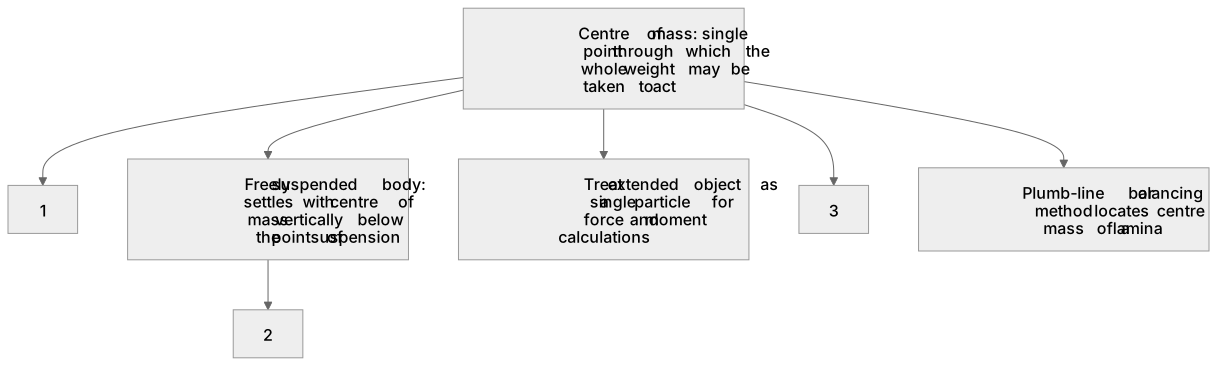
1Box 1
2Box 2
3Box 3
There is more to this lesson
The full lesson goes on to check your understanding and help you earn the marks. Create a free account to carry on, with your progress saved.
A week of Premium from your first lesson · Then the free plan continues · No card, no charge
Test your understanding of Moments: Centre of mass.
Active recall beats re-reading. Take an instant quiz now to test what you’ve learned and lock it into long-term memory.
A week of Premium from your first lesson · Then the free plan continues · No card, no charge