AQA · A-Level · Physics
Course version: 7408 · Version from Sept 2016
Knowledge that the position of the centre of mass of uniform regular solid…
Full specification wording
Moments: Knowledge that the position of the centre of mass of uniform regular solid is at its centre.
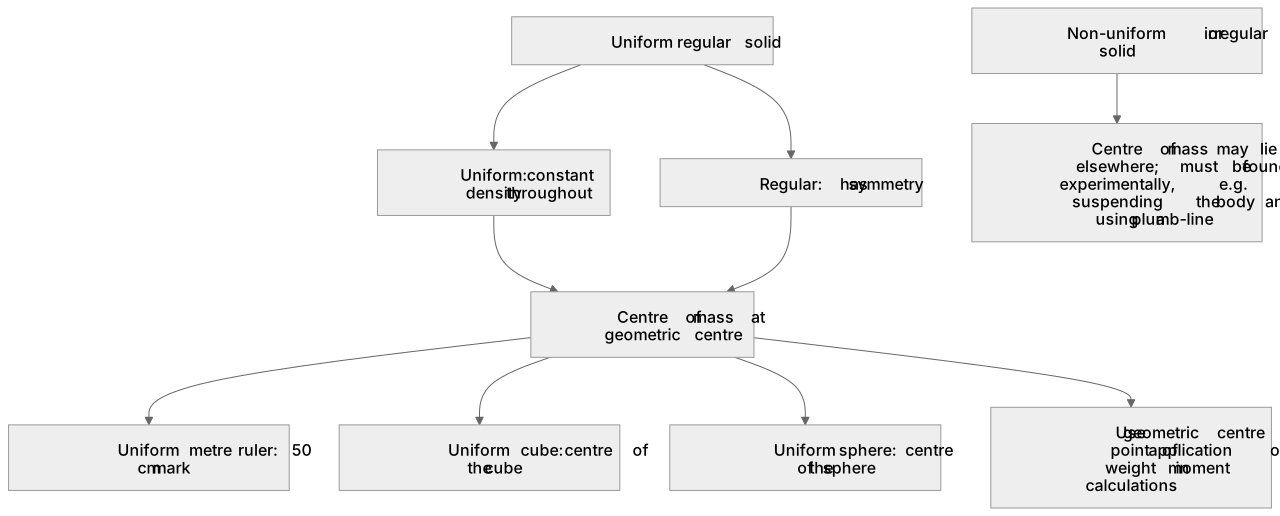
A uniform solid has the same density throughout, and a regular solid has symmetry, so its centre of mass lies at its geometric centre.
Checked against the AQA 7408 specification (opens in a new tab) on .
- Point 7 of 7
- 4 key terms
Study notes
From the checked teaching notes for this specification point.
The idea
A uniform solid has the same density throughout, and a regular solid has symmetry, so its centre of mass lies at its geometric centre. For a uniform metre ruler the centre of mass is at the 50 cm mark; for a cube it is at the centre of the cube; for a sphere it is at the sphere's centre. This symmetry result means you can place the whole weight at that point in moment calculations without measuring it. If the solid is not uniform, or not regular, the centre of mass may lie elsewhere and must be found experimentally, for example by suspending the body and using a plumb-line.
What earns the marks
- State that a uniform solid has constant density throughout its volume.
- State that a regular solid has symmetry, so its centre of mass is at its geometric centre.
- Locate the centre of mass of a uniform metre ruler at the 50 cm mark and of a uniform cube at the centre of the cube.
- Use the geometric centre as the point of application of the weight in moment calculations.
- Recognise that non-uniform or irregular solids may have their centre of mass away from the geometric centre.
Common mistakes and how to put them right
Placing the centre of mass of a uniform ruler at one end or at the 0 cm mark.
Put it right by using the 50 cm mark.
Assuming the centre of mass of any solid is at its centre regardless of uniformity.
Put it right by checking that the density is constant and the shape is regular.
Confusing the centre of mass with the centre of volume for a non-uniform body.
Put it right by noting that non-uniform density shifts the centre of mass.
Exam tips
- Quote the symmetry of the shape when justifying the position of the centre of mass.
- For a uniform ruler, state the 50 cm mark explicitly before balancing moments about a pivot.
- If a body is described as non-uniform, do not assume the centre of mass is at the geometric centre.
Try the lesson
The start of the Moments: Knowledge that the position of the centre of mass of uniform regular solid is at its centre. lesson, made from checked teaching notes for this specification point.
Have a go first
Where is the centre of mass of a uniform solid cube?
Listen
A uniform solid has the same density throughout, and a regular solid has symmetry, so its centre of mass lies at its geometric centre. For a uniform metre ruler the centre of mass is at the 50 cm mark; for a cube it is at the centre of the cube; for a sphere it is at the sphere's centre. This symmetry result means you can place the whole weight at that point in moment calculations without measuring it. If the solid is not uniform, or not regular, the centre of mass may lie elsewhere and must be found experimentally, for example by suspending the body and using a plumb-line. A strong answer earns marks for these points. State that a uniform solid has constant density throughout its volume. State that a regular solid has symmetry, so its centre of mass is at its geometric centre. Locate the centre of mass of a uniform metre ruler at the 50 cm mark and of a uniform cube at the centre of the cube. Use the geometric centre as the point of application of the weight in moment calculations. A common slip: Placing the centre of mass of a uniform ruler at one end or at the 0 cm mark. Instead, using the 50 cm mark. Exam tip: Quote the symmetry of the shape when justifying the position of the centre of mass.
See it
Key words
Say what each word means before you turn the card.
Uniform solid
Try answering aloud or in your head before turning the card.
Regular solid
Try answering aloud or in your head before turning the card.
Geometric centre
Try answering aloud or in your head before turning the card.
Non-uniform or irregular solid
Try answering aloud or in your head before turning the card.
See every definition
- Uniform solid
- A solid that has the same density throughout its volume.
- Regular solid
- A solid that has symmetry, so its centre of mass is at its geometric centre.
- Geometric centre
- The point at which the whole weight can be placed in moment calculations for a uniform regular solid.
- Non-uniform or irregular solid
- A body whose centre of mass may lie elsewhere than the geometric centre and must be found experimentally, for example by suspending it and using a plumb-line.
Label the diagram
Some boxes have lost their names. Pick the right name for each number.
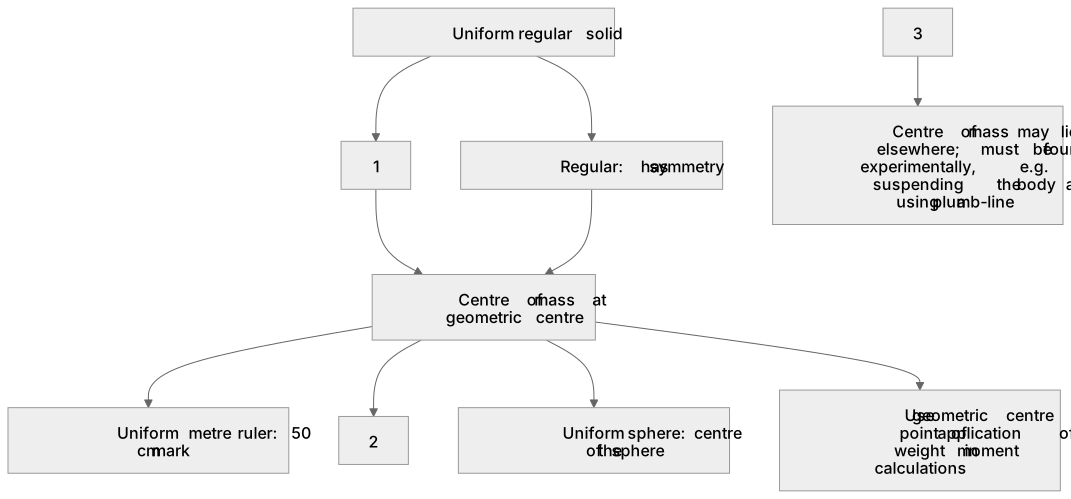
1Box 1
2Box 2
3Box 3
There is more to this lesson
The full lesson goes on to check your understanding and help you earn the marks. Create a free account to carry on, with your progress saved.
A week of Premium from your first lesson · Then the free plan continues · No card, no charge
Test your understanding of Moments: Knowledge that the position of the centre of mass of uniform regular solid is at its centre.
Active recall beats re-reading. Take an instant quiz now to test what you’ve learned and lock it into long-term memory.
A week of Premium from your first lesson · Then the free plan continues · No card, no charge