AQA · A-Level · Physics
Course version: 7408 · Version from Sept 2016
Appreciation of momentum conservation issues in the context of ethical…
Full specification wording
Momentum: Appreciation of momentum conservation issues in the context of ethical transport design.
Momentum conservation shapes transport safety.
Checked against the AQA 7408 specification (opens in a new tab) on .
- Point 6 of 6
- 4 key terms
Study notes
From the checked teaching notes for this specification point.
The idea
Momentum conservation shapes transport safety. In a crash, total momentum is conserved, but the force on occupants depends on how quickly momentum changes, since force is the rate of change of momentum. Crumple zones, seat belts and airbags increase the time taken for the vehicle and occupants to change momentum, reducing the average force for the same momentum change. Ethical design weighs safety benefits against cost, mass, fuel consumption and environmental impact.
For example: A car of mass 1200 kg travelling at 15 m s⁻¹ has momentum 1.8 × 10⁴ kg m s⁻¹; if it stops in 0.30 s the average force is about 6.0 × 10⁴ N, but extending the stopping time to 1.5 s reduces the average force to about 1.2 × 10⁴ N.
What earns the marks
- Link conservation of momentum to the total momentum of a vehicle and its occupants before and after a crash.
- Explain that force equals the rate of change of momentum, so a longer collision time reduces the average force.
- Describe how crumple zones, seat belts and airbags increase the time over which momentum changes.
- Discuss ethical trade-offs between occupant safety, vehicle mass, cost, fuel use and environmental impact.
- Use data or calculations to compare average forces for different collision times at the same momentum change.
Common mistakes and how to put them right
Claiming that safety features reduce the momentum change.
Put it right by explaining that they increase the time taken, reducing the force for the same momentum change.
Confusing conservation of momentum with conservation of kinetic energy in a crash.
Put it right by stating that kinetic energy is dissipated in deformation and heating.
Treating ethical design as only a technical issue.
Put it right by recognising that it also involves balancing safety, cost, mass and environmental consequences.
Exam tips
- Use the relationship between force, momentum change and time to justify each safety feature you describe.
- Support ethical discussion with specific consequences, such as increased mass raising fuel consumption.
- Keep momentum calculations separate from ethical evaluation so each part of the answer is clear.
Try the lesson
The start of the Momentum: Appreciation of momentum conservation issues in the context of ethical transport design. lesson, made from checked teaching notes for this specification point.
Have a go first
In a crash test, a car is designed to crumple on impact. Why does crumpling reduce the force on the passengers?
Listen
Momentum conservation shapes transport safety. In a crash, total momentum is conserved, but the force on occupants depends on how quickly momentum changes, since force is the rate of change of momentum. Crumple zones, seat belts and airbags increase the time taken for the vehicle and occupants to change momentum, reducing the average force for the same momentum change. Ethical design weighs safety benefits against cost, mass, fuel consumption and environmental impact. For example, a car of mass 1200 kg travelling at 15 m s⁻¹ has momentum 1.8 × 10⁴ kg m s⁻¹; if it stops in 0.30 s the average force is about 6.0 × 10⁴ N, but extending the stopping time to 1.5 s reduces the average force to about 1.2 × 10⁴ N. A strong answer earns marks for these points. Link conservation of momentum to the total momentum of a vehicle and its occupants before and after a crash. Explain that force equals the rate of change of momentum, so a longer collision time reduces the average force. Describe how crumple zones, seat belts and airbags increase the time over which momentum changes. Discuss ethical trade-offs between occupant safety, vehicle mass, cost, fuel use and environmental impact. A common slip: Claiming that safety features reduce the momentum change. Instead, explaining that they increase the time taken, reducing the force for the same momentum change. Exam tip: Use the relationship between force, momentum change and time to justify each safety feature you describe.
See it
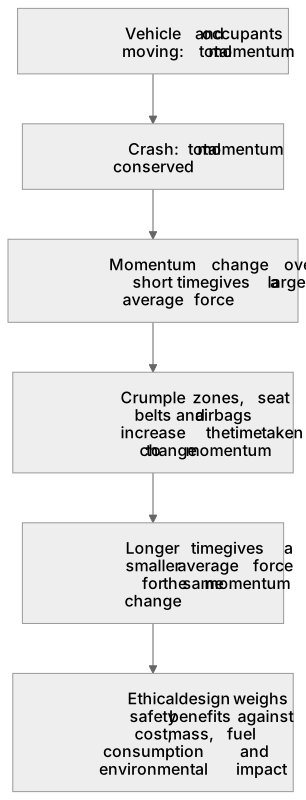
Put it in order
Put these steps in the order they happen.
- 1. Momentum change over a short time gives a large average force
- 2. Crash: total momentum conserved
- 3. Vehicle and occupants moving: total momentum
- 4. Ethical design weighs safety benefits against cost, mass, fuel consumption and environmental impact
- 5. Longer time gives a smaller average force for the same momentum change
- 6. Crumple zones, seat belts and airbags increase the time taken to change momentum
Key words
Say what each word means before you turn the card.
Momentum conservation in road collisions
Try answering aloud or in your head before turning the card.
Force as rate of change of momentum
Try answering aloud or in your head before turning the card.
Vehicle safety engineering
Try answering aloud or in your head before turning the card.
Ethical and environmental trade-offs in transport design
Try answering aloud or in your head before turning the card.
See every definition
- Momentum conservation in road collisions
- In a crash, total momentum is conserved, though the force on occupants depends on how quickly momentum changes.
- Force as rate of change of momentum
- The force on occupants depends on how quickly momentum changes, since force is the rate of change of momentum.
- Vehicle safety engineering
- Crumple zones, seat belts and airbags increase the time taken for the vehicle and occupants to change momentum, reducing the average force for the same momentum change.
- Ethical and environmental trade-offs in transport design
- Ethical design weighs safety benefits against cost, mass, fuel consumption and environmental impact.
Label the diagram
Some boxes have lost their names. Pick the right name for each number.
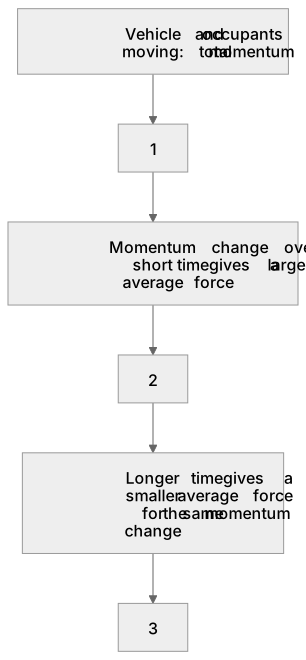
1Box 1
2Box 2
3Box 3
There is more to this lesson
The full lesson goes on to check your understanding and help you earn the marks. Create a free account to carry on, with your progress saved.
A week of Premium from your first lesson · Then the free plan continues · No card, no charge
Test your understanding of Momentum: Appreciation of momentum conservation issues in the context of ethical transport design.
Active recall beats re-reading. Take an instant quiz now to test what you’ve learned and lock it into long-term memory.
A week of Premium from your first lesson · Then the free plan continues · No card, no charge