AQA · A-Level · Physics
Course version: 7408 · Version from Sept 2016
Momentum: Elastic and inelastic collisions; explosions.
Momentum is conserved in every collision and explosion provided no external resultant force acts on the system.
Checked against the AQA 7408 specification (opens in a new tab) on .
- Point 5 of 6
- 4 key terms
Study notes
From the checked teaching notes for this specification point.
The idea
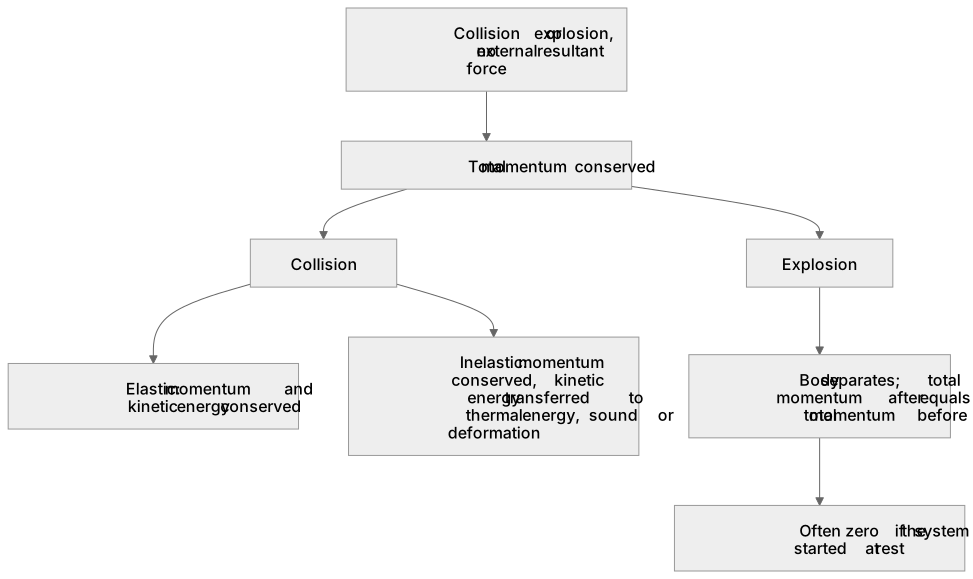
Momentum is conserved in every collision and explosion provided no external resultant force acts on the system. In an elastic collision, both momentum and kinetic energy are conserved; in an inelastic collision, momentum is still conserved but kinetic energy is transferred to thermal energy, sound or deformation. An explosion is the reverse process: an initially stationary or moving body separates, and the total momentum afterwards equals the total momentum before.
For example: Two trolleys of masses 2.0 kg and 3.0 kg moving towards each other at 4.0 m s⁻¹ and 2.0 m s⁻¹ have total momentum 2.0 kg × 4.0 m s⁻¹ − 3.0 kg × 2.0 m s⁻¹ = 2.0 kg m s⁻¹, which must equal the total after any collision.
What earns the marks
- State that total momentum is conserved in all collisions and explosions when no external resultant force acts.
- Distinguish elastic collisions, where kinetic energy is conserved, from inelastic collisions, where kinetic energy decreases.
- Apply conservation of momentum to find an unknown velocity or mass before and after a collision or explosion.
- Use a sign convention consistently so that oppositely directed velocities have opposite signs.
- Calculate kinetic energy before and after a collision to classify it as elastic or inelastic.
- Explain that in an explosion the total momentum remains constant, often zero if the system started at rest.
Common mistakes and how to put them right
Treating kinetic energy as conserved in every collision.
Put it right by checking kinetic energy totals and only calling a collision elastic when they are equal.
Forgetting that momentum is a vector and ignoring direction.
Put it right by defining one direction as positive and giving opposing velocities negative signs.
Assuming an explosion creates momentum from nothing.
Put it right by stating that the total momentum after equals the total momentum before, which is zero for a stationary body that explodes.
Exam tips
- Write the momentum equation in the form total momentum before = total momentum after before substituting values.
- Define positive direction clearly in your working so sign errors are easy to spot and to justify.
- When asked whether a collision is elastic, calculate kinetic energy before and after rather than relying on the word collision.
Try the lesson
The start of the Momentum: Elastic and inelastic collisions; explosions. lesson, made from checked teaching notes for this specification point.
Have a go first
In an explosion, a stationary firework of total mass 3.0 kg splits into two fragments. One fragment of mass 1.0 kg moves to the left at 8.0 m/s. What is the velocity of the other fragment?
Listen
Momentum is conserved in every collision and explosion provided no external resultant force acts on the system. In an elastic collision, both momentum and kinetic energy are conserved; in an inelastic collision, momentum is still conserved but kinetic energy is transferred to thermal energy, sound or deformation. An explosion is the reverse process: an initially stationary or moving body separates, and the total momentum afterwards equals the total momentum before. For example, two trolleys of masses 2.0 kg and 3.0 kg moving towards each other at 4.0 m s⁻¹ and 2.0 m s⁻¹ have total momentum 2.0 kg × 4.0 m s⁻¹ − 3.0 kg × 2.0 m s⁻¹ = 2.0 kg m s⁻¹, which must equal the total after any collision. A strong answer earns marks for these points. State that total momentum is conserved in all collisions and explosions when no external resultant force acts. Distinguish elastic collisions, where kinetic energy is conserved, from inelastic collisions, where kinetic energy decreases. Apply conservation of momentum to find an unknown velocity or mass before and after a collision or explosion. Use a sign convention consistently so that oppositely directed velocities have opposite signs. A common slip: Treating kinetic energy as conserved in every collision. Instead, checking kinetic energy totals and only calling a collision elastic when they are equal. Exam tip: Write the momentum equation in the form total momentum before = total momentum after before substituting values.
See it
Key words
Say what each word means before you turn the card.
Conservation of linear momentum
Try answering aloud or in your head before turning the card.
Vector nature of momentum
Try answering aloud or in your head before turning the card.
Elastic versus inelastic collisions
Try answering aloud or in your head before turning the card.
Explosions as momentum-conserving separations
Try answering aloud or in your head before turning the card.
See every definition
- Conservation of linear momentum
- Total momentum is conserved in all collisions and explosions when no external resultant force acts.
- Vector nature of momentum
- Momentum is a vector, so a sign convention is used consistently and oppositely directed velocities have opposite signs.
- Elastic versus inelastic collisions
- In an elastic collision both momentum and kinetic energy are conserved; in an inelastic collision momentum is still conserved but kinetic energy is transferred to thermal energy, sound or deformation.
- Explosions as momentum-conserving separations
- An initially stationary or moving body separates, and the total momentum afterwards equals the total momentum before, often zero if the system started at rest.
Label the diagram
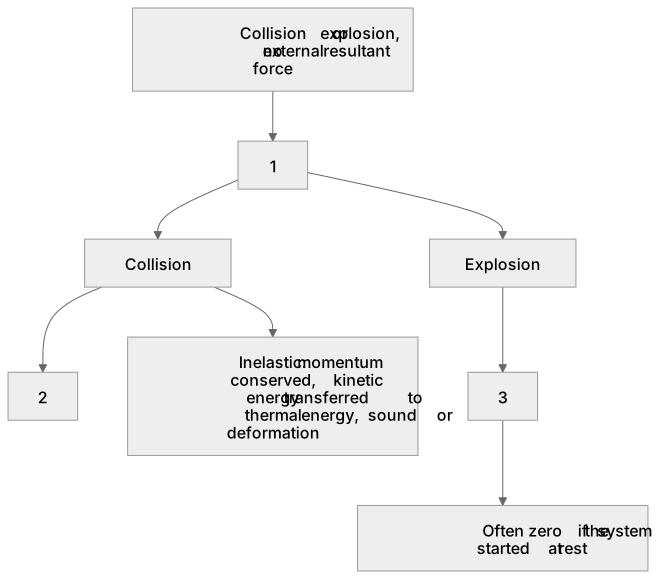
Some boxes have lost their names. Pick the right name for each number.
1Box 1
2Box 2
3Box 3
There is more to this lesson
The full lesson goes on to check your understanding and help you earn the marks. Create a free account to carry on, with your progress saved.
A week of Premium from your first lesson · Then the free plan continues · No card, no charge
Test your understanding of Momentum: Elastic and inelastic collisions; explosions.
Active recall beats re-reading. Take an instant quiz now to test what you’ve learned and lock it into long-term memory.
A week of Premium from your first lesson · Then the free plan continues · No card, no charge