AQA · A-Level · Physics
Course version: 7408 · Version from Sept 2016
Knowledge and application of the three laws of motion in appropriate…
Full specification wording
Newton’s laws of motion: Knowledge and application of the three laws of motion in appropriate situations.
Newton’s three laws describe how forces change motion.
Checked against the AQA 7408 specification (opens in a new tab) on .
- Point 1 of 2
- 2 key terms
Study notes
From the checked teaching notes for this specification point.
The idea
Newton’s three laws describe how forces change motion. The first law: a body stays at rest or moves at constant velocity unless a resultant external force acts; this defines inertia and explains why seatbelts are needed. The second law: resultant force equals rate of change of momentum, so for constant mass F = ma; a 2 kg trolley pushed with 6 N accelerates at 3 m s⁻². The third law: if A exerts a force on B, B exerts an equal magnitude, opposite direction force on A, acting on a different body; for example, a swimmer pushes water backwards and water pushes the swimmer forwards. Apply each law by identifying the body, listing forces, finding the resultant, then predicting motion.
What earns the marks
- State the first law as constant velocity or rest when the resultant force is zero, and link it to inertia.
- Use the second law as resultant force equals rate of change of momentum, reducing to F = ma when mass is constant.
- State the third law as two forces equal in magnitude, opposite in direction, of the same type, acting on two different bodies.
- Apply the laws to a named situation by drawing a free-body diagram and resolving forces before calculating acceleration or identifying equilibrium.
- Distinguish equilibrium (zero resultant force, constant velocity) from a body with a non-zero resultant force, which accelerates.
Common mistakes and how to put them right
Treating action and reaction as balanced forces on one body.
Put it right by stating they act on different bodies and never cancel for a single object.
Assuming a moving object always has a resultant force.
Put it right by noting constant velocity means zero resultant force.
Using F = ma with F as any single force rather than the resultant force.
Put it right by summing vector forces first.
Exam tips
- Name the law you are using and quote its condition before substituting values.
- Draw and label a free-body diagram; examiners reward clear force identification.
- Check units and directions: acceleration is in the direction of the resultant force.
Try the lesson
The start of the Newton’s laws of motion: Knowledge and application of the three laws of motion in appropriate situations. lesson, made from checked teaching notes for this specification point.
Have a go first
A book rests on a horizontal table. Which law of motion explains why the table exerts an upward force on the book?
Listen
Newton’s three laws describe how forces change motion. The first law: a body stays at rest or moves at constant velocity unless a resultant external force acts; this defines inertia and explains why seatbelts are needed. The second law: resultant force equals rate of change of momentum, so for constant mass F = ma; a 2 kg trolley pushed with 6 N accelerates at 3 m s⁻². The third law: if A exerts a force on B, B exerts an equal magnitude, opposite direction force on A, acting on a different body; for example, a swimmer pushes water backwards and water pushes the swimmer forwards. Apply each law by identifying the body, listing forces, finding the resultant, then predicting motion. A strong answer earns marks for these points. State the first law as constant velocity or rest when the resultant force is zero, and link it to inertia. Use the second law as resultant force equals rate of change of momentum, reducing to F = ma when mass is constant. State the third law as two forces equal in magnitude, opposite in direction, of the same type, acting on two different bodies. Apply the laws to a named situation by drawing a free-body diagram and resolving forces before calculating acceleration or identifying equilibrium. A common slip: Treating action and reaction as balanced forces on one body. Instead, stating they act on different bodies and never cancel for a single object. Exam tip: Name the law you are using and quote its condition before substituting values.
See it
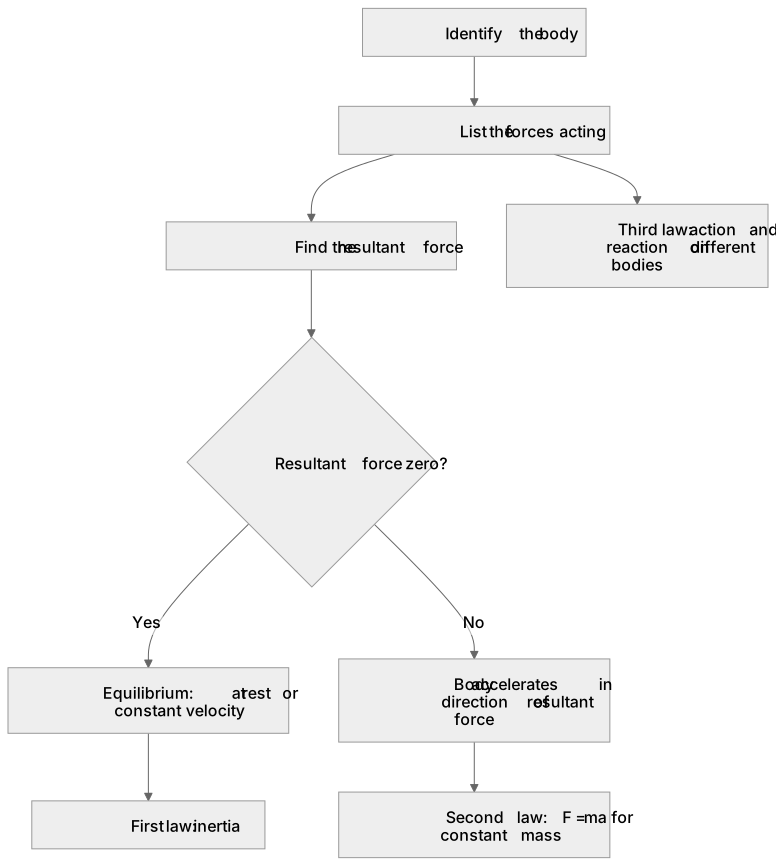
Key words
Say what each word means before you turn the card.
Action–reaction pairs
Try answering aloud or in your head before turning the card.
Equilibrium
Try answering aloud or in your head before turning the card.
See every definition
- Action–reaction pairs
- Two forces equal in magnitude, opposite in direction, of the same type, acting on two different bodies.
- Equilibrium
- Zero resultant force and constant velocity, distinguished from a body with a non-zero resultant force, which accelerates.
Label the diagram
Some boxes have lost their names. Pick the right name for each number.
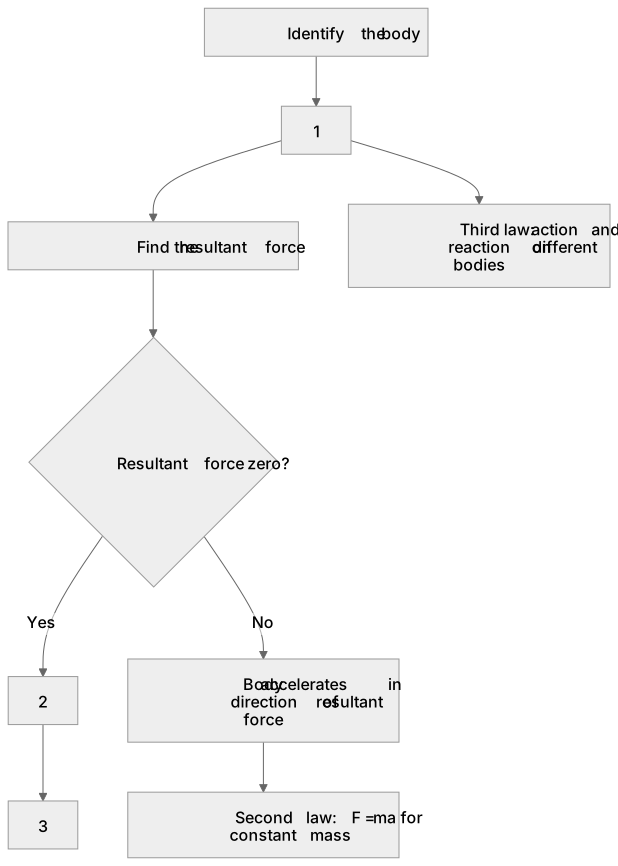
1Box 1
2Box 2
3Box 3
There is more to this lesson
The full lesson goes on to check your understanding and help you earn the marks. Create a free account to carry on, with your progress saved.
A week of Premium from your first lesson · Then the free plan continues · No card, no charge
Test your understanding of Newton’s laws of motion: Knowledge and application of the three laws of motion in appropriate situations.
Active recall beats re-reading. Take an instant quiz now to test what you’ve learned and lock it into long-term memory.
A week of Premium from your first lesson · Then the free plan continues · No card, no charge