AQA · A-Level · Physics
Course version: 7408 · Version from Sept 2016
Photodiode (A-level only): Use with scintillator to detect atomic particles.
A photodiode converts light into an electrical signal.
Checked against the AQA 7408 specification (opens in a new tab) on .
- Point 3 of 3
- 4 key terms
Study notes
From the checked teaching notes for this specification point.
The idea
A photodiode converts light into an electrical signal. When coupled to a scintillator, it detects atomic particles indirectly: the scintillator absorbs particle energy and emits visible photons, which the photodiode converts into a photocurrent. The photodiode is reverse-biased so its depletion region is wide and the electric field is strong, giving fast response and linear output. The signal is small, so a transimpedance amplifier or comparator is used. This arrangement is used in particle detectors, medical imaging and radiation monitors. The photodiode does not detect the particle directly; it detects the scintillation light. The choice of scintillator and photodiode must match emission and sensitivity spectra.
What earns the marks
- A scintillator absorbs energy from an incident atomic particle and re-emits visible or near-visible photons.
- A photodiode is a p-n junction operated in reverse bias, creating a wide depletion region and strong internal electric field.
- Photons entering the depletion region generate electron-hole pairs, producing a photocurrent proportional to light intensity.
- The photodiode signal is processed by external circuitry such as a transimpedance amplifier to produce a measurable voltage pulse.
- The scintillator and photodiode must be optically coupled and spectrally matched so emitted photons are efficiently detected.
- The system detects particles indirectly via scintillation light, not by direct charge collection from the particle.
Common mistakes and how to put them right
Thinking the photodiode directly absorbs the atomic particle and produces current.
Put it right: Correct understanding is that the scintillator converts particle energy to light first.
Assuming the photodiode operates in forward bias.
Put it right: It must be reverse-biased to widen the depletion region and increase sensitivity.
Ignoring spectral matching between scintillator emission and photodiode responsivity.
Put it right: Poor matching reduces signal and may prevent detection.
Exam tips
- Describe the sequence clearly: particle energy → scintillator photons → photodiode electron-hole pairs → photocurrent → amplified voltage pulse.
- State that the photodiode is reverse-biased and explain why this improves detection.
- When comparing detectors, mention that the scintillator plus photodiode is indirect and may have lower energy resolution than direct semiconductor detectors.
Try the lesson
The start of the Photodiode (A-level only): Use with scintillator to detect atomic particles. lesson, made from checked teaching notes for this specification point.
Have a go first
In a scintillator–photodiode particle detector, what is the role of the photodiode?
Listen
A photodiode converts light into an electrical signal. When coupled to a scintillator, it detects atomic particles indirectly: the scintillator absorbs particle energy and emits visible photons, which the photodiode converts into a photocurrent. The photodiode is reverse-biased so its depletion region is wide and the electric field is strong, giving fast response and linear output. The signal is small, so a transimpedance amplifier or comparator is used. This arrangement is used in particle detectors, medical imaging and radiation monitors. The photodiode does not detect the particle directly; it detects the scintillation light. The choice of scintillator and photodiode must match emission and sensitivity spectra. A strong answer earns marks for these points. A scintillator absorbs energy from an incident atomic particle and re-emits visible or near-visible photons. A photodiode is a p-n junction operated in reverse bias, creating a wide depletion region and strong internal electric field. Photons entering the depletion region generate electron-hole pairs, producing a photocurrent proportional to light intensity. The photodiode signal is processed by external circuitry such as a transimpedance amplifier to produce a measurable voltage pulse. Exam tip: Describe the sequence clearly: particle energy → scintillator photons → photodiode electron-hole pairs → photocurrent → amplified voltage pulse.
See it
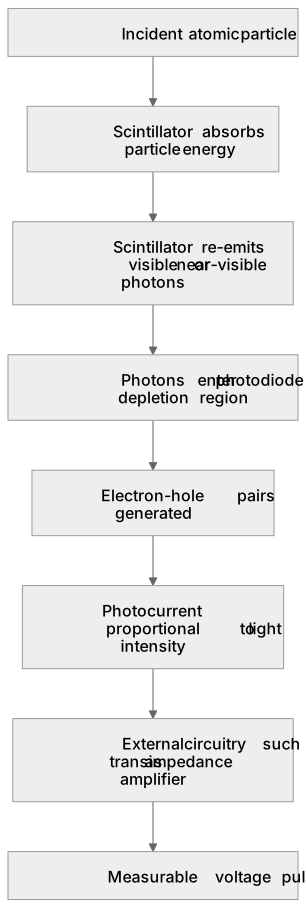
Put it in order
Put these steps in the order they happen.
- 1. Electron-hole pairs generated
- 2. Measurable voltage pulse
- 3. Photocurrent proportional to light intensity
- 4. Incident atomic particle
- 5. Scintillator absorbs particle energy
- 6. External circuitry such as transimpedance amplifier
- 7. Scintillator re-emits visible or near-visible photons
- 8. Photons enter photodiode depletion region
Key words
Say what each word means before you turn the card.
Scintillator
Try answering aloud or in your head before turning the card.
Photodiode
Try answering aloud or in your head before turning the card.
Reverse bias
Try answering aloud or in your head before turning the card.
Photocurrent
Try answering aloud or in your head before turning the card.
See every definition
- Scintillator
- Absorbs energy from an incident atomic particle and re-emits visible or near-visible photons.
- Photodiode
- A p-n junction operated in reverse bias that converts light into an electrical signal.
- Reverse bias
- Operation that creates a wide depletion region and strong internal electric field, giving fast response and linear output.
- Photocurrent
- Produced when photons entering the depletion region generate electron-hole pairs, proportional to light intensity.
Label the diagram
Some boxes have lost their names. Pick the right name for each number.
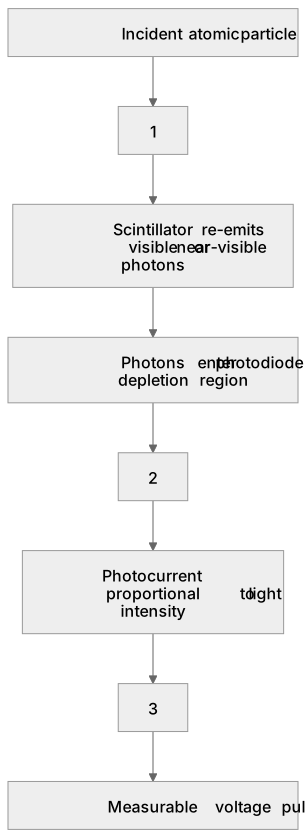
1Box 1
2Box 2
3Box 3
There is more to this lesson
The full lesson goes on to check your understanding and help you earn the marks. Create a free account to carry on, with your progress saved.
A week of Premium from your first lesson · Then the free plan continues · No card, no charge
Test your understanding of Photodiode (A-level only): Use with scintillator to detect atomic particles.
Active recall beats re-reading. Take an instant quiz now to test what you’ve learned and lock it into long-term memory.
A week of Premium from your first lesson · Then the free plan continues · No card, no charge