AQA · A-Level · Physics
Course version: 7408 · Version from Sept 2016
Spatial resolution of the eye; explanation in terms of the behaviour of…
Full specification wording
Physics of vision (A-level only): Spatial resolution of the eye; explanation in terms of the behaviour of rods and cones.
Spatial resolution is the smallest separation between two points that the eye can distinguish as separate.
Checked against the AQA 7408 specification (opens in a new tab) on .
- Point 3 of 3
- 4 key terms
Study notes
From the checked teaching notes for this specification point.
The idea
Spatial resolution is the smallest separation between two points that the eye can distinguish as separate. On the retina, two images must fall on different photoreceptors with an unstimulated cell between them for the brain to register two objects rather than one. Cones are densely packed in the fovea, where each cone connects to its own bipolar and ganglion cell, giving high acuity in good light. Rods are absent from the fovea, are more numerous towards the periphery, and several rods converge onto one neurone, so their signals are pooled and acuity is lower. Rods also contain the pigment rhodopsin, which bleaches in bright light, so rod vision dominates in dim conditions. Resolution therefore depends on receptor spacing, convergence and illumination.
What earns the marks
- Spatial resolution is the minimum angular or linear separation at which two points are seen as distinct, not merely detected as one blurred patch.
- Two retinal images must stimulate separate cones with at least one unstimulated receptor between them for the brain to resolve them.
- Foveal cones are tightly packed and have private pathways to ganglion cells, giving the highest acuity in bright light.
- Rods are absent from the fovea, are pooled in groups onto single neurones, and so reduce resolution despite high sensitivity.
- Convergence of many rods onto one neurone sums weak signals, improving dim-light detection but worsening spatial detail.
- Illumination matters: in dim light cones cease to function and rod-based peripheral vision has poorer resolution.
Common mistakes and how to put them right
Saying rods give sharper vision because there are more of them.
Put it right: Rods are more numerous overall but their signals are pooled, so cones in the fovea give the finer resolution.
Claiming the fovea contains both rods and cones in equal numbers.
Put it right: The fovea is cone-dominated and essentially rod-free.
Treating resolution as the same as sensitivity.
Put it right: Sensitivity is the ability to detect faint light, whereas resolution is the ability to separate two nearby points.
Exam tips
- Link each receptor type to both its wiring and its location, because the explanation needs structure as well as function.
- Use the phrase 'one-to-one connection' for foveal cones and 'convergence' for rods to show precise understanding.
- When asked to explain, always state the consequence for the brain: separate signals are needed before two points can be distinguished.
Try the lesson
The start of the Physics of vision (A-level only): Spatial resolution of the eye; explanation in terms of the behaviour of rods and cones. lesson, made from checked teaching notes for this specification point.
Have a go first
Which statement best explains why the eye's spatial resolution is limited by the spacing of cones rather than by the spacing of rods?
Listen
Spatial resolution is the smallest separation between two points that the eye can distinguish as separate. On the retina, two images must fall on different photoreceptors with an unstimulated cell between them for the brain to register two objects rather than one. Cones are densely packed in the fovea, where each cone connects to its own bipolar and ganglion cell, giving high acuity in good light. Rods are absent from the fovea, are more numerous towards the periphery, and several rods converge onto one neurone, so their signals are pooled and acuity is lower. Rods also contain the pigment rhodopsin, which bleaches in bright light, so rod vision dominates in dim conditions. Resolution therefore depends on receptor spacing, convergence and illumination. A strong answer earns marks for these points. Spatial resolution is the minimum angular or linear separation at which two points are seen as distinct, not merely detected as one blurred patch. Two retinal images must stimulate separate cones with at least one unstimulated receptor between them for the brain to resolve them. Foveal cones are tightly packed and have private pathways to ganglion cells, giving the highest acuity in bright light. Rods are absent from the fovea, are pooled in groups onto single neurones, and so reduce resolution despite high sensitivity. A common slip: Saying rods give sharper vision because there are more of them. Instead, rods are more numerous overall but their signals are pooled, so cones in the fovea give the finer resolution. Exam tip: Link each receptor type to both its wiring and its location, because the explanation needs structure as well as function.
See it
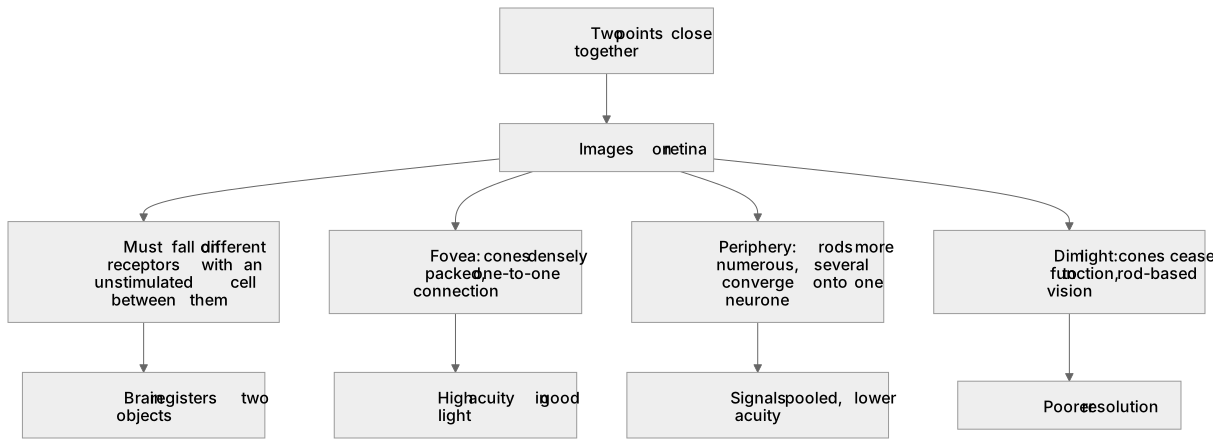
Key words
Say what each word means before you turn the card.
Spatial resolution
Try answering aloud or in your head before turning the card.
Convergence
Try answering aloud or in your head before turning the card.
Fovea
Try answering aloud or in your head before turning the card.
Rhodopsin
Try answering aloud or in your head before turning the card.
See every definition
- Spatial resolution
- The smallest separation between two points that the eye can distinguish as separate.
- Convergence
- Several rods connect onto one neurone, so their signals are pooled and acuity is lower.
- Fovea
- The region where cones are densely packed, each connecting to its own bipolar and ganglion cell, giving high acuity in good light.
- Rhodopsin
- A pigment contained in rods which bleaches in bright light, so rod vision dominates in dim conditions.
Label the diagram
Some boxes have lost their names. Pick the right name for each number.
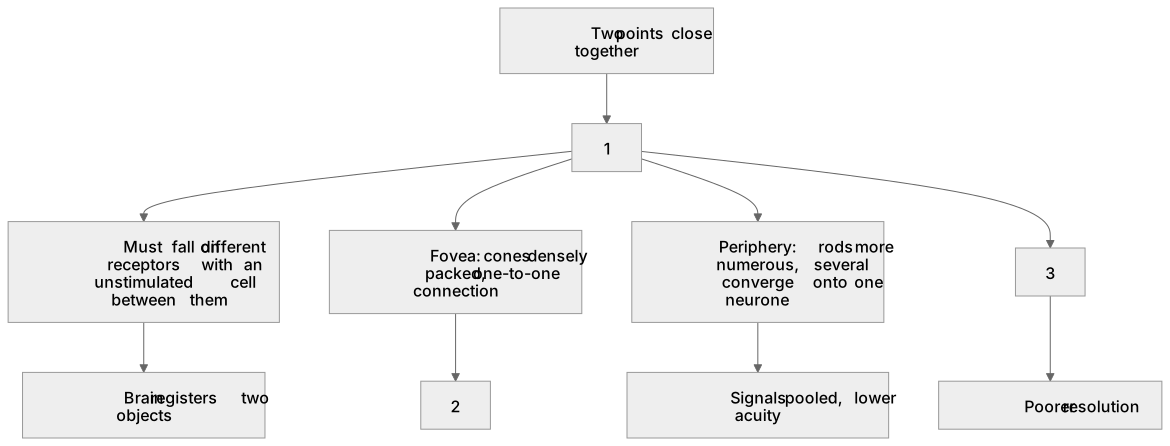
1Box 1
2Box 2
3Box 3
There is more to this lesson
The full lesson goes on to check your understanding and help you earn the marks. Create a free account to carry on, with your progress saved.
A week of Premium from your first lesson · Then the free plan continues · No card, no charge
Test your understanding of Physics of vision (A-level only): Spatial resolution of the eye; explanation in terms of the behaviour of rods and cones.
Active recall beats re-reading. Take an instant quiz now to test what you’ve learned and lock it into long-term memory.
A week of Premium from your first lesson · Then the free plan continues · No card, no charge