AQA · A-Level · Physics
Course version: 7408 · Version from Sept 2016
Sensitivity of the eye; spectral response as a photodetector.
Full specification wording
Physics of vision (A-level only): Sensitivity of the eye; spectral response as a photodetector.
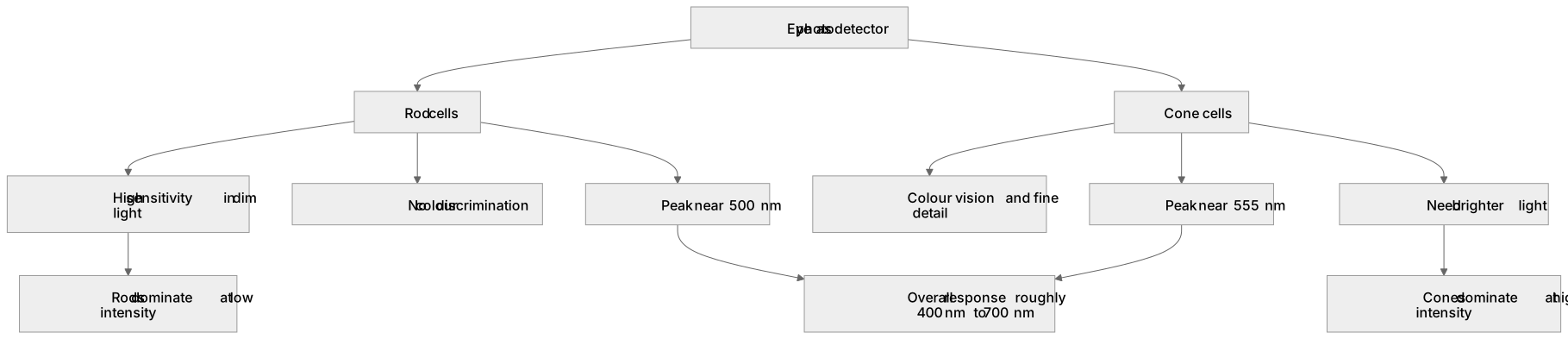
The retina behaves as a photodetector: rod cells give high sensitivity in dim light but no colour discrimination, while cone cells give colour vision and fine detail but need brighter light.
Checked against the AQA 7408 specification (opens in a new tab) on .
- Point 2 of 3
- 4 key terms
Study notes
From the checked teaching notes for this specification point.
The idea
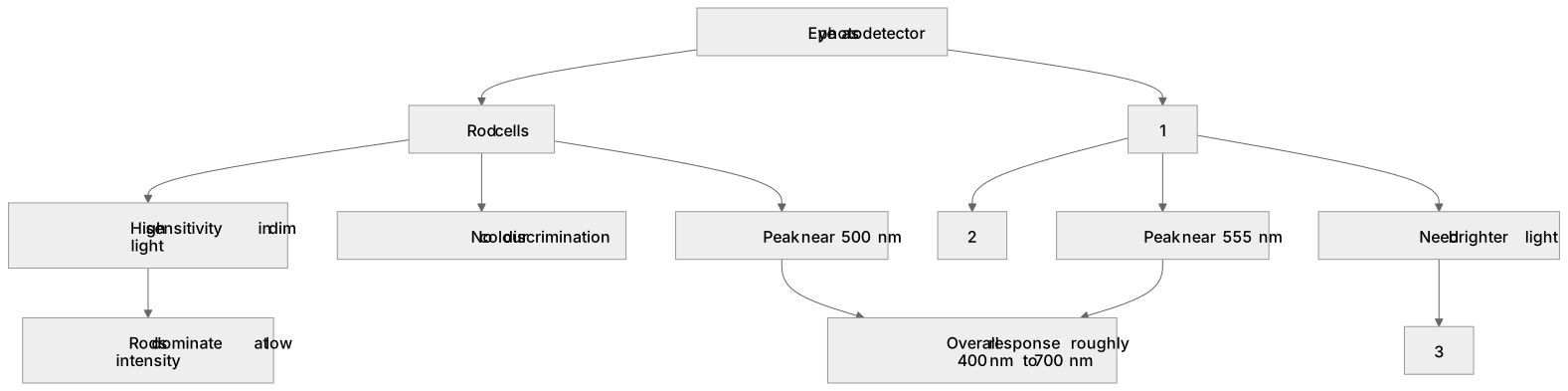
The retina behaves as a photodetector: rod cells give high sensitivity in dim light but no colour discrimination, while cone cells give colour vision and fine detail but need brighter light. Sensitivity therefore depends on wavelength and light intensity. Plot spectral response as relative sensitivity against wavelength: rods peak near 500 nm, cones peak near 555 nm in bright light, and the overall eye responds roughly from 400 nm to 700 nm. Beyond the visible range, ultraviolet and infrared are largely absorbed before reaching the retina. Compare the eye with a semiconductor photodetector, noting the eye's logarithmic intensity response and its narrow spectral window.
What earns the marks
- Distinguishes rod cells, which are highly sensitive in dim light but colour-blind, from cone cells, which detect colour and detail in brighter light.
- Describes spectral response as relative sensitivity plotted against wavelength, with the eye responding across roughly 400 nm to 700 nm.
- States that rod sensitivity peaks near 500 nm and cone sensitivity peaks near 555 nm, so overall sensitivity varies with wavelength.
- Explains that sensitivity also depends on light intensity, with rods dominating at low intensity and cones at high intensity.
- Compares the eye with a photodetector, noting its narrow spectral range and logarithmic response to intensity.
Common mistakes and how to put them right
Stating that the eye responds equally at all visible wavelengths.
Put it right by describing a peaked spectral response curve.
Claiming rods detect colour.
Put it right by assigning colour vision to cones and dim-light detection to rods.
Assuming the eye detects ultraviolet and infrared.
Put it right by noting these are largely absorbed before the retina.
Exam tips
- Sketch the spectral response curve with wavelength on the x-axis and relative sensitivity on the y-axis, marking both peaks.
- Use comparative language such as higher, lower, broader or narrower when contrasting rods and cones.
- Link each statement about sensitivity to either wavelength or intensity, since the specification names both.
Try the lesson
The start of the Physics of vision (A-level only): Sensitivity of the eye; spectral response as a photodetector. lesson, made from checked teaching notes for this specification point.
Have a go first
Over which range of wavelengths is the human eye most sensitive as a photodetector?
Listen
The retina behaves as a photodetector: rod cells give high sensitivity in dim light but no colour discrimination, while cone cells give colour vision and fine detail but need brighter light. Sensitivity therefore depends on wavelength and light intensity. Plot spectral response as relative sensitivity against wavelength: rods peak near 500 nm, cones peak near 555 nm in bright light, and the overall eye responds roughly from 400 nm to 700 nm. Beyond the visible range, ultraviolet and infrared are largely absorbed before reaching the retina. Compare the eye with a semiconductor photodetector, noting the eye's logarithmic intensity response and its narrow spectral window. A strong answer earns marks for these points. Distinguishes rod cells, which are highly sensitive in dim light but colour-blind, from cone cells, which detect colour and detail in brighter light. Describes spectral response as relative sensitivity plotted against wavelength, with the eye responding across roughly 400 nm to 700 nm. States that rod sensitivity peaks near 500 nm and cone sensitivity peaks near 555 nm, so overall sensitivity varies with wavelength. Explains that sensitivity also depends on light intensity, with rods dominating at low intensity and cones at high intensity. A common slip: Stating that the eye responds equally at all visible wavelengths. Instead, describing a peaked spectral response curve. Exam tip: Sketch the spectral response curve with wavelength on the x-axis and relative sensitivity on the y-axis, marking both peaks.
See it
Key words
Say what each word means before you turn the card.
Spectral response
Try answering aloud or in your head before turning the card.
Rod cells
Try answering aloud or in your head before turning the card.
Cone cells
Try answering aloud or in your head before turning the card.
Comparison with a photodetector
Try answering aloud or in your head before turning the card.
See every definition
- Spectral response
- Relative sensitivity plotted against wavelength, with the eye responding across roughly 400 nm to 700 nm.
- Rod cells
- Highly sensitive in dim light but colour-blind, dominating at low intensity and peaking near 500 nm.
- Cone cells
- Detect colour and detail in brighter light, dominating at high intensity and peaking near 555 nm.
- Comparison with a photodetector
- The eye has a narrow spectral range and a logarithmic response to intensity.
Label the diagram
Some boxes have lost their names. Pick the right name for each number.
1Box 1
2Box 2
3Box 3
There is more to this lesson
The full lesson goes on to check your understanding and help you earn the marks. Create a free account to carry on, with your progress saved.
A week of Premium from your first lesson · Then the free plan continues · No card, no charge
Test your understanding of Physics of vision (A-level only): Sensitivity of the eye; spectral response as a photodetector.
Active recall beats re-reading. Take an instant quiz now to test what you’ve learned and lock it into long-term memory.
A week of Premium from your first lesson · Then the free plan continues · No card, no charge